NZ Super Fund Returns 14.17% to Reach NZ$94.4 Billion, but Holds a Lower Long-Term Return Expectation of 7.2%
NZ Super returned 14.17% in the year to 30 June and grew to NZ$94.4 billion, yet it now expects 7.2% a year over the long term, down from 7.8%. What that means for GPs.
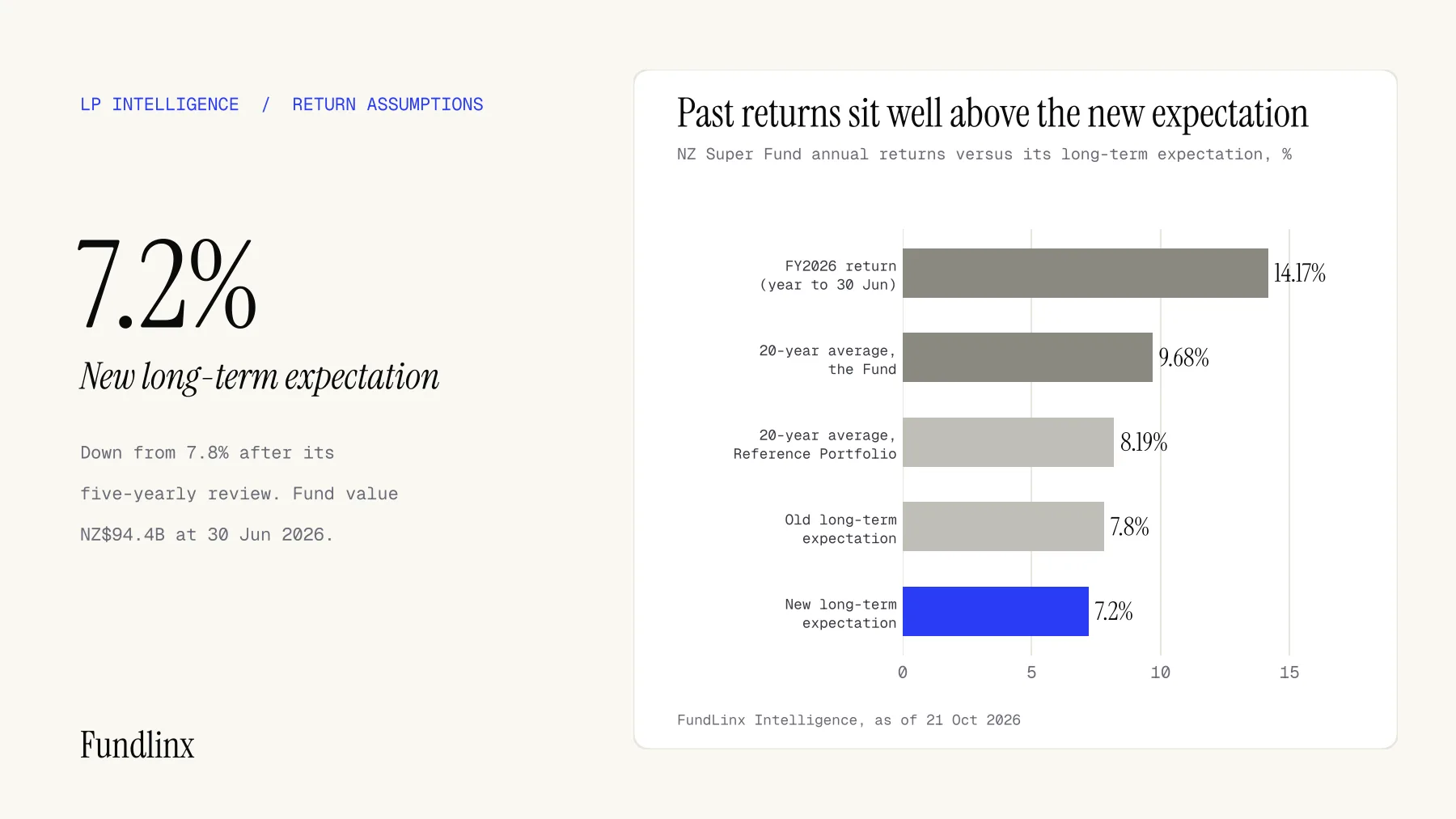
The Guardians of New Zealand Superannuation reported that the NZ Super Fund returned 14.17% after costs and before New Zealand tax in the year to 30 June 2026, lifting its value to NZ$94.4 billion, up NZ$9.3 billion in twelve months. On 19 October the Guardians published its 2026 annual report, which carries a more cautious message alongside the strong year: the fund now expects a long-term return of 7.2% a year, down from 7.8%, because the Guardians see global equities as overvalued. The fund finished 0.10 percentage points behind its passive Reference Portfolio, which suggests, in our reading, that most of the gain came from markets rather than from beating the benchmark.
What the report says
The 14.17% compares with 2.71% for 90-day Treasury bills over the same year. The Reference Portfolio is a notional, passively managed mix of 80% global equities and 20% fixed income against which the fund is judged, and it returned slightly more than the fund, hence the 0.10 point gap. A five-yearly review of that portfolio kept the 80/20 mix. The cut in the long-term expectation, from 7.8% to 7.2%, was made earlier this year, and the Guardians also trimmed the value they expect active management to add, alongside a smaller active risk budget. They pointed out that recent US equity returns have run at close to double their 20-year annualised average, so some reversion to the mean is expected.
How the result compares with history
Over 20 years the fund has returned 9.68% a year against 8.19% for the Reference Portfolio, and has added NZ$22.59 billion above a passive investor with the same appetite for risk since inception. Set against those figures, 2026's 14.17% is 4.49 points above the 20-year average and the new 7.2% expectation is 2.48 points below it, our arithmetic. The Guardians are effectively telling stakeholders that the past two decades are not a guide to the next twenty. They are not alone in resetting expectations this season: we reported that Princeton's endowment kept its long-term planning assumption at 8% after a 23.7% year. That puts NZ Super's 7.2% 0.8 points lower, although the two figures are set by different institutions and are not strictly comparable.
The LP behind the return
The NZ Super Fund is a sovereign wealth fund set up to part-fund New Zealand's future pension costs, managed by the Guardians under chief executive Jo Townsend. It holds timber, real estate, private market investments and listed companies, a much broader mix than its benchmark. The Guardians project that the fund will reach NZ$200 billion by 2040. The Finance Minister, Nicola Willis, has said withdrawals are now forecast to begin in 2054, and Treasury forecasts that the fund's tax payments will exceed the Government's required capital contribution by more than NZ$1 billion a year over the next five years, rising above NZ$2 billion within ten. In its annual report the Guardians say they restructured their investment team to improve efficiency and scalability for a much larger pool of assets, and that they aim to grow climate-related impact allocations while reducing risk exposure. Among sovereign wealth funds it sits at a very different scale from Mubadala, which has said it will keep deploying about $39 billion a year. We have not seen a verified ticket size for NZ Super's private market commitments, or evidence on whether it backs first- and second-time funds, so treat both as questions for a first meeting.
What GPs should do now
This is our advice, not something the Guardians have said. The fund measures itself against a passive 80/20 portfolio and fell 0.10 points short of it in a year when equities rose strongly, so a pitch to a sovereign like this should lead with net return relative to a public-market equivalent, show results after fees and costs, which is how the fund reports its own return, and explain how the strategy behaves when equities fall. The new 7.2% expectation gives you a reference point: an illiquid strategy has to justify itself against a portfolio the Guardians expect to earn roughly that with daily liquidity. A hurdle rate or net target set only a little above it will be a harder case than one with a clear spread.
Because the Guardians see equities as overvalued and hold timber, real estate and private markets, managers in real assets, credit and climate impact have a natural conversation to open, provided they can show with their own numbers how the fund lowers correlation to listed equities. A fund expecting NZ$200 billion by 2040 will need to place larger amounts, so smaller managers should be ready to explain capacity, co-investment and how a modest ticket could fit. Our guide to LP allocation trends in 2026 covers how other long-term investors are reshaping their books.
What to watch next
Watch whether other sovereign and endowment investors that report in the coming weeks trim their own return assumptions as the Guardians did, and how the restructured NZ Super investment team approaches managers in the year ahead. FundLinx members can see which sovereign and pension investors are resetting return expectations.
FundLinx Intelligence | FundLinx.ai
Playbooks, LP moves and compliance notes for emerging managers. Unsubscribe any time.