Princeton's Endowment Returns 23.7% to a Record $42.3 Billion, but Its Long-Term Planning Assumption Stays at 8%
Princeton's endowment gained 23.7% in fiscal 2026 and hit a record $42.3 billion, yet the university still plans on 8% a year. What that lower yardstick means for GPs pitching endowments.
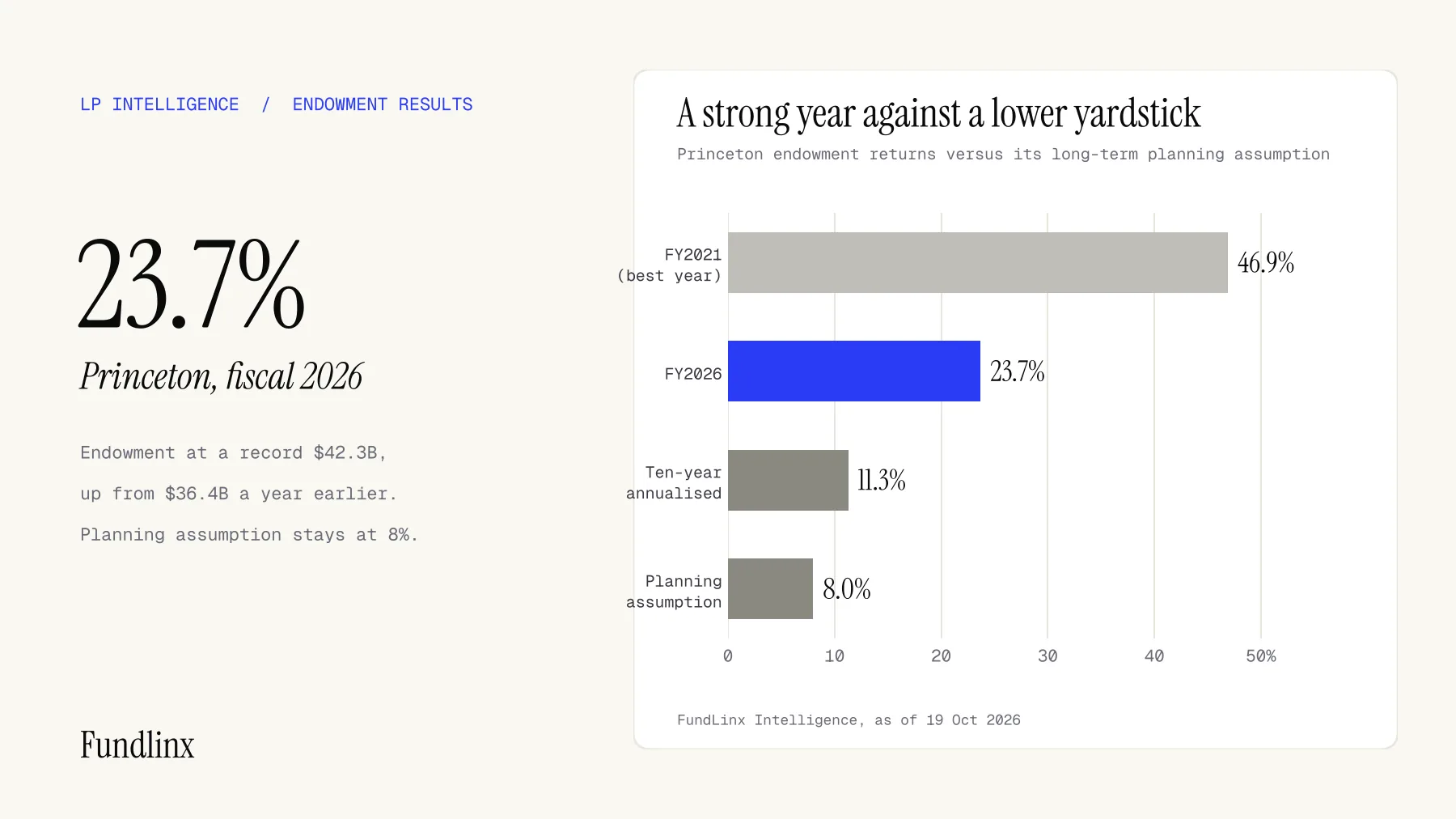
Princeton University's endowment returned 23.7% in the fiscal year ended 30 June 2026 and grew to a record $42.3 billion, up from $36.4 billion a year earlier, the university announced on 16 October 2026. The ten-year annualised return is 11.3%. The more useful number for a GP is a different one: Princeton's spokesperson confirmed that the long-term planning assumption stays at 8% a year, after a cut from 10.2% earlier in 2026. A big year did not change the yardstick, and that tells a manager how this endowment will judge a pitch.
What Princeton reported
The endowment is run by the Princeton University Investment Company. The $5.9 billion rise in value is our arithmetic on the two reported totals. The 23.7% compares with 46.9% in fiscal 2021, the endowment's best year, so this year's gain is about half that peak. The university said it is on a multiyear path to a more sustainable budget and has made several months of budget cuts. The endowment funds roughly two-thirds of Princeton's operating revenue, so the return matters to the whole institution, not only to the investment office.
How it compares with earlier periods and peers
Over ten years the endowment has returned 11.3% a year, which is 3.3 percentage points above the 8% assumption. The latest year is 15.7 points above it. Among the seven fiscal 2026 results we have covered, Princeton sits fifth. UNC returned 37.8%, Stanford 31.7% in its merged pool, the Penn endowment 27.4% and Harvard 27.1%, while the Brown endowment returned 19.6% and MIT 10.3%. By count, four of the six others returned more than Princeton (67%) and two returned less (33%). We have not weighted the comparison by capital, because the pools are defined differently. At $42.3 billion Princeton is smaller than Harvard at $68 billion and Stanford at $61.5 billion, and larger than Penn at $31.1 billion and MIT at $29.2 billion.
The LP behind the result
Princeton's endowment is a US university endowment that backs external managers across asset classes, and the investment company's profile sits with the other endowment LPs. The university has not disclosed which investments drove this year's gain, and we have no verified commitment sizes for it, so a GP should not assume a ticket from the headline value. What the university has said, in February and again this month, is that it is shifting from a growth footing to a more cautious one. A lower assumption is a statement about how much future return the institution is willing to budget for, and it changes what a new commitment has to clear.
The cut itself was set out by President Christopher Eisgruber in his February 2026 letter to the community, which warned that long-term returns are declining and that Princeton is moving from growth to focus. Moving from 10.2% to 8% is a 2.2 point reduction, or about 22% less expected return each year. Applied to $42.3 billion, an 8% assumption is roughly $3.4 billion of return a year before spending, which is our arithmetic and not a figure Princeton has published. The point for a GP is that the institution is planning on a number well below the last decade's realised average, so a fund that merely matches the endowment's recent history is not the bar to clear.
What GPs should do now
This is our advice, not a statement from Princeton. First, pitch against 8%, not 23.7%. Show how your fund is built to clear an 8% annual return net of fees and carry, with an explicit premium over public markets for tying up capital. Second, lead with cash back. An endowment that supplies about two-thirds of the operating budget values distributions, so put your realisation history and distributions to paid-in capital near the top of the one-page summary. Third, expect close attention to fee drag. When the planning return falls by 2.2 points, each point of cost is a larger share of what the institution expects to earn. Fourth, time the approach to results season and refer to this year's numbers only to show you understand the budget pressure, not to flatter. Fifth, show a lower-for-longer case. Include a projection in which returns across your strategy come in below your base case, with the distributions and net multiple that result, because an investment committee budgeting at 8% will test your downside before it rewards your upside. Sixth, keep the endowment vocabulary of spending rate, payout and purchasing power in your materials, because that is how the investment committee will frame your fund.
What to watch next
Watch the remaining large endowments still to report fiscal 2026 results, and whether any of them follow Princeton in lowering its long-term assumption. Also watch whether Princeton changes the 8% figure again, or discloses more about the mix behind the gain. FundLinx members can see which endowments are active allocators this quarter.
FundLinx Intelligence | FundLinx.ai
Playbooks, LP moves and compliance notes for emerging managers. Unsubscribe any time.