Brown Endowment Returns 19.6% in Fiscal 2026, Its Best in Five Years, as CIO Jane Dietze Prepares to Leave
Brown's endowment returned 19.6% in the year to 30 June, its best in five years, and grew to $9.5 billion. CIO Jane Dietze leaves at year end, with deputy Joshua Kennedy set to take over.
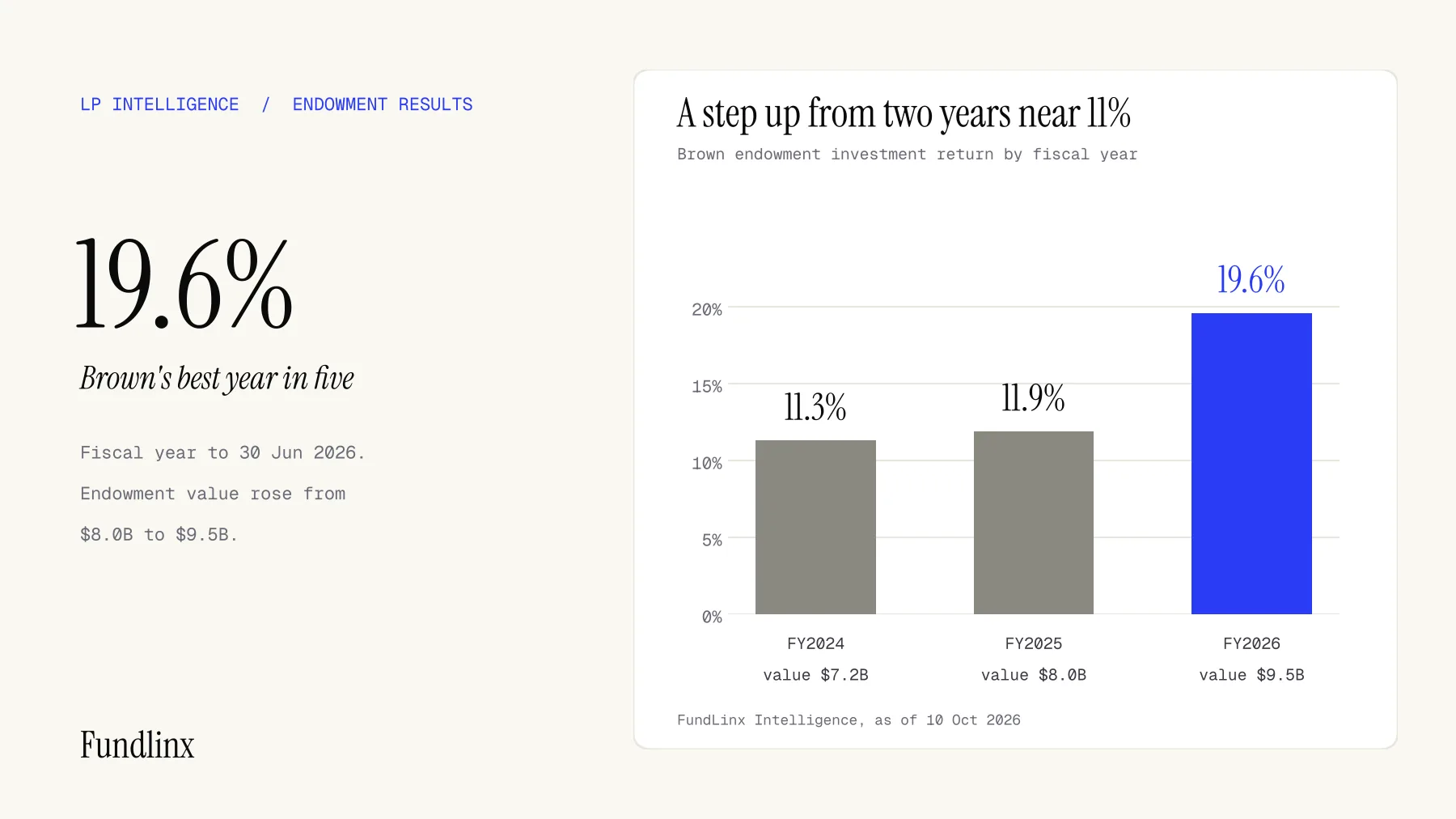
Brown University reported on 9 October 2026 that its endowment returned 19.6% in the fiscal year to 30 June 2026, its highest in five years. Total market value rose from $8.0 billion to $9.5 billion, and the endowment paid a record $357 million into the university's operating budget. The result arrives as the investment office changes hands. Brown announced on 22 September that Chief Investment Officer Jane Dietze will leave at the end of 2026 to become the first CIO of the Fund for Science and Technology, and that deputy CIO Joshua Kennedy will succeed her.
What the numbers show
The rise in value came from $1.6 billion of investment gains, $135 million of new endowed gifts and $200 million of assets from Brown University Health that the investment office manages, less the money paid out to the university. The $357 million budget contribution is 24% of the university's fiscal 2026 revenue, and Brown sets its payout each year at between 4.5% and 5.5% of average market value. Brown says the 19.6% return places it in the first quartile of more than 130 endowments and foundations with over $1 billion, measured against an industry peer benchmark, and that its ten-year return of 13.6% a year is in the top 5% of reported returns. Over the decade, the endowment and other managed assets produced $7.2 billion of investment returns.
How this compares with earlier years
Brown returned 11.3% in fiscal 2024 and 11.9% in fiscal 2025, so the latest year is 7.7 percentage points above the last one by our arithmetic. Market value grew about 19% in fiscal 2026, from $8.0 billion to $9.5 billion, against about 11% the year before, when it rose from $7.2 billion to $8.0 billion. The longer windows moved in different directions. The three-year annualised return rose to 14.2% from 8.6% a year earlier and the ten-year return to 13.6% from 11.4%, while the five-year return fell to 7.8% from 13.0% as a strong year left the window. Against other fiscal 2026 results we have covered, 19.6% sits above Ohio State's 16.03% and below Penn's 27.4%. The spread across the group is wide, as we showed when six endowments landed 27.5 points apart, so a single return says less than the gap to each pool's own policy portfolio. Brown's release does not name a benchmark gap, which is the figure its investment committee will care about most.
The LP behind the number
The Brown University endowment is run by the Investment Office in Providence, Rhode Island, and holds about 4,000 individual funds. As of 31 December 2025 its ten-year historical average allocation was 36% to private equity, 28% to absolute return strategies, 17% to public equity, 10% across credit, fixed income, cash and hedges, and 9% to real assets. That is an average and not the current mix, so the following is an illustration only: 36% of $9.5 billion would be about $3.4 billion in private equity. Dietze credited the results to a dedicated professional team, long-term partnerships with skilled external managers and governance that provides oversight. Brown describes the portfolio only as diversified, gives no return by asset class and does not disclose typical ticket sizes or whether it backs first-time funds, so all three should be treated as unknown. Kennedy joined the office in 2016, has been deputy CIO since 2022 and oversees manager selection, portfolio construction and direct investments. Peter Levine, who joined in 2018, becomes deputy CIO. The changes take effect on 31 December 2026.
What GPs should do now
This is our advice and not something Brown said. Managers already in the portfolio should treat Kennedy and Levine as the day to day relationship, since Kennedy already oversees manager selection, and send annual reporting and updates to them before the year ends. Come with specifics: your net distributions to date, how a cheque would be sized against a book of this size, and where your strategy sits in a portfolio whose largest sleeve has averaged 36%. A manager whose main contact has been Dietze should ask the investment office for an introduction rather than assume the relationship transfers. For managers still pitching, we would expect a new CIO to spend early months reviewing the portfolio, so a fundraise that needs a Brown decision in the first quarter of 2027 should be planned with that in mind. Brown also said it will enter the 4% tier of the federal excise tax on university investment gains in fiscal 2027, up from the 1.4% bracket it was in last year. That puts more weight on net returns and cash distributions when a university compares managers, and our playbook on the new tax tiers sets out how to prepare. Our guide to what to send a CIO after a strong or weak endowment year covers the follow up itself.
What to watch next
Watch for the handover on 31 December 2026, for any asset allocation detail in Brown's next endowment report, and for the remaining large endowments that have yet to publish fiscal 2026 results. You can compare Brown with other university endowment LPs by size and allocation. FundLinx members can see which endowments are allocating this quarter.
FundLinx Intelligence | FundLinx.ai
Playbooks, LP moves and compliance notes for emerging managers. Unsubscribe any time.