SpaceX Lifts UNC to 37.8% as Six Endowments Land 27.5 Points Apart in Fiscal 2026
UNC's endowment returned 37.8% on an early SpaceX stake while MIT made 10.3%, a 27.5 point gap across six endowments. What one concentrated winner means for GPs pitching endowments.
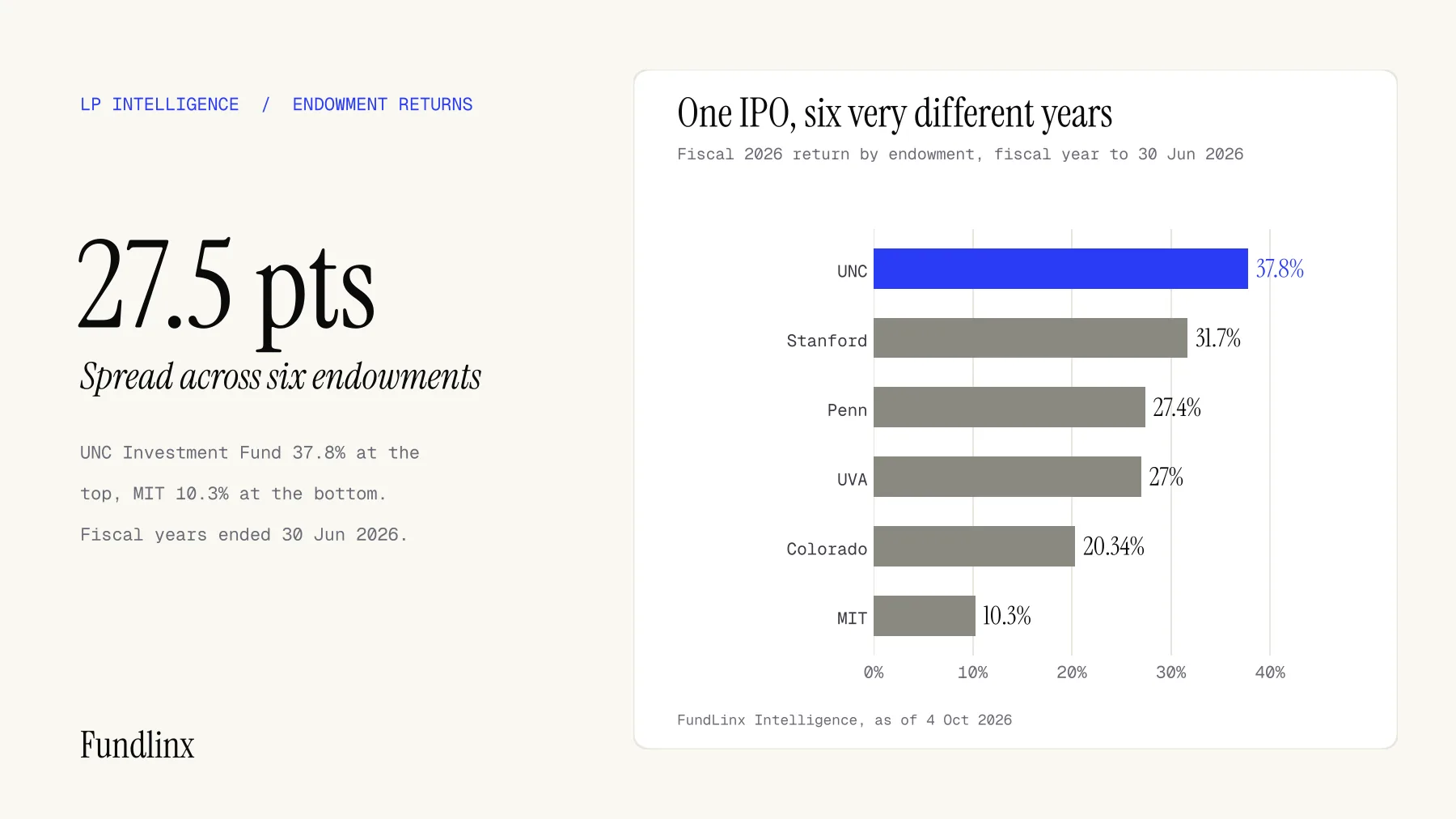
The UNC Investment Fund returned 37.8% in the fiscal year to 30 June 2026 and grew to $17 billion from $12.5 billion a year earlier. About half of that growth came from a single position: a SpaceX stake first bought through a venture capital fund in 2009, which turned into a large gain when the company listed on 12 June 2026 at $150 a share. Stefan Strein, president of UNC Management Company, said that "17 years later, we are now harvesting an enormous gain." Payouts on the position run through September 2027.
One position, six very different years
Set beside the other endowments that have reported, UNC's result stretches the range. Stanford's merged pool returned 31.7%, as we covered when it grew to $61.5 billion in fiscal 2026. Penn returned 27.4%, the University of Virginia Investment Management Company returned 27% on an $18.8 billion long-term pool, and the University of Colorado Foundation returned 20.34% against a 19.57% policy benchmark. At the bottom, the MIT endowment returned 10.3%. Across these six, the gap between the best and worst result is 27.5 percentage points, and four of the six (67% by count) returned 27% or more.
That spread is unusual for pools that share the same asset classes. Venture, private equity and hedge funds are common to all of them, so a gap this wide points to a handful of positions, not to a difference in strategy. At UNC, SpaceX alone explains half the fund's growth. The fund rose by $4.5 billion over the year, so the position accounts for roughly $2.2 billion of that, although the change in value also reflects contributions and distributions. At Colorado the same company was worth $289 million, or 8.2% of assets, on a $150,000 initial investment in 2009 and total commitments of $4.2 million, a 57-fold increase through 30 June 2026.
How this compares with a normal year
UVA's chief executive and chief investment officer, Robert Durden, reported a 10-year average return of about 12% against the 7.5% to 8% the pool needs to meet spending. A single 27% year therefore sits on top of a decade that was already comfortably ahead of what the university requires. Colorado's longer record is more modest, with annualized returns of 7.68% over five years, 10.88% over ten, 9.20% over fifteen and 8.47% over twenty. The takeaway is that one outsized year can flatter a five-year number far more than a twenty-year one, and endowment investment committees know it.
Colorado also flagged the other side of concentration. It cautioned that SpaceX's share price may fluctuate over the next year and that expiring lock-ups could add volatility, which is a polite way of saying that paper gains in a public stock are no longer private-market marks.
The LPs behind the numbers
The UNC Investment Fund is run by UNC Management Company and pools money for the UNC Chapel Hill Foundation, UNC Health and NC State, among others. The Foundation's pool grew from $6.04 billion to $8.16 billion over the year and distributed $315.1 million to support university programs. UNC Health holds about $4 billion in the pool and NC State about $1.8 billion. These are endowments with long horizons, and the SpaceX stake began as a fund commitment, not a direct deal. Colorado's allocation is 35% global public equities, 32% global private capital, 12% real assets, 11% global hedge funds and 10% fixed income and cash, so 32% of its capital sits in private capital against 68% elsewhere.
What GPs should do now
Venture and growth GPs have a ready-made argument: the best result of the season began as a fund commitment 17 years ago. Use it carefully. An endowment that has just booked a gain from one position will want to know how your portfolio concentrates, how quickly you expect to turn paper value into cash, and what your realized record looks like. Lead with DPI alongside any multiple, show how much of your value sits in your top three positions, and be ready to explain how you would handle a public listing and its lock-up.
Timing also matters. Endowments that realize gains from a few large holdings can end up rebalancing, and some may have fresh room to commit to early-stage funds. Those with a smaller return, like MIT's 10.3%, may be more focused on cash flow and manager selectivity. Tailor the pitch to which side of the spread the LP is on.
What to watch next
More endowments will publish fiscal 2026 results over the next few weeks. Watch whether the leaders disclose how much of their return came from one name, since that is the number that will shape their next round of manager commitments. FundLinx members can see which endowments are active in venture this quarter.
FundLinx Intelligence | FundLinx.ai