CalPERS Earned 14.8% but Only 6.83% a Year Over Five Years, Barely Above Its 6.8% Assumption
CalPERS posted 14.8% for fiscal 2026 and $637.1 billion in assets, yet its five-year return is 6.83% against a 6.8% assumption. What a thin cushion means for GPs.
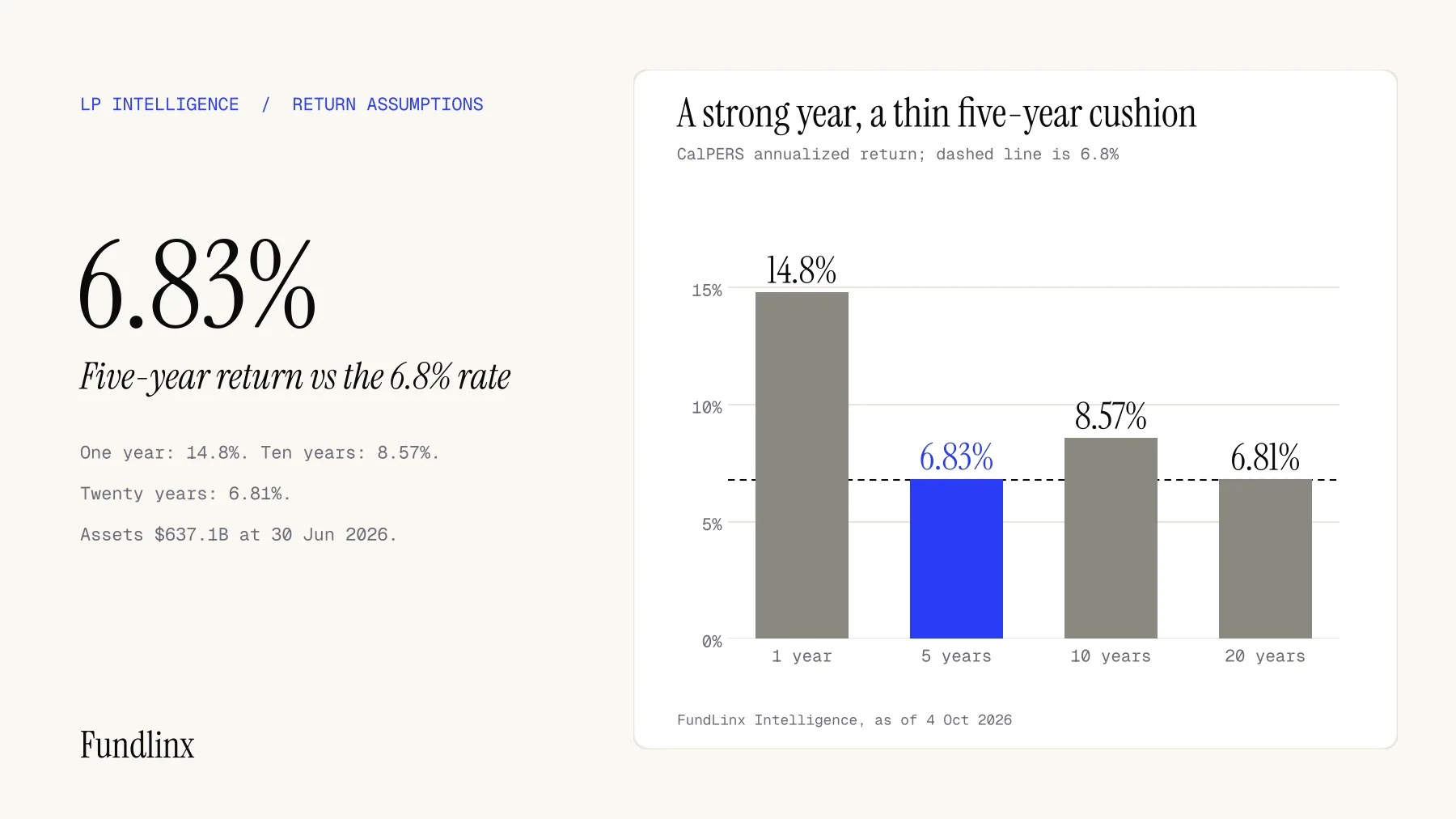
CalPERS posted a preliminary return of 14.8% for the 12 months to 30 June 2026, its best result in five years and up from 11.6% a year earlier. The Public Employees' Retirement Fund ended the year with $637.1 billion in assets and an 85% funded status, up from 79% in fiscal 2025. Chief executive Marcie Frost said the improved funded status "shows this effort is paying off for our 2.4 million members." The headline number is strong. The longer record is where the story for fund managers sits.
A strong year on a thin cushion
CalPERS assumes a long-run return of 6.8%. Measured against that rate, the single year beat it by 8.0 percentage points. The five-year annualized return of 6.83% beat it by 0.03 points, the 20-year return of 6.81% by 0.01 points, and only the 10-year figure of 8.57% shows a clear margin of 1.77 points. In other words, one very good year has lifted a five-year number that would otherwise have been under the line. Our chart sets out the four horizons against the assumption.
That matters because a pension fund that has barely met its assumption over five years has little room for a bad stretch. A year like 14.8% repairs the funded status, and the funded status rose six points, but it does not change the arithmetic that the plan needs 6.8% a year, every year, on average.
How the asset classes contributed
Public equity returned 24.1% and private equity 17.0%, both above the total fund's 14.8%. Private debt returned 11.0%, real assets 6.3% and fixed income 5.9%. Of the five sleeves, two (40% by count) beat the total return, and two (40%) came in under the 6.8% assumption, real assets and fixed income. Private equity was the second-best performer, which supports its place in the portfolio, though it still trailed public equity in a year when equity markets were very strong.
CalPERS is also a very large buyer of private equity. In our earlier look at US public pensions' $100.9 billion of private equity commitments in 2025, CalPERS took $20 billion, about 20% of the capital by amount. Its sister plan CalSTRS committed more than $9 billion to private markets managers in the first half of 2026. Together they set a tone for US pension funds that other plans watch.
The longer arc of the funded status is worth noting. CalPERS was 65% funded when Frost became chief executive in 2016, 79% a year ago and is 85% now, a gain of 20 percentage points over a decade. With the plan this much closer to full funding, protecting that position is the natural priority, and for a manager the strongest pitch is one that speaks to steady, risk-adjusted contribution as well as headline return.
The LP behind the numbers
CalPERS is the California Public Employees' Retirement System, one of the largest US public pensions, serving 2.4 million members. Chief Investment Officer Stephen Gilmore has described a move to a whole-portfolio approach, saying CalPERS will focus on "the best investments for the whole portfolio level." Theresa Taylor is board president. Fund-level ticket sizes are not published here, and a plan of this size generally favors managers that can absorb large commitments, so smaller managers should also consider the consultants, funds of funds and co-investment routes that lead to it.
What GPs should do now
A plan with a thin five-year margin tends to ask how each manager contributes to the total portfolio rather than whether a fund is good in isolation. That reading is our inference from the plan's stated approach, but it is a sensible way to prepare. Show how your strategy behaves when public equities fall, what your net return has been after fees across a full cycle, and how quickly capital comes back as distributions. A private credit or real assets manager has a clear opening because those sleeves returned 11.0% and 6.3% in a year when equities did the heavy lifting, and the plan will be weighing how much diversification it wants to keep.
For managers who cannot reach the plan directly, the nearer opportunity is the consultants and funds of funds that serve it and the other large plans on our US pension funds list. Our guide to LP allocation trends in 2026 covers how plans with similar positions are shifting their targets.
What to watch next
Watch whether the CalPERS board revisits its assumed return, and how it describes the five-year number at the next investment committee meeting. A change in the assumption would reset every manager's return hurdle at the plan. FundLinx members can see which large pensions are active in your strategy.
FundLinx Intelligence | FundLinx.ai