Korea’s NPS Says Its Rebalancing Rule Would Have Meant Selling 800 Billion Won of Stocks a Day
NPS's chairman told a parliamentary audit that its rebalancing rule would have forced about 800 billion won of stock sales a day. The fund raised its domestic equity target to 20.8%.
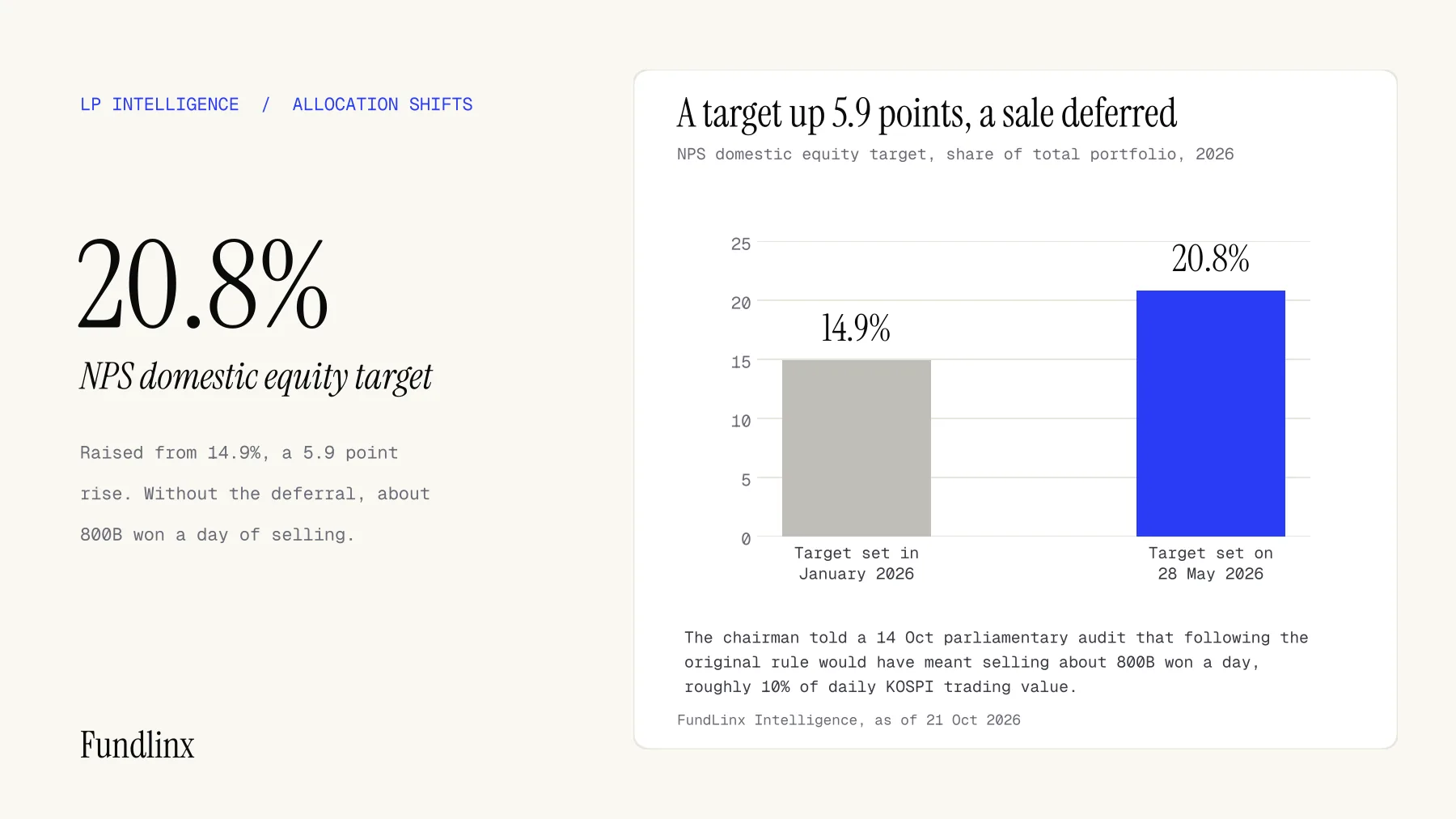
The chairman of South Korea's National Pension Service, Kim Sung-joo, told a National Assembly audit on 14 October 2026 that following the fund's original rebalancing rule would have meant selling about 800 billion won of domestic stocks a day, roughly a tenth of the market's daily trading value at the time. The fund's management committee instead suspended rebalancing of domestic equities in January and, on 28 May, raised the domestic equity target from 14.9% to 20.8%. Opposition lawmakers say the changes were meant to support share prices before June's local elections. Kim denied any political motive and said the decisions reflected market conditions.
What happened and when
The sequence, as set out at the audit, begins in January 2026, when the Fund Management Committee approved suspending rebalancing of domestic equity holdings and decided to withhold the minutes of that decision until 2030. On 28 May, about four months after the suspension began on 26 January, it lifted the domestic equity target to 20.8% and temporarily widened the allowable range around it. That is a rise of 5.9 percentage points, or about 40% in relative terms, our arithmetic. Kim said the suspension was reasonable given conditions in January and May, and that government requests did not simply pass through the fund. Lawmakers from the main opposition party accused the government of changing allocation rules to support the stock market ahead of the elections and raised the possibility of a parliamentary investigation. Lawmakers from the Democratic Party argued the fund had not propped up the market by buying shares, and that rebalancing before the elections would have been better.
What a rebalancing rule does
A rebalancing rule makes a fund trim assets that have risen beyond a set range around their target and buy those that have fallen. It keeps risk near plan and preserves liquidity for downturns, but at the scale of a very large pension it moves markets. Kim's figure shows why: 800 billion won a day was close to a tenth of daily trading. The committee's choice to raise the target rather than sell is a reminder that an LP's published target is a policy decision that governance can change, not a fixed number. For a GP, the practical point is that a target quoted in a deck can be months out of date.
The LP behind the decision
The NPS is South Korea's national pension fund and one of the largest pension investors in the world. An allocation committee sets its targets and ranges, and the audit showed how closely that process is now watched by politicians. Everything reported at the audit concerns domestic listed equities. We have not seen a change to the fund's alternatives targets reported alongside it, so do not assume a read-across to private markets. The fund appears among the pension funds that are resetting targets this season. We reported that Milwaukee's pension fund moved to pause private equity in 2027, and that the Alaska Permanent Fund sits below its 18% private equity target. Different funds, different reasons, but all three show targets moving within a single quarter.
What is not yet known
The audit coverage does not say how wide the temporary range is, whether it expires, or how the committee voted on either decision. It also does not say how far the fund's actual domestic equity weight sits from the new 20.8% target, so we cannot tell how much rebalancing pressure remains. Those are the facts that would show whether the fund is likely to trim stocks in the coming months, and they are fair questions for any manager or adviser who meets the fund's staff.
What GPs should do now
This is our advice, not something the NPS has said. Before you use any LP's allocation target in a pitch, check its date and whether the range around it is permanent or temporary, and ask in a first meeting when the target was last changed and who approves changes. If you raise from Asian limited partners, expect conversations about public market volatility to come before conversations about new commitments, and do not quote NPS figures as evidence of appetite for your strategy, because the facts reported concern domestic stocks only.
It is also worth noting how little visibility the minutes give. If the January decision was recorded in minutes that are not due out until 2030, as reported, then public statements, parliamentary hearings and committee announcements are the only live signals, and a GP tracking a large Korean LP should watch those rather than wait for papers. Our guide to LP allocation trends in 2026 covers how to read target changes across different LP types.
What to watch next
Watch for any parliamentary investigation, for whether the committee publishes the minutes earlier than planned, and for its next decision on the domestic equity range, which was widened temporarily on 28 May. FundLinx members can see which large pension investors have moved their targets this quarter.
FundLinx Intelligence | FundLinx.ai
Playbooks, LP moves and compliance notes for emerging managers. Unsubscribe any time.