Milwaukee's Pension Fund Moves to Pause Private Equity in 2027 and Cut Its Target to 4% by 2035
A $6.7 billion Wisconsin pension fund is recommending no new private equity commitments in 2027, with a long glidepath to about 4% of assets by 2035. Here is what that means for GPs.
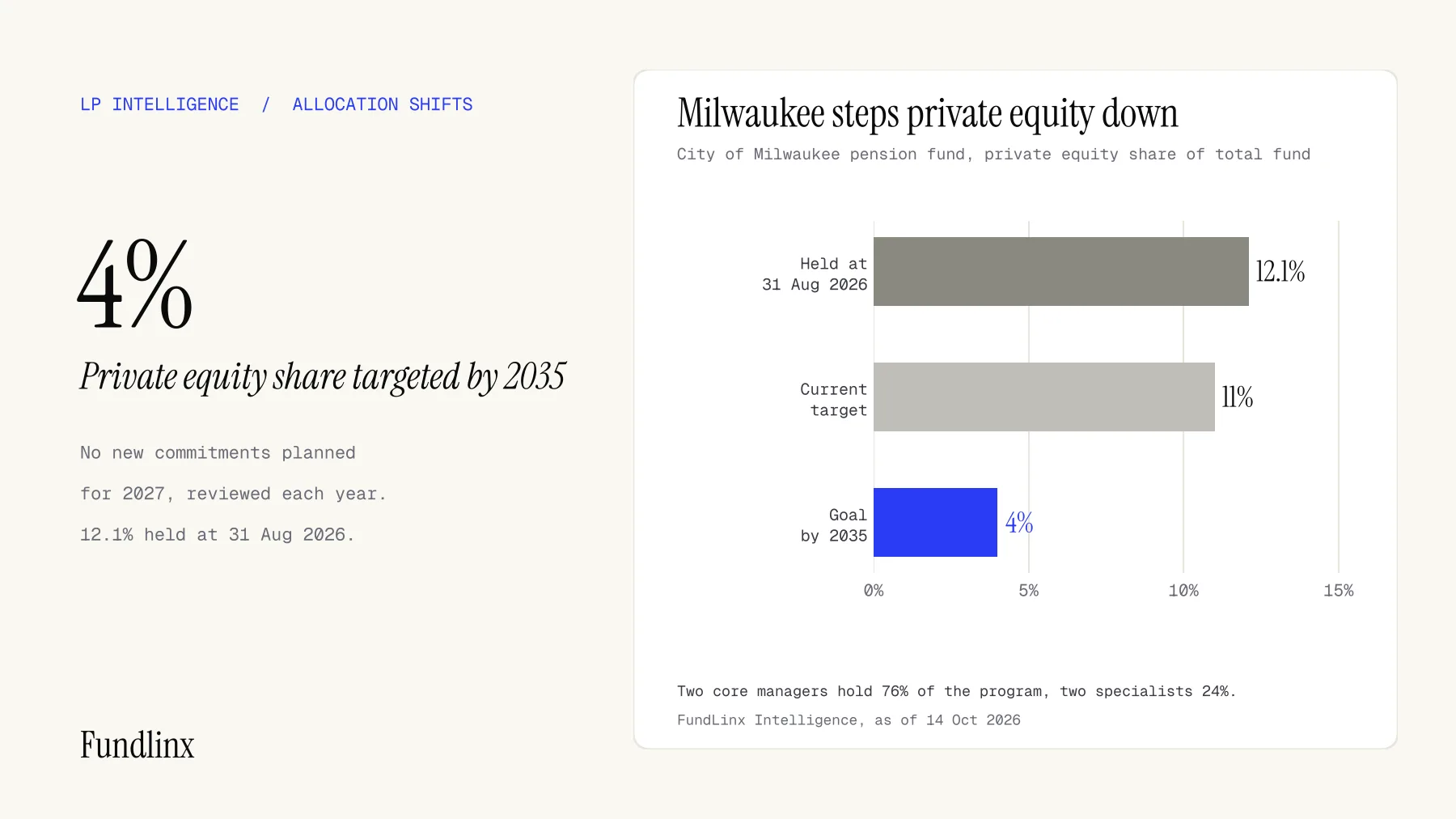
The City of Milwaukee's retirement system is moving to stop committing to new private equity funds in 2027 and to shrink the asset class to about 4% of the portfolio by 2035. Its consultant, Callan, recommended no new commitments for 2027, with the question to be revisited every year, and the item was listed for approval at the fund's board meeting on 24 September 2026. We could not confirm from the sources we reviewed that the board has voted, so treat the pause as a recommendation, not a closed decision. For GPs the useful point is what a mature public pension does when it decides to de-risk: it keeps the funds it already owns, stops adding new ones and lets cash come back.
What the fund said
The fund held about $6.7 billion at the end of August 2026. Private equity stood at 12.1% of the portfolio on 31 August, above an 11% policy target. By our arithmetic that is roughly $810 million, and 1.1 percentage points over target, or about 10% above the target in relative terms. Staff described the program as showing strong, consistent performance that ranks in the second quartile, so the pause is a portfolio-level choice, not a verdict on its managers.
The plan avoids forced sales. Existing holdings are expected to decline gradually as investments mature and distributions return to the fund, not through an immediate sale. Getting from 12.1% to about 4% by 2035 means giving up roughly one percentage point of the portfolio a year over nine years, which by our arithmetic depends heavily on how fast the existing funds distribute. Put another way, the weight of private equity in the portfolio would fall by about two thirds. The fund has not said how it will treat the proceeds, so we cannot say which asset classes would receive them.
The program runs through four managers. Two core managers, Abbott Capital Management and Mesirow, hold about 76% of the program by capital, and two specialty managers, Neuberger Berman and Apogem Capital, hold about 24%. By count, it is an even split of two and two. At the last count about $490 million of earlier commitments had not yet been called, which is capital still owed to funds the pension already backs.
How this compares
Milwaukee is moving against the direction of most recent LP news. This month we covered Maine PERS lining up up to $100 million for AE Industrial Partners Fund IV after it approved $890 million of commitments in September, and Pennsylvania SERS committing up to $130 million to Reverence Capital Partners, its first deal with the manager. Both are public pension funds adding exposure. Milwaukee has chosen the opposite course, with an explicit glidepath downward, which is a reminder that pension funds do not move as one group, even when they face the same markets and the same calendar.
The LP behind the pause
The City of Milwaukee Employes' Retirement System is a US public pension fund with about $6.7 billion in assets. It reaches private equity through a small set of long-standing managers, not through a wide roster of direct fund relationships, and the largest two hold about three quarters of the program. Neither source we reviewed says whether the fund backs first-time managers. In our view, a program built around a handful of managers is unlikely to be a direct route for a Fund I or Fund II, and it is more likely to be a source of capital through the managers it already uses. A GP that wants this money would normally meet it through a fund-of-funds or specialist manager, which is a different conversation from pitching the pension directly.
What GPs should do now
This section is our advice, not something the fund said. If you were planning to raise a new primary commitment from Milwaukee in 2027, the window looks closed on current plans. Move it from your active pipeline to a relationship file and revisit it when the annual pacing review comes around.
If you already sit in a portfolio that holds Milwaukee money, expect the conversation to be about distributions. An LP that is above target and shrinking an allocation values cash returned, and DPI is the number a de-risking investor watches. Update your realisation outlook and be ready to explain the timing of exits in plain terms. We set out the practical steps in a playbook for working with a pension that is pacing down.
Finally, use this as a prompt to sort your own LP list by how far each pension sits from its target. A fund that is above target after a long run may pace down, and one below target may need to catch up. That is a screening idea, not a statement from any fund.
What to watch next
Because the fund reviews pacing every year, each autumn's decision is the moment to listen for a change of course. Watch for the board's decision on the 2027 recommendation, for the next annual pacing review, and for whether other mature public pensions adopt explicit glidepaths. FundLinx members can see which pension funds are pacing up or down.
FundLinx Intelligence | FundLinx.ai
Playbooks, LP moves and compliance notes for emerging managers. Unsubscribe any time.