Danish Pension Fund P+ Gives Schroders Capital a EUR 200 Million Private Equity Co-Investment Mandate
A Danish pension fund with about DKK 170 billion in assets has handed a manager EUR 200 million to co-invest in European lower and mid-market companies, under 1% of its assets.
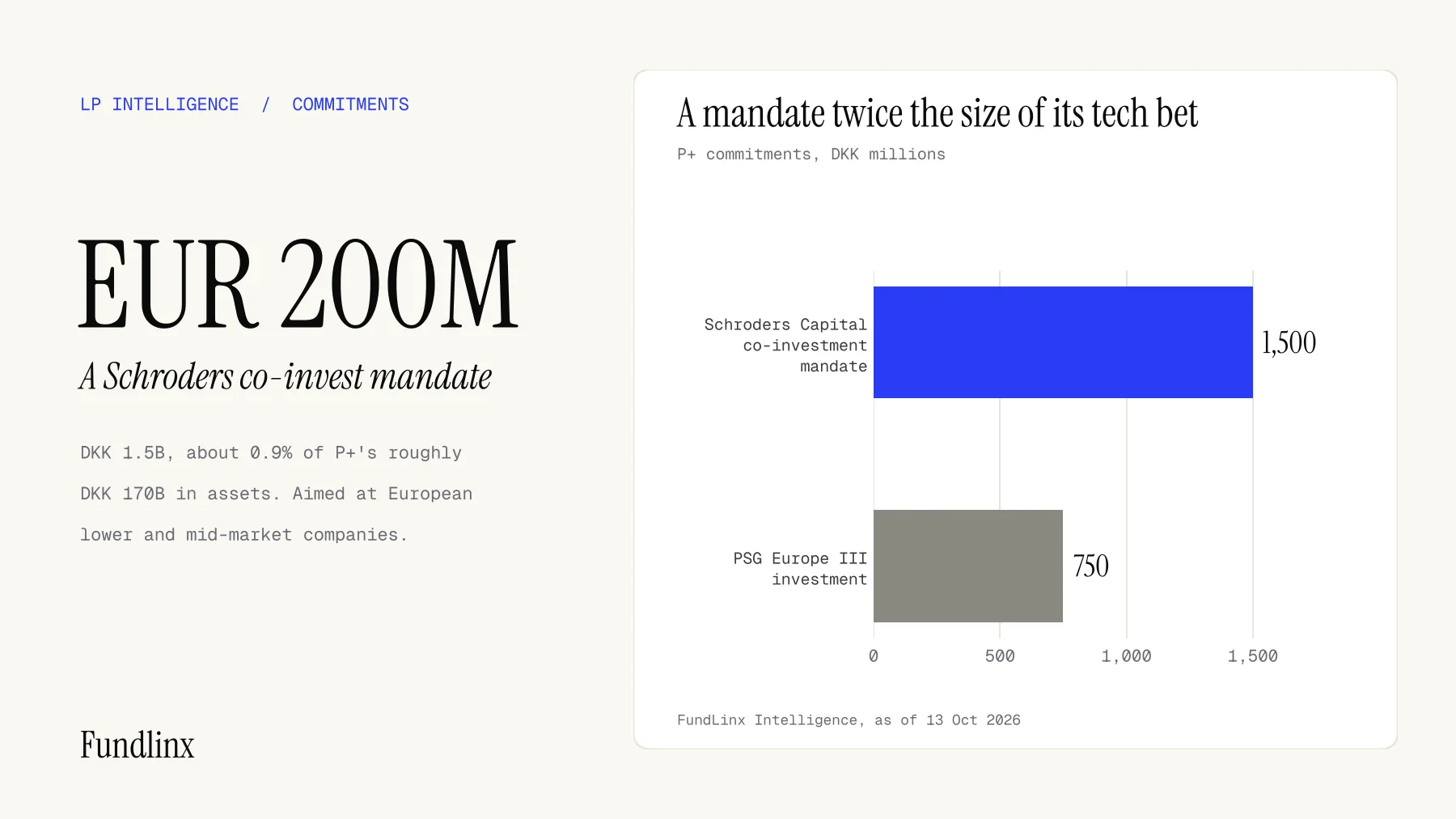
On 8 October 2026, Danish pension fund P+ was reported to have awarded Schroders Capital a EUR 200 million (DKK 1.5 billion) private equity co-investment mandate. The mandate gives P+ a dedicated route into European lower and mid-market companies that it finds hard to reach directly, and it puts a specialist manager, not the pension fund itself, in the seat that picks the deals. For GPs the useful detail is who now sits between them and a pension fund with about DKK 170 billion under management.
What was announced
P+ said it wants more exposure to European companies, particularly in the lower and mid-market. Chief Investment Officer Jasper Riis said the fund sees European growth companies with strong market positions and value-creation potential, and he linked the allocation to European competitiveness and resilience in a changing geopolitical and economic environment. The portfolio will invest alongside specialist private equity managers in European businesses with growth potential, with healthcare, technology, business services, consumer and industrials named as target sectors.
Schroders Capital runs the mandate through its European private equity co-investment strategy. It invests directly alongside established general partners and takes part in underwriting and selecting individual deals. Benjamin Alt, Head of Global Private Equity Portfolios at Schroders Capital, pointed to domestically focused, service-oriented lower and mid-market businesses, which he argued tend to be more resilient in uncertain periods. Henrik Jonsson, Head of Nordics and Netherlands, called the win a further step in the firm's institutional business in the region. Schroders Capital manages USD 29.7 billion in private equity assets.
An earlier report, dated 24 September, had said Schroders Capital won a standalone co-investment mandate from P+, a new client, expected to be invested over three years. The announcements we reviewed do not give a fund name, a fee structure or the number of deals expected, so we cannot say how many companies the money will reach.
How the numbers compare
By our arithmetic, DKK 1.5 billion is about 0.9% of P+'s roughly DKK 170 billion in assets. This is a measured step, not a reallocation. If the money is invested evenly over the three years reported, it comes to about EUR 67 million a year. P+ also says it is investing DKK 750 million in PSG Europe III, a vehicle for European technology companies. That commitment equals 50% of the co-investment mandate by capital, which shows P+ already writes cheques into sponsor-led vehicles as well as through delegated mandates.
The theme is not new. Earlier this month we covered ABP's EUR 250 million commitment to EQT's Scaleup Europe fund, another large European pension choosing a route into European growth companies. In both cases the pension is paying for access to deal flow in a part of the market it cannot cover with its own staff.
The LP behind the mandate
P+ is a Danish pension fund owned by more than 125,000 members, with about DKK 170 billion under management according to its own website. Riis became Chief Investment Officer in 2023. Neither source we reviewed says whether P+ backs first-time managers, and a mandate that invests alongside established general partners is not a test of that. The more useful signal is the structure: P+ has chosen a dedicated, three-year co-investment sleeve with one manager, which tells you it prefers a single accountable partner for deal selection over many direct relationships.
What GPs should do now
This section is our advice, not something P+ or Schroders said. If you run a lower mid-market buyout or growth fund in Europe, and your companies sit in healthcare, technology, business services, consumer or industrials, the co-investment slice of your next deal may now be offered to Schroders Capital on behalf of P+. Because Schroders takes part in underwriting, expect to be asked for the full diligence set, not a summary. Prepare a deal-ready co-investment package, set your allocation policy before the call, and be clear about the timetable for closing the round.
Second, build the relationship with the co-investment team rather than trying to reach P+ directly. For a mandate like this, the person who decides whether your deal fits is a manager's deal team. A shared sponsor or lender is the most natural introduction, a route we explain in our piece on why co-investors are your warmest route to fund LPs. Third, treat fund-level conversations with P+ as a separate track. This mandate does not tell us how P+ evaluates new fund commitments, and the DKK 750 million PSG Europe III investment shows it also writes directly into sponsor vehicles.
Finally, keep Nordic timing in mind. A three-year investment period means the deal flow is likely to be spread out, so the first co-investments are the ones that set the tone for the relationship.
What to watch next
Watch for the first co-investments announced under the mandate, for a fund name and terms, and for whether other Nordic pensions follow with dedicated co-investment sleeves. FundLinx members can see which European pensions are building co-investment programmes.
FundLinx Intelligence | FundLinx.ai
Playbooks, LP moves and compliance notes for emerging managers. Unsubscribe any time.