Mubadala's CFO Says It Will Keep Deploying About $39 Billion a Year, With Asia Now 13% of the Portfolio
Mubadala plans to deploy about $39 billion a year through all cycles. Asia has grown from about 10% to about 13% of its $385 billion portfolio, with China, South Korea, India and Japan in focus.
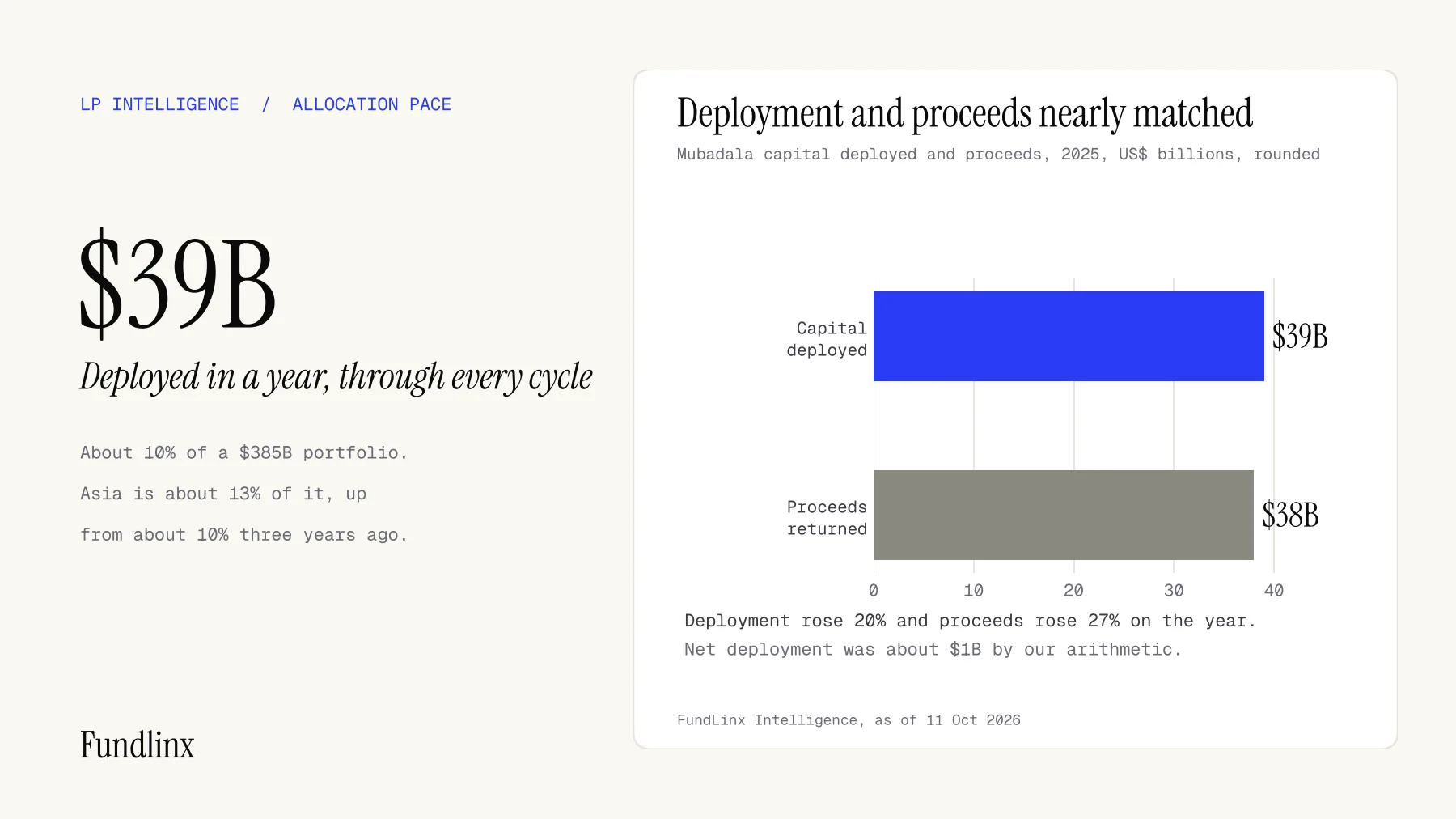
On 7 October 2026, Carlos Obeid, chief financial officer of Mubadala, told a panel at the Milken Institute Asia Summit in Singapore that the Abu Dhabi investor wants to deploy the same amount every year, whatever the market is doing. That amount is about $39 billion, which he put at roughly 10% of the portfolio. He also said Asia has grown from about 10% of the portfolio three years ago to about 13% today, and that Mubadala plans to add exposure in China, South Korea, India and Japan. For a sovereign wealth fund that writes cheques through both direct and indirect private equity, a stated pace is useful information for any manager deciding when and where to approach it.
What was said
Obeid described four investment themes: the energy transition, what he called "technology everywhere", the rebuilding of global supply chains and the evolving consumer. He said the strategy lines up with the Abu Dhabi government's goals of earning returns while tying the economy into the global one, mainly by partnering with leading companies through direct and indirect private equity. The sectors named for Asia were renewables, mobility, advanced technology, AI and life sciences. The Temasek chief investment officer, Rohit Sipahimalani, sat on the same panel. Obeid's remarks put the stated pace on the record with a regional focus attached.
How this compares with the last full year
Mubadala's own results for 2025, published on 9 April 2026, show where the $39 billion comes from. Capital deployment rose 20% to AED 143 billion, about $39 billion, which the CFO called a record. Proceeds rose 27% to AED 138 billion, about $38 billion, also a record. By our arithmetic, proceeds were about 97% of deployment, so net new capital put to work was only about $1 billion. Assets under management rose 17% to AED 1.4 trillion, about $385 billion, and the annualised internal rate of return was 10.7% over five years and 10.3% over ten. Mubadala has not disclosed revenue or net income since 2021 and reports rolling returns instead.
Two points follow from those numbers. First, $39 billion is 10.1% of $385 billion, which matches the share Obeid quoted. Second, a three-point rise in Asia's share over three years is about one point a year. If the 13% applied to the full $385 billion, Asia would be about $50 billion, but that is our illustration, because the company has not given a dollar figure. Our 9 October coverage of MENA sovereign funds put Mubadala at the top of regional deal activity, though that was an industry estimate of deal value and is not like for like with the company's own deployment figure.
The LP behind the numbers
Mubadala Investment Company is the Abu Dhabi government's investment vehicle, led by Group CEO Khaldoon Khalifa Al Mubarak, with its portfolio spread across six continents and several asset classes. It is one of the larger names on our lists of Middle East LPs. Its ticket sizes and appetite for first-time funds are not stated in the remarks, so neither should be assumed. The Asia push also sits alongside moves by peers: Temasek is planning its first Middle East offices, and Temasek's chief investment officer shared the Singapore panel with Obeid, so Temasek's profile is worth reading alongside Mubadala's.
What GPs should do now
This section is our advice, not something Obeid said. Managers with a credible China, South Korea, India or Japan strategy have the clearest opening, because the CFO named those four markets as places where exposure will grow. A pace that is held "through all cycles" suggests there is little value in timing an approach to a market rally or a dip, and more value in being ready when a slot opens. Because proceeds nearly matched deployment last year, a new commitment will probably depend on capital coming back from older positions, so evidence of how your fund returns cash, and when, should be in the first conversation. Obeid framed the strategy as direct and indirect private equity, so a fund pitch is stronger when it comes with a co-investment option that lets Mubadala put more capital behind the best deals. Mubadala reports rolling five-year and ten-year returns instead of annual profit, so expect questions about your return history over those horizons and have them ready. Obeid also said Asia is "very important" to Mubadala and that it already has a presence in China, South Korea, Japan and India, so a manager with local relationships in those markets starts from a stronger position than one without. Finally, remember that a stated 10% annual pace is a portfolio-level number. It says nothing about how much goes to external fund managers, and we would not read it as capital available to GPs.
What to watch next
Watch Mubadala's next annual results, which came in April this year, for whether Asia's share moves beyond 13% and whether proceeds again track deployment. Any dollar figure for the Asia sleeve would also help GPs size an approach. FundLinx members can see which sovereign investors are active in your strategy.
FundLinx Intelligence | FundLinx.ai
Playbooks, LP moves and compliance notes for emerging managers. Unsubscribe any time.