Australia's Future Fund Reports an 11.0% One-Year Return to 30 September, Down From 14.8% at June, With 12.1% of Its Portfolio in Private Equity
The Future Fund's one-year return fell to 11.0% from 14.8% in a quarter, still above its 8.2% target. Private equity is 12.1% of its A$289.9 billion portfolio.
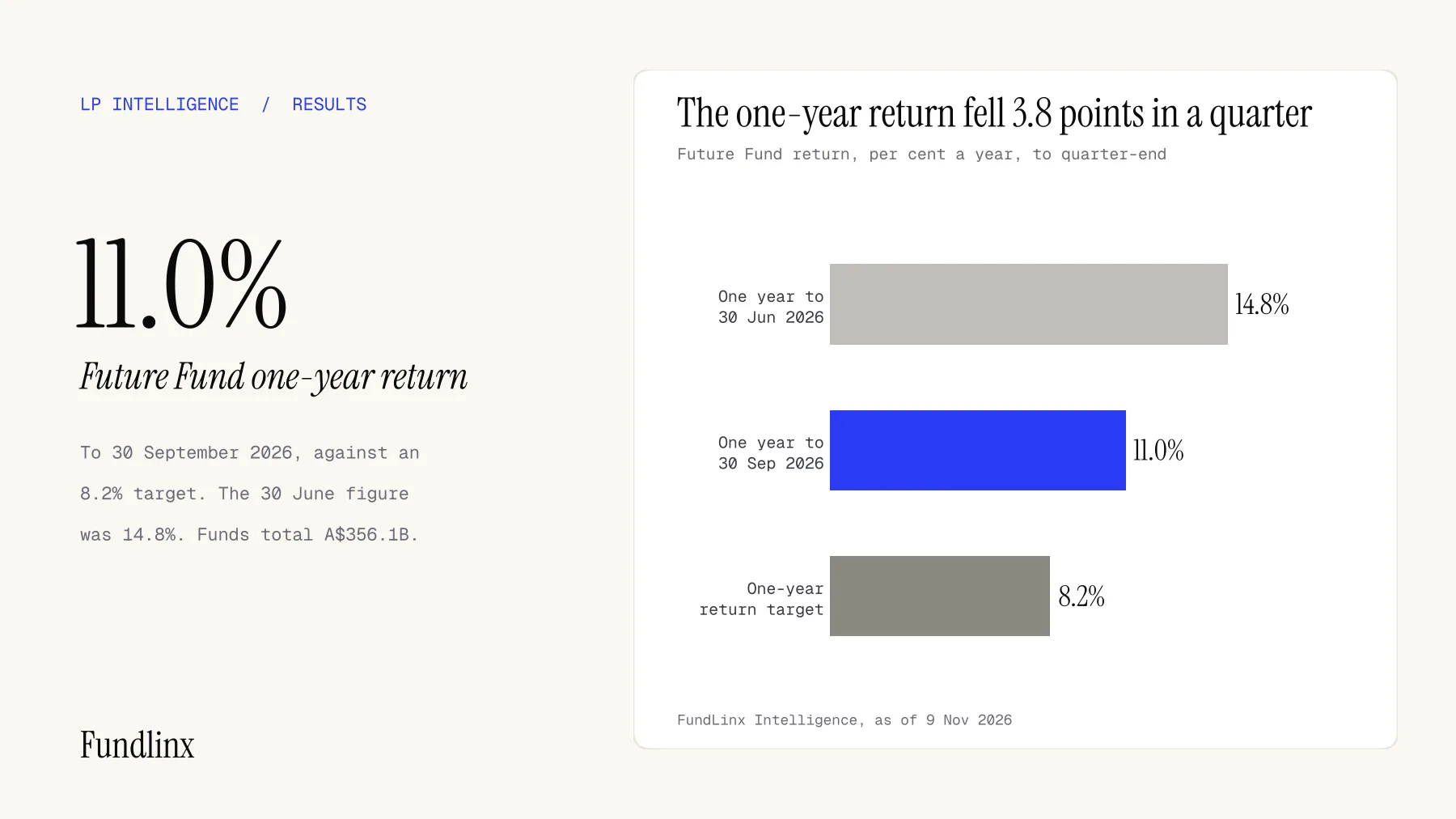
Australia's Future Fund published its portfolio update for the quarter to 30 September 2026 on 5 November. The sovereign wealth fund's one-year return was 11.0%, down from 14.8% at the end of June, but still above its mandate target of 8.2%. The Future Fund portfolio stood at A$289.9 billion, and total funds under management across all the funds the agency runs were A$356.1 billion. For fund managers raising from sovereign and endowment-style investors, the update shows a portfolio that is still heavily invested in private markets while its headline return cools.
What the update shows
The agency said the data is unaudited. Funds under management of A$356.1 billion compare with A$356.0 billion at 30 June, so the total was almost flat over the quarter. The Future Fund itself was A$289.9 billion, up from A$289.7 billion. The agency also manages the Medical Research Future Fund at A$26.2 billion, the DisabilityCare Australia Fund at A$14.6 billion, the Housing Australia Future Fund at A$11.7 billion, the Future Drought Fund at A$5.8 billion, the Disaster Ready Fund at A$5.3 billion and the ATSILS Fund at A$2.6 billion. Those six funds add to A$66.2 billion, which together with the Future Fund gives the A$356.1 billion total, our arithmetic from the disclosed figures.
Future Fund returns are 11.0% a year over one year, 12.2% over three years, 7.8% over five years, 8.8% over ten years and 8.2% a year since inception in May 2006. At 30 June the equivalent figures were 14.8%, 12.0%, 8.0% and 9.0% for one, three, five and ten years. Chief Investment Officer Richard Brandweiner said the 11% return compares with a mandate target of 8.2% for the year and that the 8.8% ten-year return compares with a 7.2% target. He said the quarter was hurt by rising real yields, which weighed on listed infrastructure and bonds, and helped by commodities.
The allocation
The allocation matters more to a GP than the headline. Of the Future Fund portfolio, private equity is 12.1%, infrastructure and timberland 11.3%, property 3.7%, credit 8.4% and alternatives 14.9%. Developed market global equities are 30.1%, emerging market equities 4.9%, Australian equities 10.0% and cash 4.7%. Adding private equity, infrastructure and timberland, and property gives 27.1% of the portfolio, our arithmetic from three disclosed lines, which on A$289.9 billion is roughly A$78.6 billion. On the same basis private equity alone is about A$35.1 billion and infrastructure and timberland about A$32.8 billion. The percentages sum to 100.1% because of rounding in the source table. Across the five return horizons the agency reports, the three-year figure of 12.2% is the highest and the five-year figure of 7.8% the lowest, so the recent past has been stronger than the middle of the decade for this portfolio.
How it compares
The change from quarter to quarter is the point worth noting. The one-year return fell 3.8 percentage points in three months, from 14.8% to 11.0%, while the ten-year return slipped only 0.2 points to 8.8%. Other sovereign investors have reported cooler numbers recently. We reported that New Zealand's Super Fund returned 14.17% but cut its long-term return expectation to 7.2%, and that Norway's wealth fund lost 0.5% in the third quarter. The periods and measures differ, so the three results are not directly comparable.
The named LP
The Future Fund is Australia's sovereign wealth fund, established in 2006 with an endowment of A$60.5 billion that Chief Executive Raphael Arndt said has grown to almost A$290 billion. Arndt said the portfolio remains in very good shape despite geopolitical uncertainty, persistent inflation and strong global demand for capital. Brandweiner said diversification gives the fund multiple sources of return and resilience. We have no verified figures on its typical commitment size or on whether it backs first-time managers, so we offer none. Other Australian institutions are active in private markets too, and we reported that AustralianSuper has committed more than A$1.5 billion to Australian venture.
What a GP should do
This section is our advice, not guidance from the Future Fund. First, if your strategy sits in private equity, infrastructure, credit or real assets, note that these lines together are about 35.5% of the portfolio, our arithmetic from 12.1%, 11.3%, 8.4% and 3.7%, so the agency is a large buyer across several strategies, not a single-sleeve investor. Second, expect the conversation to be about resilience and diversification, the words the CIO used, so bring evidence of how your fund held up when real yields rose. Third, state your returns against a clear benchmark and period, because this LP reports its own results against a target in exactly that way. Fourth, if you are a manager of a specialist strategy, use a sovereign investor mapping exercise to find who else in your category it already works with.
What to watch next
Watch the next quarterly update for the one-year return against the 8.2% target and for any change to the private equity share of 12.1%. FundLinx members can see which sovereign funds are adding to private markets.
FundLinx Intelligence | FundLinx.ai
Playbooks, LP moves and compliance notes for emerging managers. Unsubscribe any time.