CPP Investments Loses 0.5% in the September Quarter as Bond Yields Rise, Yet Net Assets Reach C$866.2 Billion and the Six-Month Return Holds at 7.0%
CPP Investments lost 0.5% in the July to September quarter as higher bond yields hit fixed income, but C$7.3 billion of net transfers lifted net assets to C$866.2 billion. Six-month return: 7.0%.
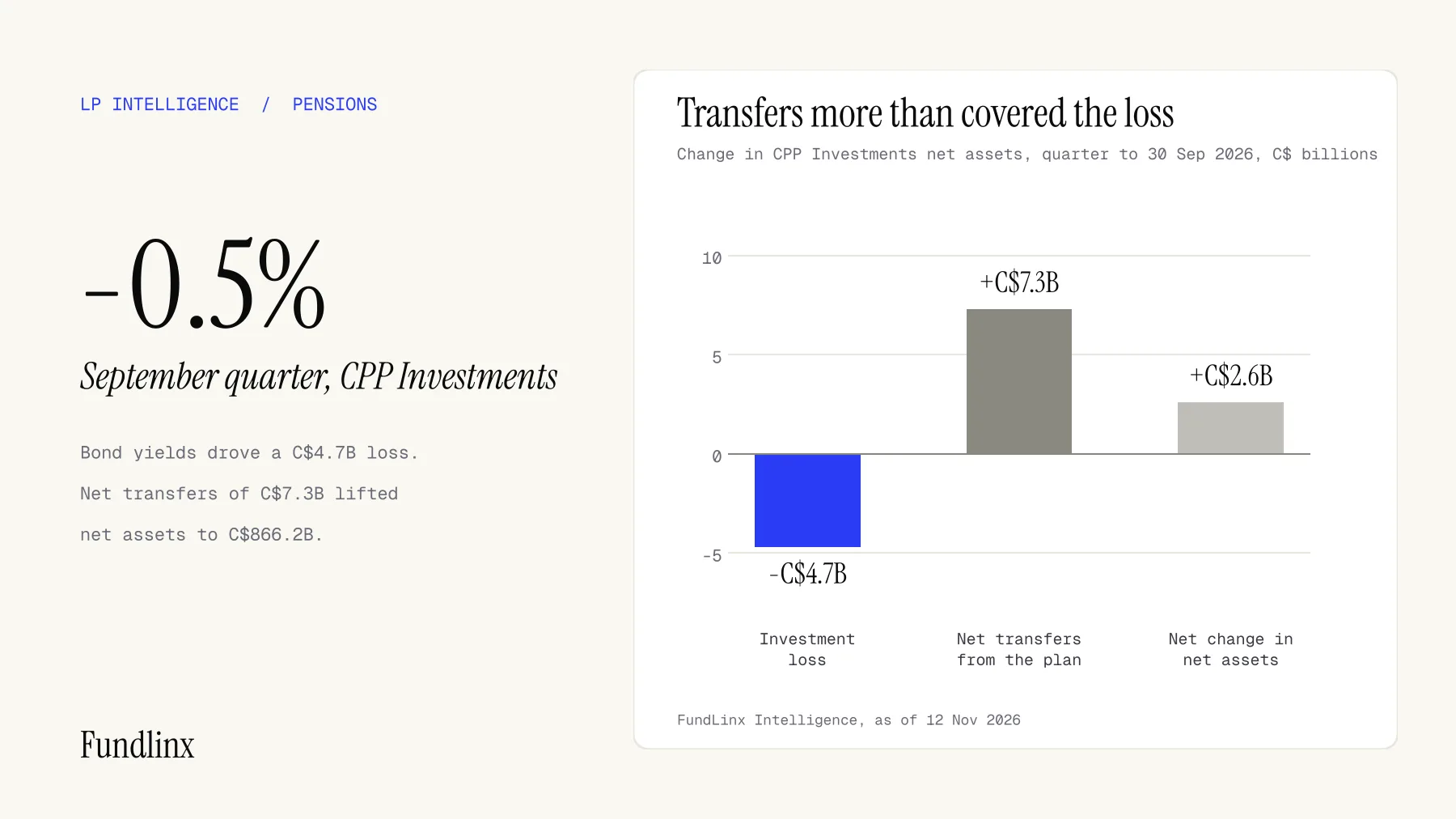
CPP Investments reported a net loss of C$4.7 billion for the quarter ended 30 September 2026, a return of negative 0.5%, as higher government bond yields weighed on its fixed income holdings. Net assets still rose to C$866.2 billion from C$863.6 billion at the end of June, because C$7.3 billion of net transfers from the Canada Pension Plan more than covered the loss. Over the first six months of its 2027 financial year the Fund returned 7.0%.
What was reported
The results are for the second quarter of the 2027 fiscal year, covering July to September. CPP Investments said public equities, private equity and real assets all contributed gains, helped by resilient corporate earnings, momentum in AI-related sectors and sustained demand for infrastructure assets. Fixed income losses more than offset those gains, as government bond yields rose across developed markets on persistent inflation concerns and expectations that rates stay higher for longer. John Graham, President and Chief Executive Officer, said higher bond yields weighed on fixed income while diversification across the portfolio helped offset some of the pressure.
The June quarter had been the opposite. Net assets reached C$863.6 billion then, after what the organisation called its strongest quarterly investment performance in more than a decade. One quarter of gains followed by one of losses is why the six-month figure of 7.0% is the more useful number.
The numbers, as a share of capital and of count
By capital, the C$4.7 billion loss was about 0.54% of the C$863.6 billion of opening net assets, consistent with the reported negative 0.5%. The C$7.3 billion of net transfers was about 155% of the loss, so contributions covered it one and a half times, which is our arithmetic. By count, three of the portfolio's asset classes named in the results, public equities, private equity and real assets, contributed gains, and one, fixed income, produced the loss that outweighed them. The results summaries we reviewed did not give a return for each asset class, so we cannot say how large each contribution was.
How this compares with earlier quarters and peers
CPP Investments joins other large allocators that lost on bonds in the same quarter. We covered Norway's wealth fund losing 0.5% as bonds fell 3.5% and Japan's GPIF losing 1.65% as foreign bonds fell 6.52%. The pattern is the same in all three: gains in equities and real assets, outweighed by falling bond prices. For a fund manager, the point is that the losses came from rates, not from private markets.
Who the limited partner is
CPP Investments is the Canadian pension investment organisation that manages the assets of the Canada Pension Plan, and it reports two accounts. The base account ended September with net assets of C$771.7 billion and the additional account with C$94.5 billion, which together make up the C$866.2 billion. Net transfers matter for GPs because they show that new money is still arriving: the C$7.3 billion this quarter was C$1.9 billion into the base account and C$5.4 billion into the additional account. CPP Investments invests in private equity, real assets and credit and often co-invests, as in the Blackstone-led deal for a stake in a Mitsubishi LNG Canada holding company. We do not have a verified typical ticket size, and we have not seen evidence of whether it backs first-time managers.
What a fund manager should do
This section is our advice, not guidance from CPP Investments. A negative quarter driven by bonds is not a reason to expect a pullback from private markets, and the results say private equity and real assets contributed gains. Positioning matters more than timing. If you raise infrastructure, private equity or real asset strategies, say clearly how your returns relate to rates and inflation, since that is what hurt this quarter. Offer a co-investment option as well, because the organisation often invests directly. Keep any approach to the investment staff who cover your strategy, and use a warm introduction where you have one. Expect the next report to show how the second half starts.
Why the transfers matter for fund managers
Net transfers are the money the Canada Pension Plan sends to the Fund after paying benefits, and they are the reason net assets rose in a quarter when returns were negative. For a manager raising capital, a limited partner that keeps receiving new money has less need to sell holdings to meet outflows. That is our reading of the numbers and not something CPP Investments said. It also sits alongside another large Canadian vehicle that is only just forming: this week the federal government named a chief executive for the C$25 billion Canada Strong Fund, which has a very different mandate and no investment history yet.
What to watch next
Watch the third quarter results, which cover October to December, for whether bond yields stay high and whether private markets keep contributing gains. Also watch for how CPP Investments describes the pace of net transfers, because they are what lifted net assets this quarter. FundLinx members can compare how pensions and sovereign funds are positioned across asset classes.
FundLinx Intelligence | FundLinx.ai
Playbooks, LP moves and compliance notes for emerging managers. Unsubscribe any time.