Canada Names Bridgewater's Karen Karniol-Tambour First CEO of the C$25 Billion Canada Strong Fund, Its New Sovereign Wealth Fund
Canada's new sovereign wealth fund has its first chief executive, Bridgewater co-CIO Karen Karniol-Tambour. It opens with a C$25 billion commitment; no board or start date has been announced.
The Prime Minister's Office announced on 9 November 2026 that Karen Karniol-Tambour will be the first chief executive of the Canada Strong Fund, Canada's new federal sovereign wealth fund, which has an initial capital commitment of C$25 billion. She is a co-chief investment officer at Bridgewater Associates, the US investment manager, which she joined in 2006 after graduating from Princeton. The announcement did not give a start date, did not name the fund's board, and did not say who will lead its investment team.
What was announced
The Prime Minister, Mark Carney, launched the fund in the spring, and the 9 November announcement fills its top job. The fund is to be professionally managed and to operate at arm's length from the government, with its own board of directors and its own chief executive. For now it is set up as a wholly owned subsidiary of the Canada Development Investment Corporation, the government's financial and commercial adviser, until legislation makes it a standalone Crown corporation. The federal budget presented last week outlined that plan.
The mandate is commercial. The fund is to invest in Canadian companies and projects through two streams: co-investment alongside federal entities, and independent strategic investments. It is meant to make minority investments in projects and companies that the federal government already supports in other ways, and it is not described as a fund-of-funds or as a manager of external funds.
The retail leg
The fund will also have a retail product. The announcement says Canadians will be able to invest directly through what it calls Canada Strong Notes, which are described as offering principal protection through participating financial institutions. The budget documents describe them as notes similar to savings bonds. No timing or mechanics have been announced.
The numbers, as a share of capital and of count
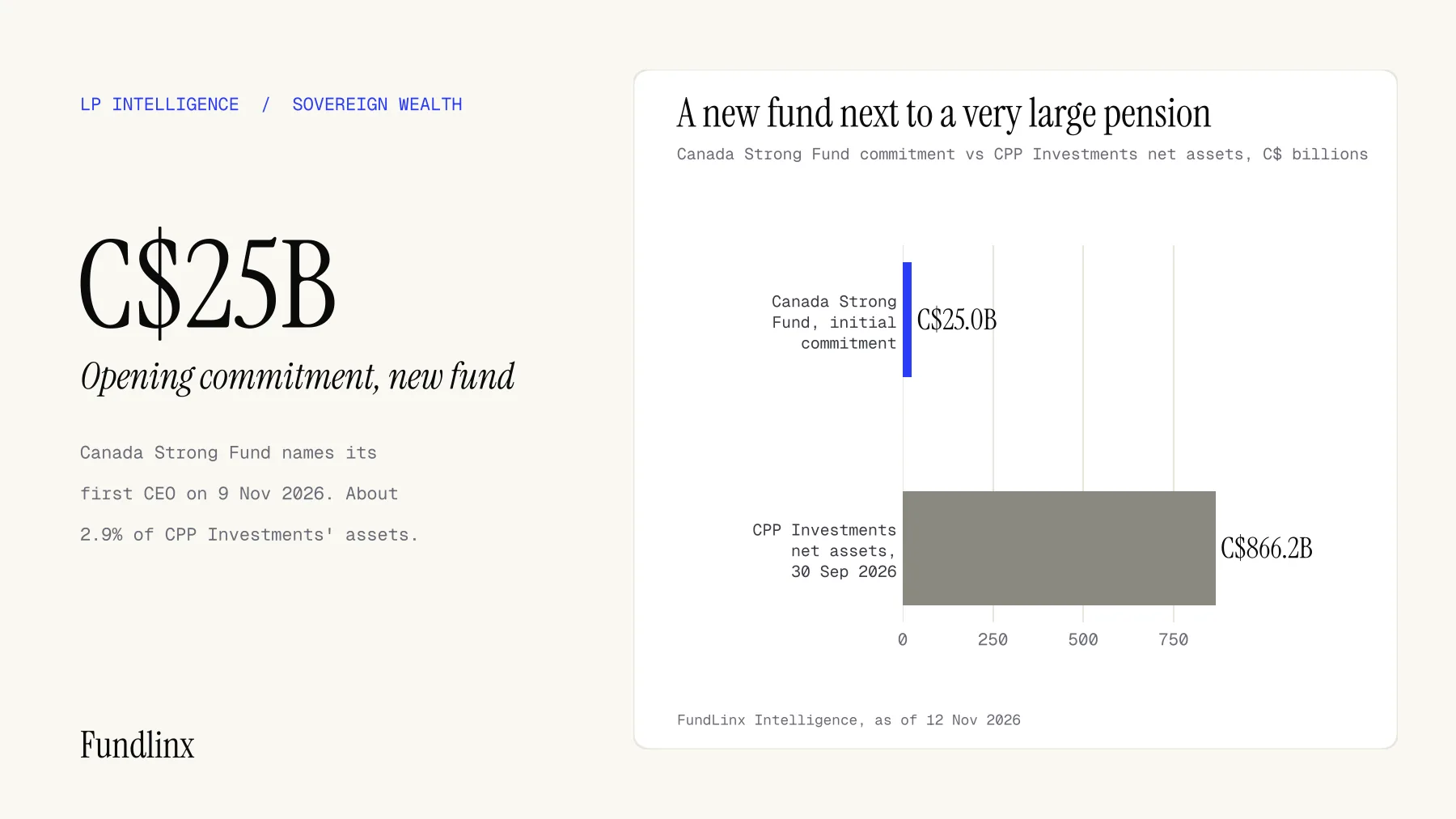
By capital, the C$25 billion commitment is about 2.9% of the C$866.2 billion of net assets that CPP Investments reported on the same day for 30 September 2026, which is our arithmetic and not a comparison either institution has made. By count, the fund has two investment streams, one named executive and no named board members or investment staff. The split of the C$25 billion between the two streams has not been disclosed, and neither has any amount for the retail notes, so we cannot say what share of capital is available to each.
How this compares with earlier signals
This is one of several sovereign moves we have covered this month. We wrote about Qatar's wealth fund restating a $500 billion US plan and about the Eurasian Development Bank and its partners launching a Central Asia and Caucasus private equity fund. Those are established sovereign investors extending programs. Canada's is a new vehicle that starts with a chief executive, a mandate and a capital figure but, so far, no disclosed team. That puts it closer to an institution being built than one that can be pitched.
Who the limited partner is
The Canada Strong Fund is a sovereign wealth fund in North America, created by the federal government with an initial commitment of C$25 billion. It has no investment history, no disclosed ticket sizes, and no evidence yet of whether it will commit to funds as a limited partner. Its stated approach is direct: co-investing beside federal entities and making strategic investments. Its new chief executive comes from a global investment manager rather than from a Canadian pension, so the fund's relationships with the country's large pensions are also an open question. Canada's pensions are already active co-investors, as in the Blackstone-led LNG Canada deal and the PSP Enercare purchase, which we covered earlier.
What a fund manager should do
This section is our advice, not guidance from the announcement. Do not send a fund pitch yet. The described mandate is direct and co-investment capital, so a fund commitment is unlikely to be the first thing it does. If you manage Canadian assets or run infrastructure, energy or technology strategies where federal support is already in place, prepare a short co-investment note that shows the deal sizes you can bring, how fast you can close, and how you would work alongside a government partner. Keep it ready, not sent. Note who the fund hires, because the people it names to run investments will be the practical first contact, and wait for those names rather than writing to the chief executive's office. Do not build outreach around the retail notes, which are a product for individuals and not an allocation to managers.
What to watch next
Watch for the chief executive's start date, the names of the board and any investment hires, the legislation to make the fund a Crown corporation, and the terms of Canada Strong Notes. FundLinx members can follow new sovereign and pension allocators as they build their teams.
FundLinx Intelligence | FundLinx.ai
Playbooks, LP moves and compliance notes for emerging managers. Unsubscribe any time.