Qatar's Wealth Fund CEO Restates a $500 Billion US Plan Over Ten Years and Names Private Equity and Private Credit Among Its Targets
Qatar Investment Authority's CEO said the fund plans to invest $500 billion in the US over ten years, naming private equity and private credit among its targets. That averages $50 billion a year.
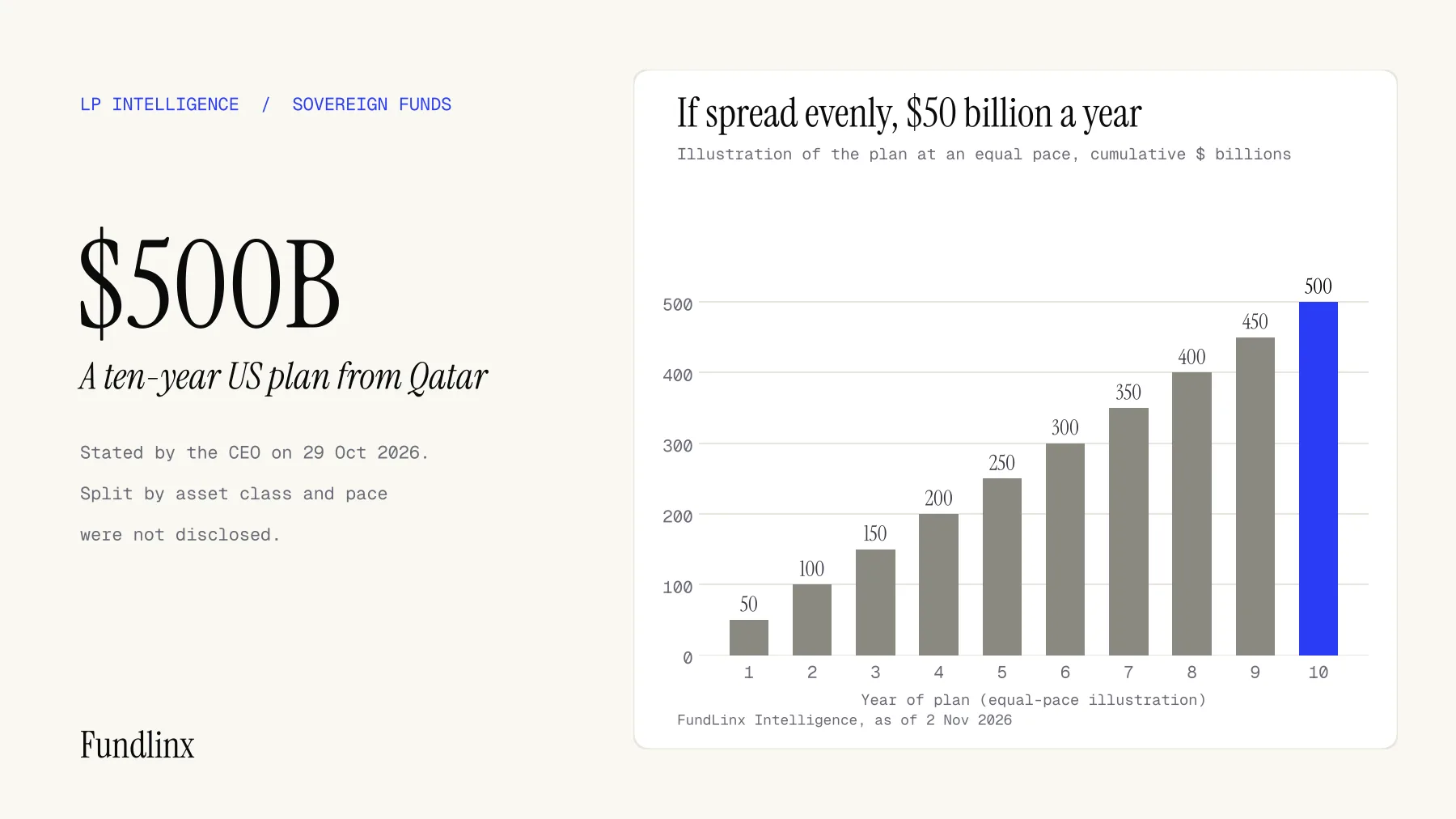
Qatar Investment Authority plans to invest $500 billion in the United States over the next ten years, its chief executive said at a CNN event in Doha on 29 October 2026. Mohammed Saif Al Sowaidi called the US one of the fund's most important destinations because of the size of its economy, the depth of its financial markets and its lead in innovation. The headline figure is not new, since the plan was first announced in 2025, but the fresh remarks name the asset classes it covers, which is what a GP raising capital needs to know.
What was said
Al Sowaidi said the opportunities the fund sees in the US run across public and private equities, private credit, technology and innovation. He described the fund as a long-term investor that offers patient, stable capital and the ability to build partnerships with companies and investment institutions. On his priorities since taking the role, he said a main aim was to prepare for expanded LNG production and the revenue growth expected from it, and the task now is to deploy those revenues through diversified investments while keeping safety margins and reserves in place.
The numbers
The plan is $500 billion over ten years. Spread evenly, that is $50 billion a year, which is our own arithmetic and not a schedule the fund has published. The announcement does not split the total between public equities, private equity, private credit and technology, and it does not say how much has already been deployed, so we cannot say what share of the $500 billion is private markets, either as a percentage of capital or of the number of commitments. Any claim about the private equity portion is unsupported until the fund discloses it.
How it compares
Set against peers, the pace is large. We reported that Mubadala's CFO said it will keep deploying about $39 billion a year across its portfolio, and that MENA sovereign funds deployed $102 billion across 245 deals in nine months, with 45% going to the US. A $50 billion average for the US alone would be roughly 1.3 times Mubadala's stated annual pace, but the two figures differ in scope, since one is a US-only plan and the other covers a whole portfolio, so treat the ratio as a scale marker only.
The named LP
Qatar Investment Authority is the sovereign wealth fund of Qatar, and its LP profile sits among the sovereign wealth funds on FundLinx. We recently reported that it added Activate Capital as the 13th manager in its $3 billion fund of funds, which shows one route by which smaller managers reach it. The latest remarks do not give AUM, a typical ticket or whether the fund backs first-time funds beyond that program, so we do not estimate those figures or offer a Fund I or Fund II view.
What a GP should do
This section is our advice, not guidance from the fund. First, read the statement as direction, not as an open mandate, because a plan of this size spread across public and private assets says little about how many new managers will be added. Second, if you run a US strategy in private equity or private credit, build a short note that explains how your fund fits the themes named, and state the minimum ticket you need, since in our reading a sovereign deploying billions a year is likely to favour larger tickets. Third, look at the fund-of-funds route and at co-investment alongside managers it already backs, which our note on how to map warm paths through the platforms an LP already backs describes for another sovereign. Fourth, expect questions on governance and reporting from a long-horizon investor, so prepare them in advance. Fifth, ask early about reporting and co-investment terms, because a sovereign of this size often wants information rights that smaller LPs do not. Sixth, avoid quoting the $500 billion figure back to the fund as if it were a pool waiting for you, because it is a plan across asset classes.
Why the restatement matters
A figure that is already public can still move a market when the investor adds detail. The fund's chief executive tied the plan to the revenue growth expected from expanded LNG production, which suggests the money behind it is long-dated state income and not a one-off allocation. He also said the fund must manage the link between fiscal and investment policy and keep safety margins and reserves, which is a reminder that a sovereign balances deployment against its home budget. For a GP, that argues for a patient approach: this investor is describing a decade, not a quarter.
What to watch next
Watch for the fund's annual disclosures on how much of the plan has been deployed, for further additions to its manager roster, and for any sign of a change in the pace of the plan. In the same fortnight, a separate group of sovereign and state investors announced a private equity fund for Central Asia and the Caucasus, which shows the wider pattern of state capital moving into private markets. FundLinx members can see which institutions are allocating in your strategy.
FundLinx Intelligence | FundLinx.ai
Playbooks, LP moves and compliance notes for emerging managers. Unsubscribe any time.