Oman, China, Uzbekistan and Turkey's OYAK Join the Eurasian Development Bank to Launch a Central Asia and Caucasus Private Equity Fund
Six investors, among them China's CIC, Oman's wealth fund and Turkey's OYAK, announced a private equity fund for Central Asia and the Caucasus. Fund size and stakes were not disclosed.
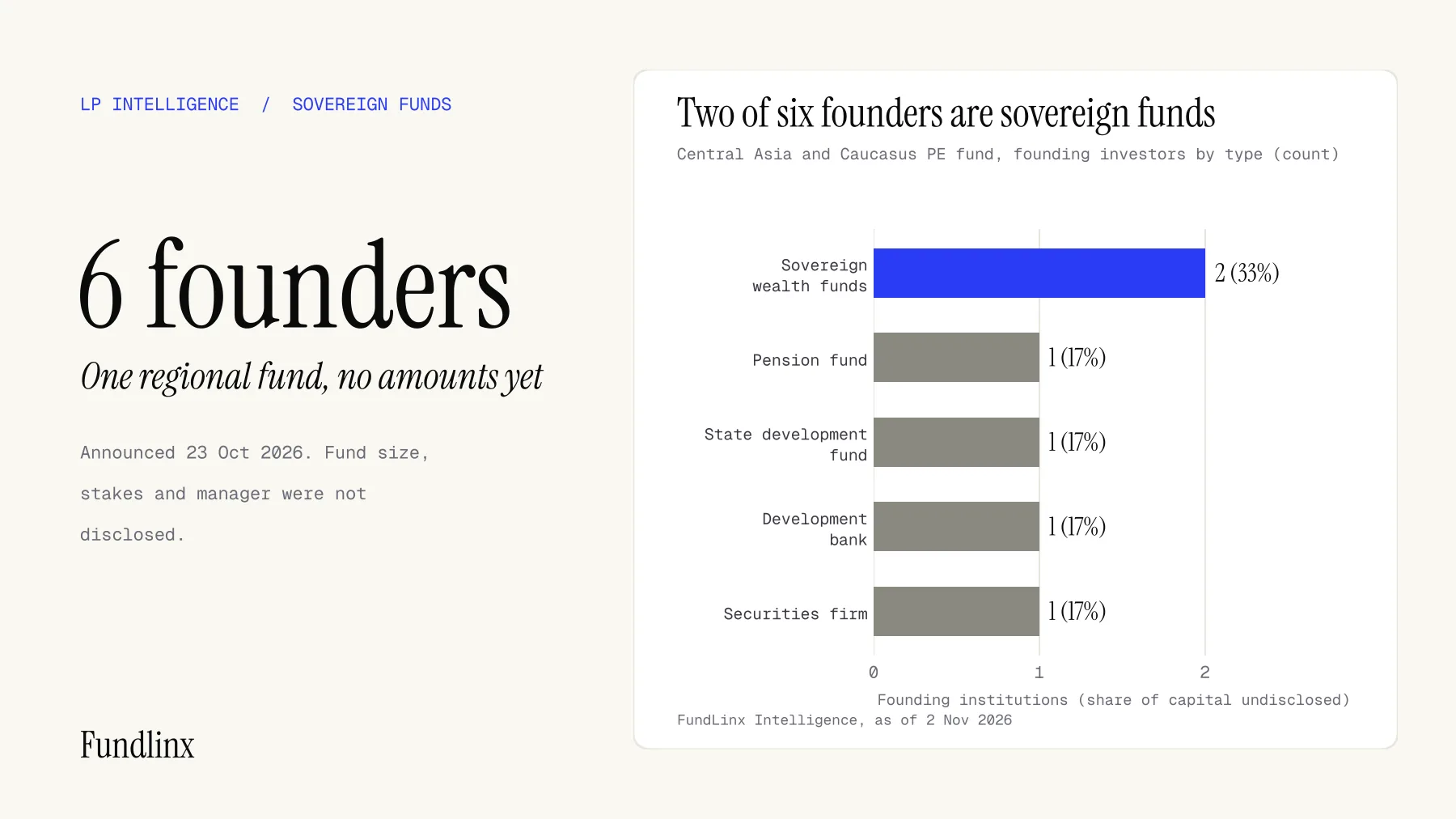
Six institutions announced plans on 23 October 2026 for a new Central Asia and Caucasus Private Equity Fund. The Eurasian Development Bank said it is a co-founder alongside China Investment Corporation, Oman Investment Authority, the Uzbekistan Fund for Reconstruction and Development, Turkey's OYAK pension fund and Shenwan Hongyuan Securities. The announcements we reviewed give no fund size, no stake for each investor, no manager and no domicile, so this is an early signal and not yet a fundraise a GP can pitch.
What was announced
The fund is described as proposed, with a stated aim of investing in companies in Central Asia and the Caucasus. Daniyar Imangaliyev, a deputy chairman of the bank's management board, said companies in the region need long-term capital to expand and enter new markets, and that taking part is one way for the bank to bring additional resources into the economies of its member states. The bank also said the initiative fits its strategy for 2027 to 2031. The statement was issued jointly by the institutions, and the amount each is putting in was not disclosed.
The numbers
Because capital is undisclosed, we cannot give a split by dollars, so we show the founders by count. Of the six founding institutions, two are sovereign wealth funds (China Investment Corporation and Oman Investment Authority), which is 33% of the count. The other four each make up 17%: a Turkish pension fund, a state development fund from Uzbekistan, a multilateral development bank and a securities firm. Share of capital is unknown for every member, and the count says nothing about who holds the largest stake or who will choose the manager.
How it compares
The mix is notable because it puts a Chinese and a Gulf sovereign beside a pension fund and a development bank in a single vehicle. Our earlier notes show how large each pool already is: sovereign funds put $14.2 billion into China and Hong Kong in nine months, and MENA sovereign funds deployed $102 billion across 245 deals over the same kind of nine-month window. Those figures are not comparable in scope to this fund, which has no disclosed size, but they show that the capital behind the founders is real.
Against recent weeks, this fits a pattern of state-linked capital building shared platforms. We have covered Norway's wealth fund adding a new logistics partner, Apollo taking a stake in Mubadala's manager arm, and Qatar's sovereign adding a manager to its fund of funds. What is different here is the number of parties: six institutions from at least four jurisdictions are putting their names to one vehicle before a manager has been chosen.
The named LPs
China Investment Corporation and Oman Investment Authority are state-owned sovereign investors that appear regularly in our coverage of global private markets. OYAK is a Turkish pension fund. The Uzbekistan Fund for Reconstruction and Development is a state fund, and the Eurasian Development Bank is a development bank owned by its member states. Shenwan Hongyuan Securities is a securities firm. The announcements do not state AUM, past commitments, typical tickets or whether any member backs first-time funds, so we offer no Fund I or Fund II view and make no estimate of those figures. It is also not stated whether the securities firm will invest its own capital or act in another role, so we count it as a founding investor only because the announcements list it as a co-founder.
What a GP should do
This section is our advice, not guidance from the founders. First, treat the news as an early marker and not a call for managers, because no manager has been named. Second, if your strategy already invests in Central Asia or the Caucasus, document your regional track record, local partners and exits now, since a six-member consortium will ask for evidence that it can compare across investors. Third, expect more than one decision maker: a development bank, two sovereigns, a pension fund and a securities firm may each weigh sanctions, governance and reporting differently, so prepare clear answers on each. Fourth, think about co-investment alongside the vehicle once it is formed, since co-investors tend to be the first managers a new regional fund meets. Fifth, prepare for a long process, since a vehicle with six founders and no named manager is likely to take time to agree its terms, and a GP that is patient and well documented will be easier to shortlist than one that pushes early. Sixth, keep a clean record of any past dealings with the founders, such as co-investments or advisory work, because a consortium tends to cross-check references among its members. Our companion note on how to map warm paths through a consortium of LPs sets out how to approach each member.
What to watch next
Watch for the formal establishment of the fund, the size and the appointment of a manager, and for whether further investors join the six. FundLinx members can see which institutions are allocating in your strategy.
FundLinx Intelligence | FundLinx.ai
Playbooks, LP moves and compliance notes for emerging managers. Unsubscribe any time.