Michigan's Endowment Returns 20.7% and Grows to $25 Billion, but Its Payout Grew Only 5.8% to $569 Million
Michigan's endowment returned 20.7% and grew to $25 billion, while distributions rose 5.8% to $569 million. What the gap between value and payout means for a GP approaching the university.
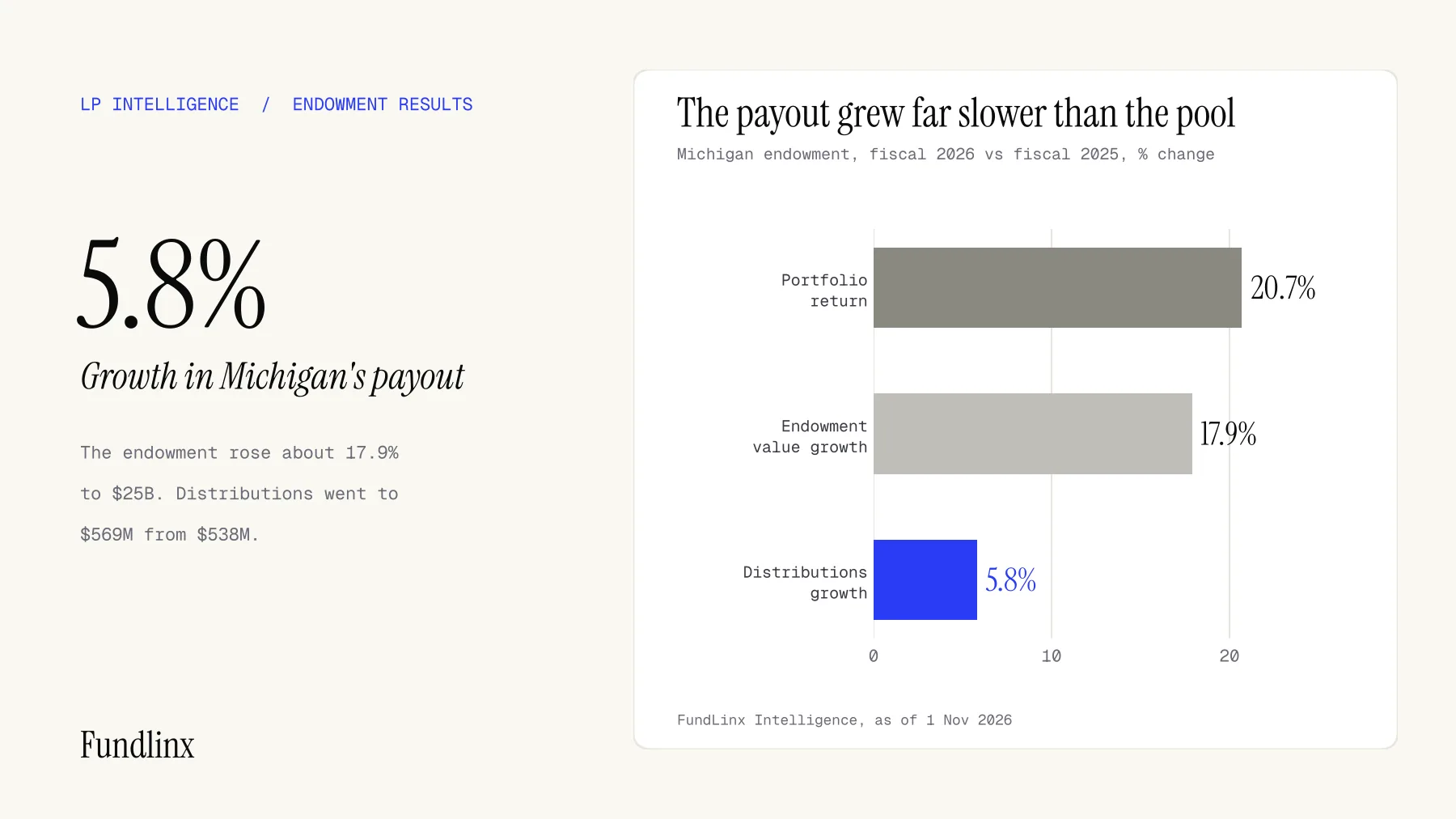
The University of Michigan said on 19 October 2026 that its endowment grew to $25 billion in fiscal year 2026, up from $21.2 billion a year earlier, as its long-term investment portfolio returned 20.7%. Distributions to the university rose to $569 million from $538 million. On our arithmetic the endowment's value rose about 17.9% while distributions rose 5.8%, and that gap is what a GP should study before approaching a public university's endowment.
What was announced
The university said the 20.7% return adds to a record that ranks among the top five of all endowments over the past 10 years and the top 10 over the past 20 years, according to Cambridge Associates. Chief Investment Officer Erik Lundberg said long-term performance continues to outpace inflation and spending combined, which preserves the endowment's purchasing power for future students, patients and researchers. Executive Vice President and Chief Financial Officer Bobby Hewlett said the endowment provides hundreds of millions of dollars a year for scholarships, patient care, teaching and research. The university said the endowment ranks ninth in the nation by size and 85th on a per-student basis, using rankings that include private peers with similar or larger endowments. A detailed investment report is due later this year.
The numbers
The endowment's value rose by $3.8 billion, from $21.2 billion to $25 billion, which is about 17.9%. The 20.7% return is higher than the 17.9% growth in value, and the announcement does not itemise the flows that explain the difference. Distributions rose by $31 million, or 5.8%. Last year's announcement said the endowment climbed $2 billion to $21.2 billion, which implies an opening value of about $19.2 billion, so on our arithmetic distributions equal about 2.7% of this year's opening value against about 2.8% a year ago. Since the start of fiscal year 2000 the endowment has distributed $7.9 billion.
The university gave four shares of fiscal 2026 distributions: 30% to scholarships, 22% to patient care, 23% to teaching and 15% to research. In dollars that is about $171 million, $125 million, $131 million and $85 million. The four shares add to 90%, and the announcement does not say what the other 10% supports. Last year's shares were 29%, 23%, 23% and 15%.
Against the prior year, the return rose 5.2 points from 15.5% in fiscal 2025. In that year the university said the portfolio had returned 9.8% annualised since it set up a separate investment office, a record it placed in the top quartile of university endowments.
How it compares
Michigan's 20.7% is above Ohio State's 16.03%, another large public university, and below Penn's 27.4% and the 26% at Bowdoin, which we cover today. Scale is very different: Michigan's $25 billion is about seven times Bowdoin's $3.6 billion. As ever, this compares the pieces we chose to cover and is not a ranking of all endowments.
The named LP
The University of Michigan's endowment is a US public university pool of $25 billion at 30 June 2026, run by an investment office under Lundberg. Its LP profile sits among the endowments on FundLinx. Last year the university said the endowment is a collection of about 13,500 separate funds, mostly restricted by donors for specific purposes, and that its student body is far larger than at private peers with similar endowments. Lundberg said then that investments in innovation and climate-friendly solutions had positively affected returns. The latest announcement gives no asset mix, pace of commitments, typical ticket or view on first-time funds, so we offer no Fund I or Fund II view and estimate none of those figures.
What a GP should do
This section is our advice, not guidance from Michigan. First, treat the announcement as context, not as evidence of open mandates; it mentions no commitments. Second, read the payout as smoothed. Distributions grew a third as fast as value, which suggests a spending rule that does not chase a good year, though the announcement does not describe the rule. Pitch steady, repeatable cash, not a windfall. Third, expect a high bar: the university places its record among the top five over 10 years, so show net returns clearly and be ready to explain how your fund adds to a portfolio that already performs well. Fourth, if your strategy touches innovation or climate solutions, say so plainly, since the CIO has named both as contributors to returns. Fifth, look for a warm route through managers the university already backs and ask for an introduction before a cold note. Sixth, keep any note short and state your strategy and fund number in one line.
What to watch next
Watch for the detailed investment report the university says will follow later this year, which may give the asset mix the announcement leaves out, and for the next annual results, which came in October in both 2025 and 2026. FundLinx members can see which institutions are allocating in your strategy.
FundLinx Intelligence | FundLinx.ai
Playbooks, LP moves and compliance notes for emerging managers. Unsubscribe any time.