Apollo Takes a Minority Stake in Mubadala Capital, and Expects $5 Billion of Commitments to Its Strategies at Initial Close
Abu Dhabi's Mubadala Capital will add Apollo and other strategic investors as minority shareholders, and expects $5 billion of commitments to its strategies at initial close. Details undisclosed.
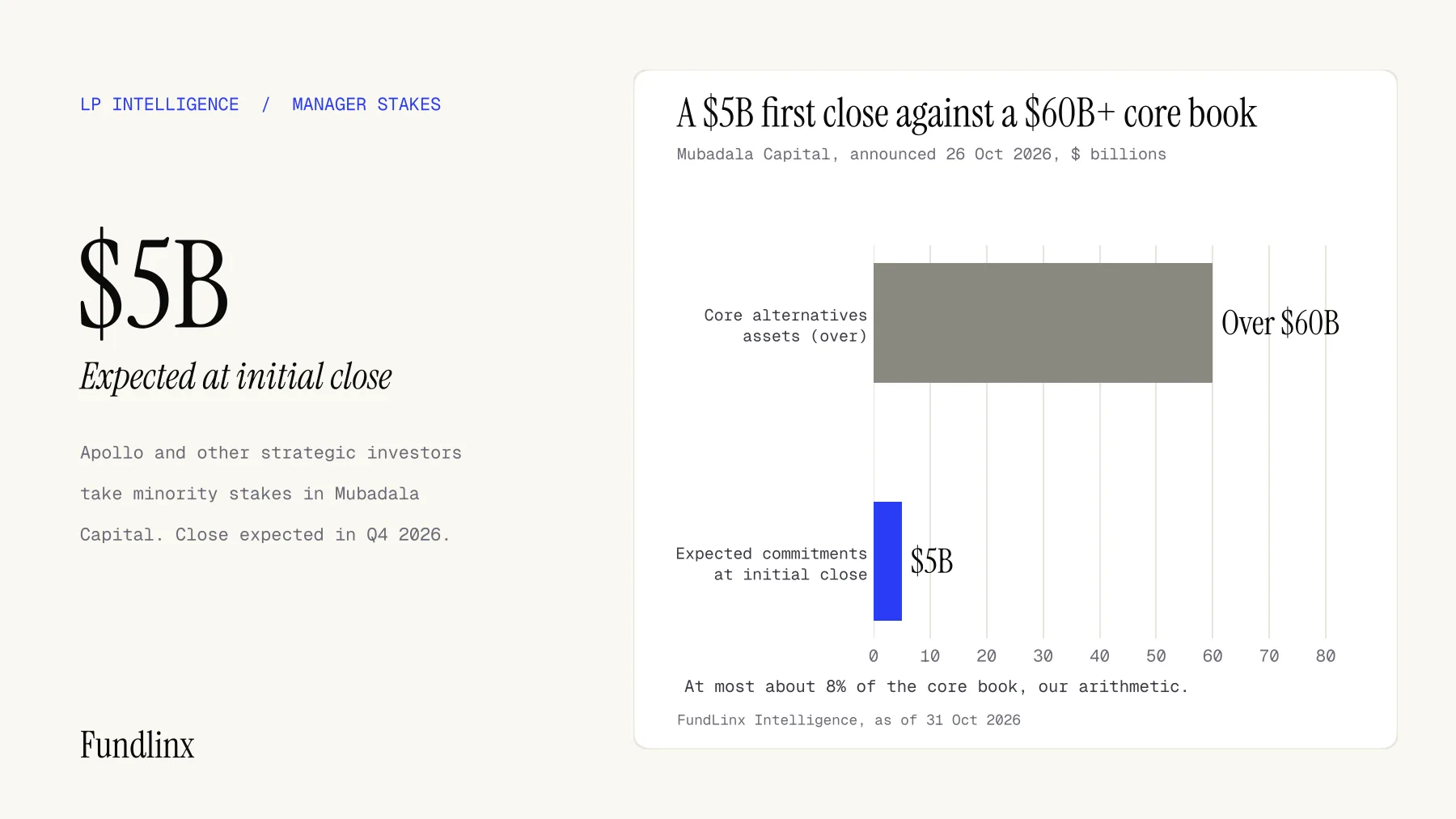
On 26 October 2026 Mubadala Capital, the alternative asset management arm of Abu Dhabi's Mubadala Investment Company, announced a strategic investment from Apollo. Apollo will take a minority equity stake and commit capital across Mubadala Capital's investment strategies. Additional strategic investors will join as minority shareholders and, together with Apollo, are expected to commit an aggregate $5 billion to those strategies at initial close. The stake, the price and each investor's commitment were not disclosed, and the deal is expected to close in the fourth quarter of 2026, subject to regulatory and legal approvals. For a GP, the story is about where a major sovereign's capital will come from and go to, and who else is now beside it.
What was announced
Mubadala Capital was founded in 2011. The announcement says its core alternatives business manages more than $60 billion across five investment strategies, and that Apollo's investment will help it broaden its investor base, expand its strategies and pursue opportunities globally. Apollo joins the founders of Silver Rock Financial as an equity holder, and Mubadala Investment Company remains the majority shareholder. After the new shareholders arrive, Mubadala Capital will keep its own governance structure, with its existing management retaining full authority over investment decisions and operations. Hani Barhoush, its chief executive, described Apollo as a trusted partner, and John Zito, co-president of Apollo Asset Management, said Mubadala has helped seed and scale a number of Apollo's strategies over the years. The announcement also cites a much larger figure, more than $755 billion, for assets that Mubadala Capital manages, advises or administers for clients and limited partners across its core business and strategic partnerships, so we use the $60 billion core figure when comparing sizes.
The numbers
Two numbers carry the story. The first is the $5 billion of expected commitments at initial close, which is an aggregate for Apollo and the other strategic investors and not a figure for Apollo alone. The second is the more than $60 billion of core alternatives assets. On our arithmetic, $5 billion is at most about 8% of the core book, and less if the core figure is higher than the stated floor. Apollo reports about $1.05 trillion of assets under management at 30 June 2026, roughly 17 times Mubadala Capital's core figure (our arithmetic). The stake size, the valuation and the commitment from each investor are not in the announcement, and we do not estimate them.
How it compares
This is the third story in our recent coverage that links an institutional investor to a manager's ownership, though the direction differs. We covered OMERS taking an indirect minority stake in Australia's La Trobe Financial, and Meiji Yasuda's plan to lift its Man Group commitment and weigh a 5% stake in the manager. In those two cases an LP buys into a manager. Here a manager buys into the asset management arm of a sovereign investor. Three stories are a count of what we chose to cover and not a measure of market-wide activity. Earlier this month we also covered Mubadala's CFO saying it will keep deploying about $39 billion a year, which is the parent's pace and a different subject from this deal.
The named LP
Mubadala Investment Company is an Abu Dhabi sovereign wealth fund and the majority owner of Mubadala Capital. Its LP profile is part of our coverage of sovereign wealth funds. Mubadala Capital has more than 250 professionals in Abu Dhabi, London, New York, Rio de Janeiro and San Francisco, and its core strategies span private equity, special opportunities with a focus on Brazil, credit, venture capital, and solutions and co-investment platforms. The announcement does not give ticket sizes, does not say whether the group backs first-time managers, and does not say how it will split the new capital across strategies, so we offer no Fund I or Fund II view.
What a GP should do
This section is our advice, not guidance from Mubadala or Apollo. First, decide which Mubadala you are approaching: the parent as an investor, or Mubadala Capital as a manager that may be a partner or a competitor, since the announcement keeps their governance separate. Second, if your strategy overlaps one of its five, expect a sophisticated peer in the room and be ready to explain what you do differently. Third, if you run a co-investment or solutions-style offering, note that these are named platforms inside the group. Fourth, map shared relationships with Apollo, because the announcement describes a history of seeding and scaling strategies together. Fifth, do not read the $5 billion as a sign that your own mandate is open: the money goes to Mubadala Capital's strategies.
What to watch next
Watch for the fourth-quarter close, for the names of the other strategic investors, and for whether the $5 billion figure is confirmed at initial close. For a practical guide to approaching this kind of investor, see our GP playbook on pitching Mubadala while its own platform raises capital. FundLinx members can see which sovereign investors are active in your strategy.
FundLinx Intelligence | FundLinx.ai
Playbooks, LP moves and compliance notes for emerging managers. Unsubscribe any time.