Meiji Yasuda Plans to Lift Its Man Group Commitment to JPY 200 Billion, About $1.25 Billion, and Weighs a 5% Stake in the Manager
Japan's Meiji Yasuda plans to raise its commitment to Man Group's strategies to about $1.25 billion over three years, focused on private credit, and is weighing a stake of about 5% in the manager.
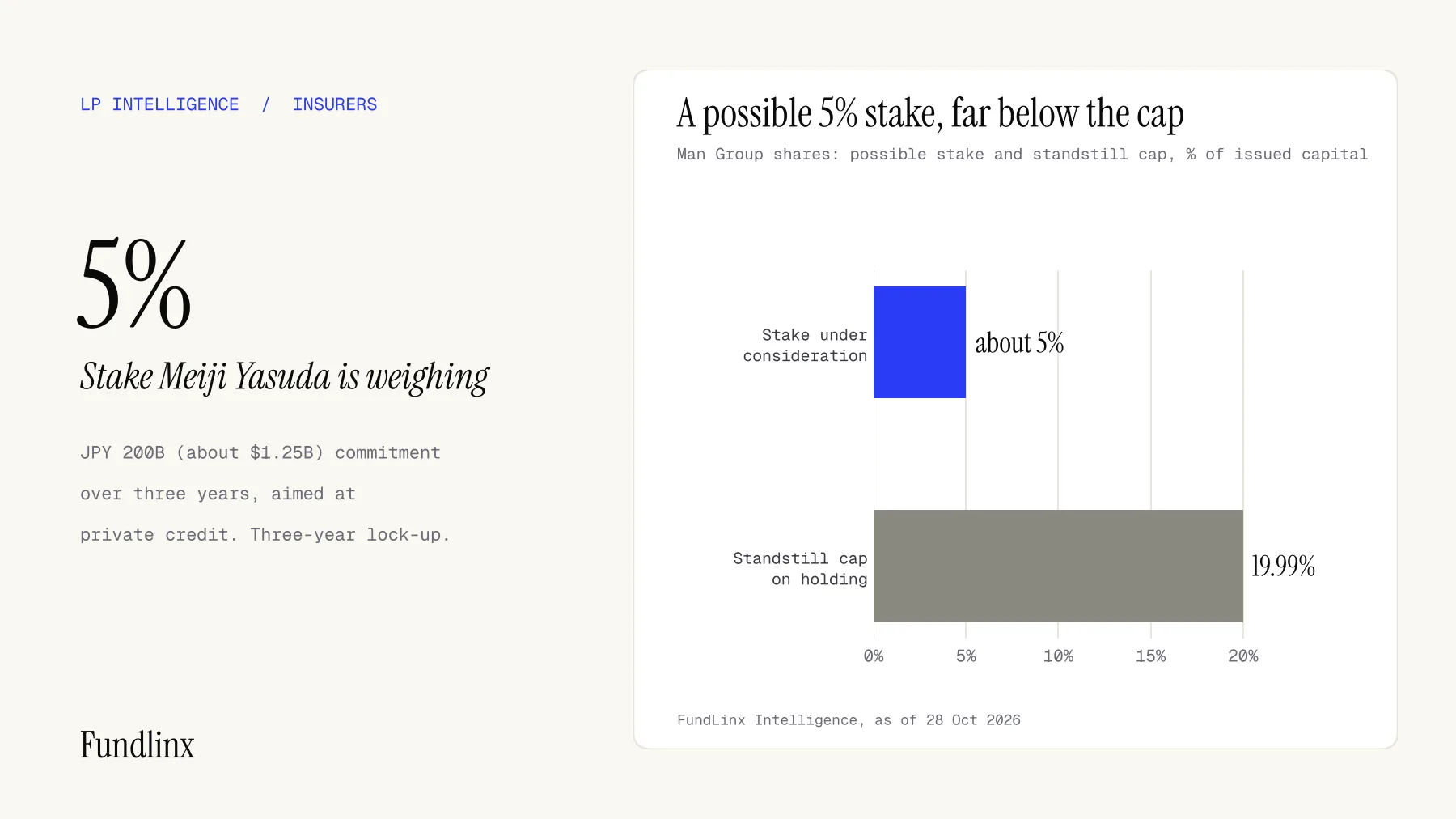
Meiji Yasuda Life Insurance Company said on 26 October 2026 that it intends to raise its capital commitment to Man Group's investment strategies to JPY 200 billion, about $1.25 billion, over the next three years, with the focus on private credit. The two firms also said Meiji Yasuda will consider buying about 5% of Man Group on the open market. For a fund manager raising money from institutions, the notable part is the shape of the deal: an insurer is pairing a large multi-year allocation with a preferred-partner role and a possible shareholding, instead of simply writing a bigger cheque into a fund.
What was announced
The expansion builds on a partnership the two firms announced in February 2025. The announcement did not state the earlier commitment, so we cannot say how much of the JPY 200 billion is new money and how much is capital already placed. Beyond the commitment, the firms will co-develop new products for the Japanese market, Man Group becomes a preferred asset management partner for the insurer, and Meiji Yasuda gains access to the Oxford-Man Institute for investment advisory services and knowledge sharing, including on technology. The proposed stake has limits. Man Group would issue no new shares, any purchase would be subject to a three-year lock-up from the date of the agreement, a standstill would cap Meiji Yasuda's holding at 19.99% of issued share capital, and orderly market arrangements would govern any later sale. The arrangements can be terminated in certain circumstances, and financial terms were not disclosed. Man Group's shares rose 3.8% after the announcement, according to market reports.
The numbers
Man Group reported assets under management of $270.9 billion at 30 September 2026. Against that figure, the $1.25 billion commitment equals about 0.46% of the manager's assets, and a 5% shareholding would be one quarter of the 19.99% ceiling. Both are our arithmetic. The commitment is spread over three years and aimed at private credit, so it should not be read as a share of one fund or one year. We cannot compare by count: the announcement does not say how many strategies or funds the commitment will cover, so a percentage of strategies would be a guess.
How it compares
Insurers are a major LP type in private credit. A survey of 463 insurers released on 27 October, which we covered in our market view of insurer private markets plans, found that 76% expect to increase private markets allocations over the next 12 months, down from 94% a year earlier, and that 41% name private debt as the area to grow. Meiji Yasuda's plan sits in the part of that picture where an insurer picks a small number of managers and goes deep. It is also a different model from the one Norway's wealth fund used days earlier, when it committed €1.5 billion to a logistics partnership with Ares and took 96% of the equity. There the LP took almost all of a dedicated vehicle. Here the LP spreads a commitment across a manager's strategies and considers a minority stake in the manager itself.
The named LP
Meiji Yasuda Life Insurance Company is a Japanese life insurer. Its president and group chief executive, Hideki Nagashima, described Man Group as an important partner with extensive expertise in quantitative investment management. The announcement did not give the insurer's assets or its current private credit allocation, so we do not either. What it does show is how the insurer prefers to work: a preferred partner, a joint product plan and now a possible equity link, which is the profile of an LP that concentrates rather than spreads. Nothing in the announcement suggests it backs first-time managers in this strategy.
What a GP should do
This section is our advice, not guidance from Meiji Yasuda or Man Group. First, read a preferred-partner structure as a signal about capacity, not about interest. An insurer that names one partner for private credit is telling other managers that a new relationship has to earn its place beside it, so a pitch should say what the insurer cannot get from its partner: a different geography, sector or part of the credit market. Second, expect product questions. The two firms plan to co-develop products for Japanese investors, which suggests Japanese insurers may value managers that can adapt structure, reporting and currency terms, not only manage the assets. If you already have a currency-hedged share class, a feeder or a reporting pack built for a Japanese investor, say so early. Third, learn from the alignment terms. A lock-up, a standstill and an orderly-disposal clause are tools a manager can offer a large investor, and a platform raising from a few big insurers should decide in advance which of them it would give a stake or a co-investment right. Fourth, do not assume appetite follows the headline: a JPY 200 billion plan runs over three years and is aimed at one manager's strategies. To find who else sits beside an insurer, see our earlier piece on mapping warm paths through the health systems, insurers and pensions that back the same fund, and for the pitch itself our playbook for an insurer that wants a bespoke mandate.
What to watch next
Watch for any disclosure of open-market purchases toward the 5% level, for the first jointly developed products for Japanese investors, and for whether other Japanese insurers announce comparable preferred-partner terms. FundLinx members can see which institutions are active in your strategy.
FundLinx Intelligence | FundLinx.ai
Playbooks, LP moves and compliance notes for emerging managers. Unsubscribe any time.