Yale's Endowment Returns 26.3% and Reaches $54.5 Billion, but Owes Roughly $900 Million of Tax on the Year's Gain
Yale's endowment gained 26.3% in the year to June, adding $11.3 billion to reach $54.5 billion. A roughly $900 million tax bill on that gain shapes what GPs should say to its investment office.
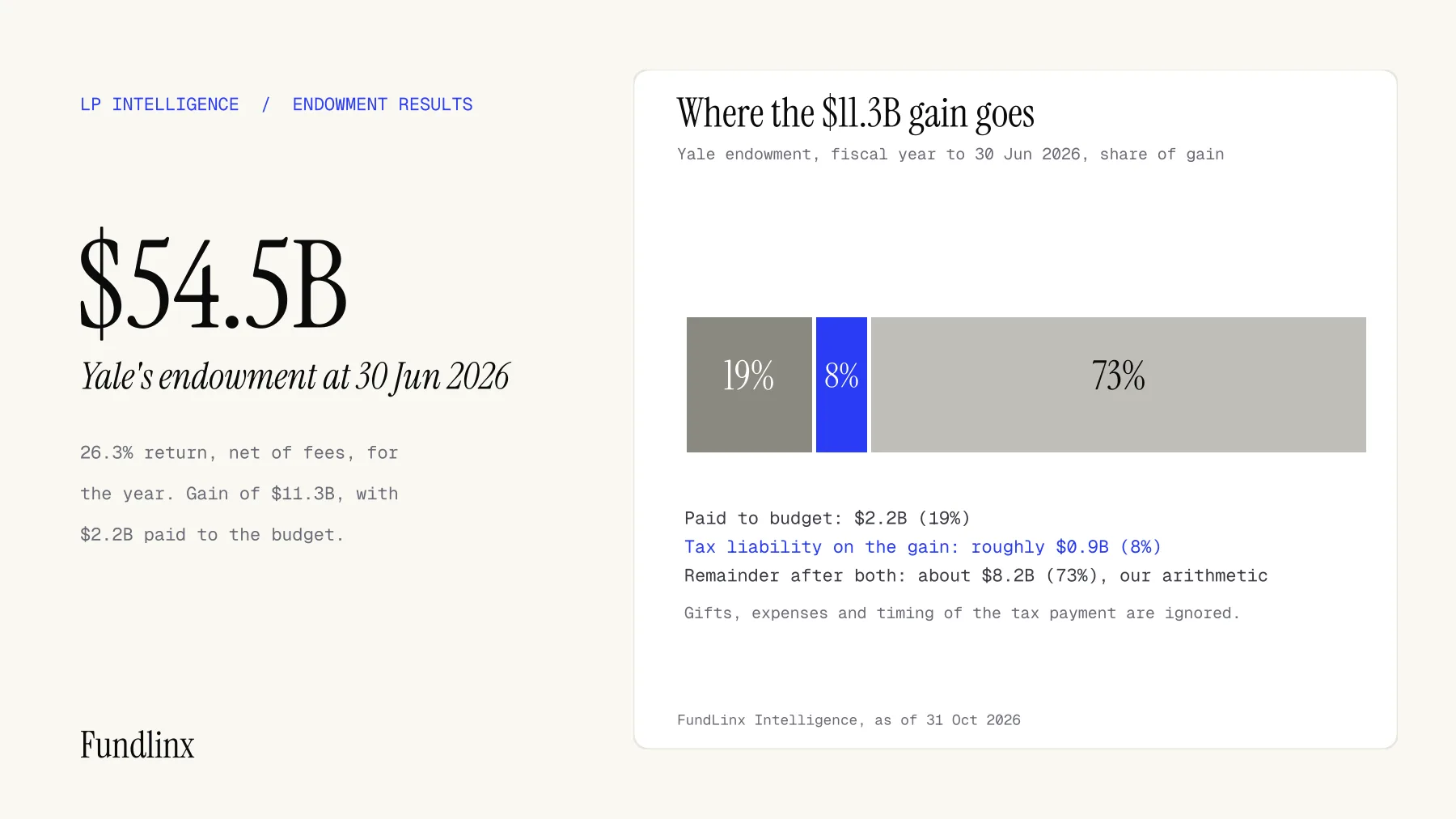
Yale University announced on 27 October 2026 that its endowment returned 26.3%, net of fees, in the year to 30 June 2026, an investment gain of $11.3 billion. After $2.2 billion of distributions to the university's operating budget, the value of the endowment rose to $54.5 billion. The same announcement said Yale is newly subject to an 8% federal endowment tax and that the tax liability tied to this year's gain is roughly $900 million. For a GP, the headline return matters less than what a large, taxed and spending-dependent investor does with a year like this one.
What was announced
Matt Mendelsohn, Yale's chief investment officer, called the result welcome "at a time of uncertainty across the landscape of higher education", thanked his team and investment partners, and cautioned that any single year matters only as a step toward long-term goals. Yale's spending policy is designed to shield the budget from market swings, so this return will be folded into the operating budget gradually, starting with the fiscal 2028 budget that begins on 1 July 2027. About 75% of the endowment's thousands of funds are restricted, meaning donors designated them for specific purposes. The endowment supplies 35% of Yale's operating revenue, including 62% of the budget of Yale College.
The numbers
The announcement gives a gain of $11.3 billion, distributions of $2.2 billion and an ending value of $54.5 billion. From those three figures we calculate an opening value of about $45.4 billion, which ignores gifts and rounding. On our arithmetic the $2.2 billion paid to the budget equals about 19% of the year's gain and roughly 4.8% of that opening value, while the roughly $900 million tax liability equals 8% of the gain, which matches the stated rate. That leaves about $8.2 billion, or 73% of the gain, after distributions and the tax liability. The liability is also equal to about 41% of the amount paid to the budget this year, which shows why a taxed investor watches cash as closely as it watches marks. The longer record is strong too: over the decade to 30 June 2026 the endowment returned 11.7% a year, which Yale estimates is 1.6 points a year above the median 10-year return for college and university endowments and 2.7 points above a typical 70/30 stock and bond portfolio. A year earlier the endowment returned 11.1%, so fiscal 2026 was 15.2 points higher (our arithmetic).
How it compares
Among the endowments we have covered for fiscal 2026, Yale's 26.3% sits just below Harvard's 27.1% and $68 billion, and above Princeton's 23.7% and Dartmouth's 17.5%. Stanford's merged pool, at 31.7%, was higher still. That is a comparison of the pieces we chose to cover, not a ranking of all endowments, and the spread between the strongest and weakest of them is wide. What many of them share is the tax: we recently looked at how Brown's endowment is heading into the 4% excise tax tier, and Yale now says it is subject to the 8% rate. A strong year raises the tax bill along with the balance, so the net gain per dollar of paper profit is lower than the headline suggests.
The named LP
Yale's endowment, run by the Yale Investments Office under Mr. Mendelsohn, is a US university endowment of $54.5 billion at 30 June 2026. Its LP profile sits among the endowments on FundLinx, alongside the other universities named above. The announcement does not give the endowment's asset mix, its pace of new commitments, its typical ticket or whether it backs first-time funds, so we offer no Fund I or Fund II view and do not estimate those figures.
What a GP should do
This section is our advice, not guidance from Yale. First, read the announcement as context for a conversation, not as a sign of open mandates: nothing in it mentions new commitments. Second, expect a taxed investor to care about what it keeps, so make your net returns easy to find and show realised cash alongside unrealised value, including DPI on a net basis. If your fund has returned capital recently, say how much and when, because cash is what funds both a payout and a tax bill. Third, remember that the gain reaches the budget only from fiscal 2028, which suggests the university is smoothing and not spending a windfall, though that is our reading. Fourth, keep any note short and anchored in fact, since the investment office has just completed its annual reporting. Fifth, state your strategy and fund number in one line, so the reader can tell at once whether it fits a programme that the announcement describes only in the most general terms. Sixth, check your own network for people who have worked with the office, and ask for an introduction before sending a cold note.
What to watch next
Watch first for the start of the fiscal 2028 budget on 1 July 2027, for any change Yale makes to how it describes its portfolio, and for further endowment results from peers in coming weeks. FundLinx members can see which institutions are allocating in your strategy.
FundLinx Intelligence | FundLinx.ai
Playbooks, LP moves and compliance notes for emerging managers. Unsubscribe any time.