Ontario Teachers' Gives the Head of Its C$25.9 Billion Venture Growth Arm the Asia-Pacific Role From 1 January 2027
Ontario Teachers' will add Asia-Pacific to the remit of the executive who runs Teachers' Venture Growth, a book that grew 69% in six months to C$25.9 billion, 9% of net investments.
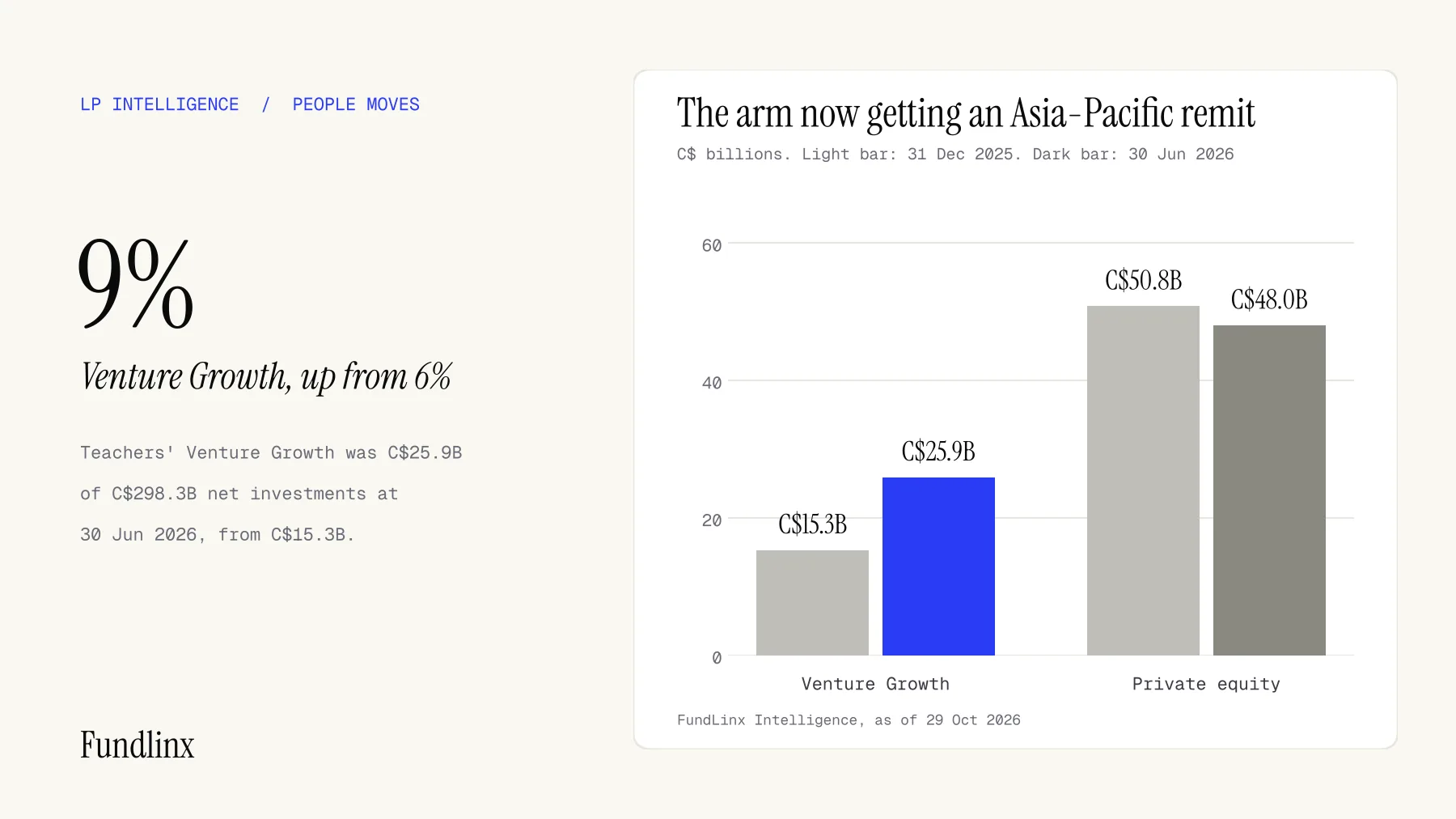
Ontario Teachers' Pension Plan announced on 22 October 2026 that Olivia Steedman, who has led its Teachers' Venture Growth arm since 2019, will also take charge of the plan's investing in Asia-Pacific from 1 January 2027. Her new title is executive managing director of Teachers' Venture Growth and head of Asia-Pacific, based in Singapore, and the plan described it as a newly established dual role. For a fund manager raising from pension funds, the title matters less than the book behind it: the venture growth portfolio grew by 69% in the first half of 2026, the largest percentage rise of any asset class the plan reports, and one executive will now answer for that book and for the region.
What was announced
Ms. Steedman keeps responsibility for Teachers' Venture Growth, which the plan calls its innovation investing arm, and adds oversight of investing activities and portfolio management across Asia-Pacific. She has more than 20 years of experience across asset classes and began in senior roles in infrastructure and natural resources, having joined the plan in 2002 as a founding member of that group. Stephen McLennan, Chief Investment Officer, Asset Allocation, said she is well positioned to lead the new dual role. The announcement did not name a predecessor in the regional seat, did not give the size of the plan's Asia-Pacific portfolio and did not describe any change to its offices or teams, so we do not either.
The numbers
The plan's first-half results, published on 10 August 2026, show how large the book is. Net assets were C$303.2 billion at 30 June 2026, up from C$279.4 billion at the end of 2025, after a 9.5% net return for the six months. Teachers' Venture Growth stood at C$25.9 billion at 30 June, reported as 9% of net investments of C$298.3 billion. At 31 December 2025 it was C$15.3 billion, reported as 6% of C$272.6 billion. That is a rise of C$10.6 billion, or 69%, in six months (our arithmetic). The plan's table does not split the rise between investment gains and new capital. Private equity moved the other way, to C$48.0 billion, or 16% of net investments, from C$50.8 billion, or 19%. Added together, the two books were C$73.9 billion against C$66.1 billion, about 24.8% of net investments against 24.2% (our arithmetic), so the mix inside the private growth bucket changed far more than its total. Shares are of net investments, a base that nets out funding and other items, so asset class shares add to more than 100%. The plan does not report how many funds or companies sit in either book, so we cannot give a share by count.
How it compares
Leadership is changing at several large allocators for the start of 2027. We covered KENFO naming Daniel von Borries as its next chief executive and chief investment officer from 1 January 2027, and the plan's first-half release says Cathy Cranston becomes Ontario Teachers' board chair on the same date, when Steve McGirr retires. On the regional side, Mubadala's finance chief said Asia is now 13% of its portfolio, and in our same-day market view, sovereign funds put $14.2 billion into China and Hong Kong in nine months.
The named LP
Ontario Teachers' Pension Plan is a fully funded defined benefit plan in Canada serving 346,000 working members and pensioners, with net assets of C$303.2 billion at 30 June 2026. Jo Taylor is its president and chief executive. The plan's release named venture growth among the largest contributors to first-half returns. Nothing in the announcement or the results addresses ticket sizes or whether the plan backs first-time managers in this strategy, and we make no claim on either.
What a GP should do
This section is our advice, not guidance from the plan. First, if you invest in growth-stage companies with an Asia-Pacific angle, find out who now holds the combined seat and note that it starts on 1 January, so a first approach is best timed for after the new year or preceded by a short, specific note. Second, speak to both lenses in one pitch: how your strategy fits a venture growth book that has just grown fast, and what you offer in the region that a Singapore-based head can act on. Third, do not read a falling private equity share as closed doors, or a rising venture growth share as open ones. We do not know why the mix moved, and a buyout manager should ask about pacing before assuming capacity. Fourth, use a warm path rather than a cold email: shared co-investors or a mutual limited partner are the credible way into a plan that is reorganising a senior seat.
What to watch next
Watch for the role taking effect on 1 January, for any named appointments beneath Ms. Steedman in Asia-Pacific, and for the plan's next results to show whether venture growth keeps its larger share. FundLinx members can see which institutions are active in your strategy.
FundLinx Intelligence | FundLinx.ai
Playbooks, LP moves and compliance notes for emerging managers. Unsubscribe any time.