Dartmouth's Endowment Returns 17.5% and Reaches $10 Billion, but Its Five-Year Return Falls to 6.8% From 11.6%
Dartmouth's endowment returned 17.5% and reached $10 billion, but its five-year return slipped to 6.8% from 11.6%. What the numbers say and how a GP can use them.
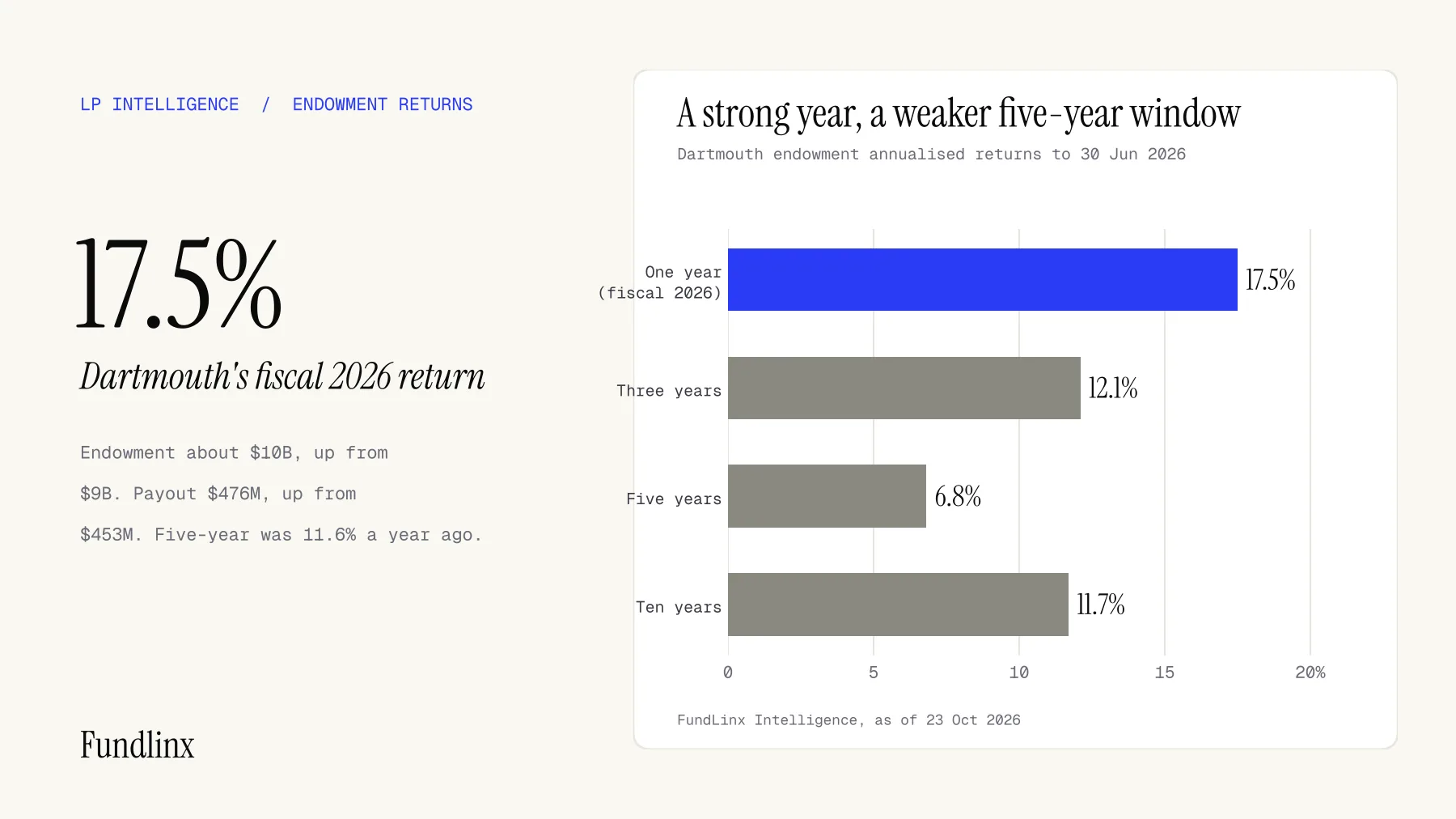
Dartmouth College's endowment returned 17.5% in the fiscal year that ended on 30 June 2026 and finished at about $10 billion, up from $9 billion a year earlier. The college reported the results on 20 October, alongside a $476 million distribution to its operating budget. The headline is strong, but the longer-term figures moved the other way: the five-year annualised return fell to 6.8% from 11.6% a year ago. Here is what the numbers show, what we infer from them and what a GP can do with them.
What changed
Investment committee chair Hadley Mullin reported the return to trustees at their October meeting and said it was well ahead of the portfolio benchmark, which the college did not publish. Annualised returns were 12.1% over three years, 6.8% over five years and 11.7% over ten years. Mullin said the ten-year figure beats the endowment's spending rate plus inflation and its benchmark, and ranks in the top decile of its peer universe. Chief financial officer Scott Frew said the stability of the endowment distribution is invaluable to the operating budget. The distribution was $476 million, up from a record $453 million in fiscal 2025, an increase of about 5%.
The numbers in context
Fiscal 2025 was a 10.8% year, so this year's return is 6.7 percentage points higher. The endowment grew about 11% in twelve months ($9 billion to $10 billion, both rounded) even after paying out more. The five-year line is the one to read carefully. A year ago the five-year annualised return was 11.6%; it is now 6.8%, while the ten-year figure rose from 9.7% to 11.7%. Our reading is that an unusually strong year dropped out of the five-year window, but the college has not said so, and we treat that as an inference.
Against the endowments we have covered this season, Dartmouth's 17.5% sits below Harvard's 27.1% return, Princeton's 23.7% and Brown's 19.6%, and above Ohio State's 16.03% and MIT's 10.3%. By count, two of those five (40%) returned less than Dartmouth and three (60%) returned more. We have not weighted by capital because we have not verified every endowment's value on the same date.
The named LP
Dartmouth is a US Ivy League college in Hanover, New Hampshire, and its endowment is run by an investment office with staff in Hanover and Boston. At 30 June 2025, the most recent breakdown we can verify, 39% of the portfolio was in private equity and venture capital, 23% in global equity, 23% in hedge funds, 9% in real assets and 6% in fixed income and cash. Its private equity and venture programme returned 16.7% a year over the ten years to June 2025. As reported, the college has paid a 4% excise tax on investment returns since fiscal 2026, up from 1.4% before. We found no public figure for Dartmouth's typical ticket size and nothing on whether it backs first-time funds, so we have not assumed either. For the wider type, see our list of endowments.
What a GP should do
This section is our advice, not guidance from Dartmouth. First, expect private markets to stay central. If the 39% share held through June 2026, which we do not know, it would be about $3.9 billion on a $10 billion endowment against about $3.5 billion a year earlier. That is arithmetic on rounded figures, not a reported number. Second, lead with distributions. An endowment that paid out $476 million and faces a higher tax bill will care about when capital comes back, so put realised returns, your distribution history and a realistic timeline for returning capital ahead of unrealised marks. Third, anchor on the long-term record. The investment committee chair used the ten-year figure as the test that matters, so show your own record over a full cycle and not only the latest year. A fund that looks strong in one vintage but weak over five years will draw questions from an office that watches the longer window.
A checklist before you approach a taxed endowment
Again, this is our advice. Can you explain in two sentences how your fund's cash returns would help an endowment that is paying out a record sum? Do your reporting and valuation dates line up with a fiscal year that ends on 30 June? Is your track record presented over five and ten years, net of fees, with the weak years visible? Do you know who runs the relationship at the investment office, and have you checked whether you share an existing manager or co-investor with it? For the full pitch approach, our playbook on pitching a university that faces the 4% excise tax tier sets out how a taxed endowment may react, and the same logic applies here. Do not treat a strong fiscal year as a reason to pitch a larger ticket; the office will weigh the five-year figure at least as heavily.
What to watch next
Watch for Dartmouth's full endowment report. Last year's report gave the portfolio mix at 30 June, so the 2026 version should show whether private equity and venture moved from 39%. Watch too for the remaining endowments still to report, including Princeton's 23.7% return and 8% long-term planning assumption. Our view of LP allocation trends puts the season in context. FundLinx members can see which endowments are active in your strategy.
FundLinx Intelligence | FundLinx.ai
Playbooks, LP moves and compliance notes for emerging managers. Unsubscribe any time.