Harvard's Endowment Returns 27.1% to Reach $68 Billion, With Private Equity Now 46% of the Portfolio
Harvard's endowment gained 27.1% in fiscal 2026 and grew by $11.1 billion to $68 billion. Private equity is now 46% of it, just as the federal tax on its investment income rises to 8%.
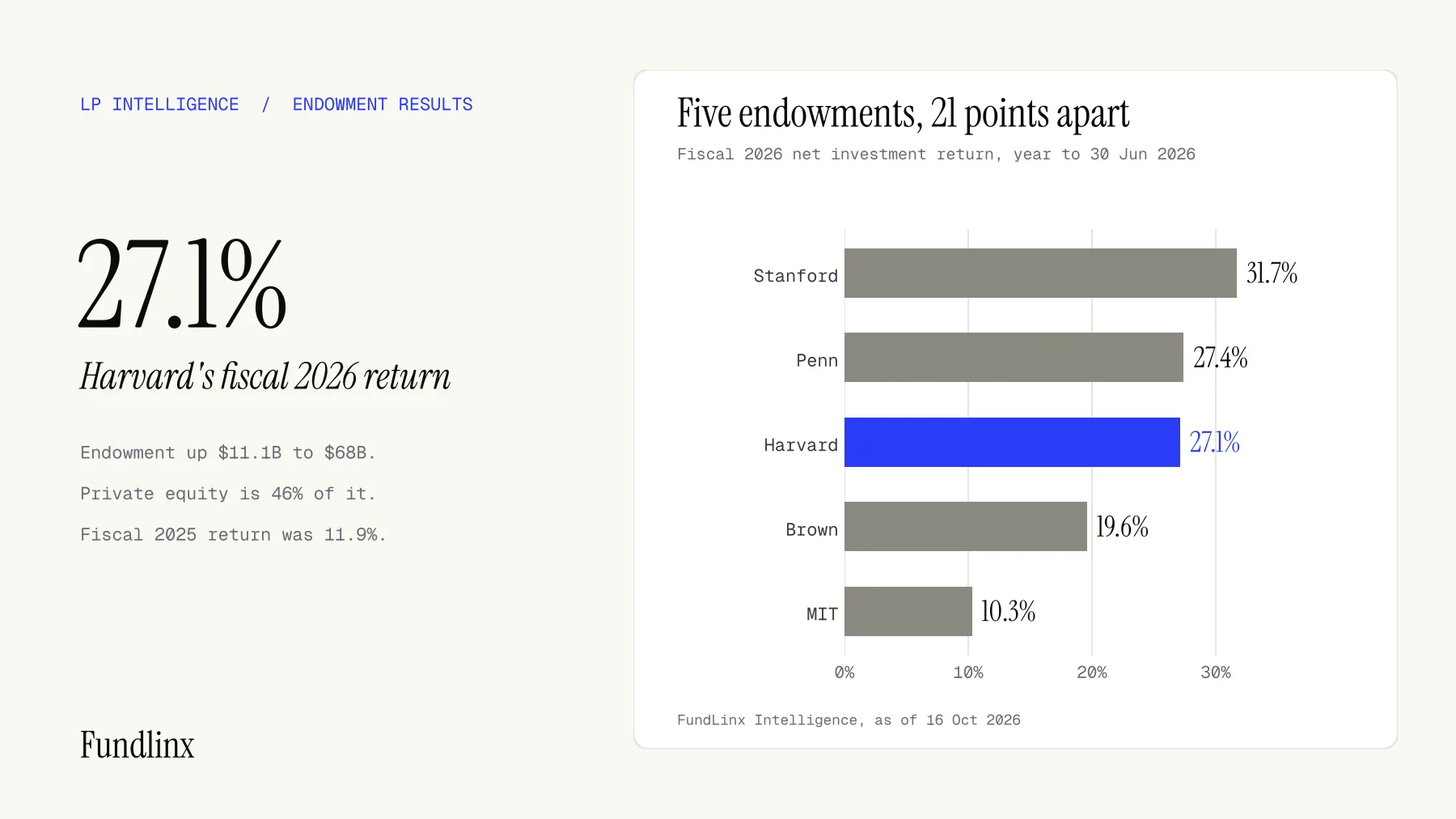
Harvard University reported on 15 October 2026 that its endowment returned 27.1% net of investment expenses in the fiscal year that ended 30 June 2026. The endowment is now worth $68 billion, up $11.1 billion, or 19.5%, from $56.9 billion a year earlier, and the return compares with 11.9% in fiscal 2025. It is Harvard's strongest result since 2021. Private equity has risen to 46% of the portfolio, the largest single component of the pool run by Harvard Management Company. By our arithmetic, that is about $31 billion in private equity.
What drove the return
Harvard said venture capital, public equities and hedge funds drove the gain. One position stood out: a direct stake in SpaceX worth about $2.2 billion at 30 June. A single holding of that size makes the year a concentrated one, and it follows the pattern we covered when SpaceX lifted UNC and five other endowments to results 27.5 points apart. Over the nine years of N.P. Narvekar's tenure as chief executive of the management company, the endowment has returned 11.4% a year, so fiscal 2026 ran well ahead of its long-run record. The swing from the 11.9% earned a year earlier is 15.2 percentage points, and the endowment's value rose 19.5% even after funding the university's $2.6 billion distribution. A swing of that size can reshape how an investment office thinks about risk and about the cash it expects back from managers.
How Harvard compares with its peers
Fiscal 2026 produced a wide spread across large university endowments. Stanford's merged pool returned 31.7%, Penn returned 27.4%, Brown returned 19.6% and MIT returned 10.3%. Harvard's 27.1% sits 0.3 points below Penn, 4.6 points below Stanford and 16.8 points above MIT. Across the five, the gap between best and worst is 21.4 points and the simple average is 23.2%. Among the four with reported asset values, Harvard, Stanford, Penn and MIT, which together hold $189.8 billion, the three that returned more than 25% hold $160.6 billion, or 84.6% of the capital, and make up 75% of the count. The practical point for a GP is that an endowment's headline return says less about its appetite than its starting position does. A pool that gained 27% and a pool that gained 10% are both still allocating, but from very different places.
The cash going out and the tax coming in
Harvard distributed $2.6 billion from the endowment in fiscal 2026, nearly 40% of the university's operating revenue. By our arithmetic that equals about 4.6% of the opening $56.9 billion balance. The federal tax on net investment income, 1.4% in fiscal 2026, rises to 8% in fiscal 2027. Harvard estimates the change will cost about $300 million a year, with larger payments possible in years with big realized gains, and its balance sheet already carries a $1.9 billion future tax liability. The university reported an operating surplus of $100 million. We looked at the same tax pressure from another angle in our playbook for pitching universities heading into a higher excise tax tier.
What the 46% means for GPs
The following is our reading, not a statement from Harvard. An LP with almost half its portfolio in private equity, a tax rate rising sharply on realized income and an endowment that funds about 40% of operating revenue is likely to care more than most about when cash comes back. Lead with DPI and show a realization schedule for your current fund, because distributed capital is the number a payout-driven pool can spend. Be ready to discuss the tax character of expected proceeds, since after-tax results matter more to an endowment facing this tax than to an LP that pays none. Offer options that do not add illiquidity, such as co-investment alongside the fund or a smaller primary ticket, and expect questions about concentration if your returns depend on a few positions, as Harvard's did this year. Venture and growth managers should assume that a team that has just booked a very large gain will ask how your valuations would look with the best asset removed.
The LP behind the numbers
Harvard's endowment is one of the largest in the world and sits among the endowments that GPs track most closely, but its individual manager commitments and ticket sizes are not public. Harvard Management Company runs the portfolio, and Narvekar has reiterated plans to retire after nearly a decade as chief executive, with reports putting the timing as soon as 2027. A leadership change at an investment office often prompts a fresh look at manager relationships, so GPs with existing ties should keep them current and GPs without ties should start building the record that a new leadership team will want to see, including references from other long-term investors.
What to watch next
Watch for any announcement on Narvekar's successor, for the first full year in which the 8% rate applies when results are reported in October 2027, and for the remaining university endowments still to report fiscal 2026 results. FundLinx members can see which endowments are allocating this quarter.
FundLinx Intelligence | FundLinx.ai
Playbooks, LP moves and compliance notes for emerging managers. Unsubscribe any time.