Nest's HarbourVest Private Equity Mandate Passes £2 Billion, Almost Triple Its £750 Million Start, as Nest Reaches About 5% in Private Equity
Nest's private equity co-investment mandate with HarbourVest has passed £2 billion, up from £750 million in 2022, and private equity is now about 5% of the scheme. What it means for managers.
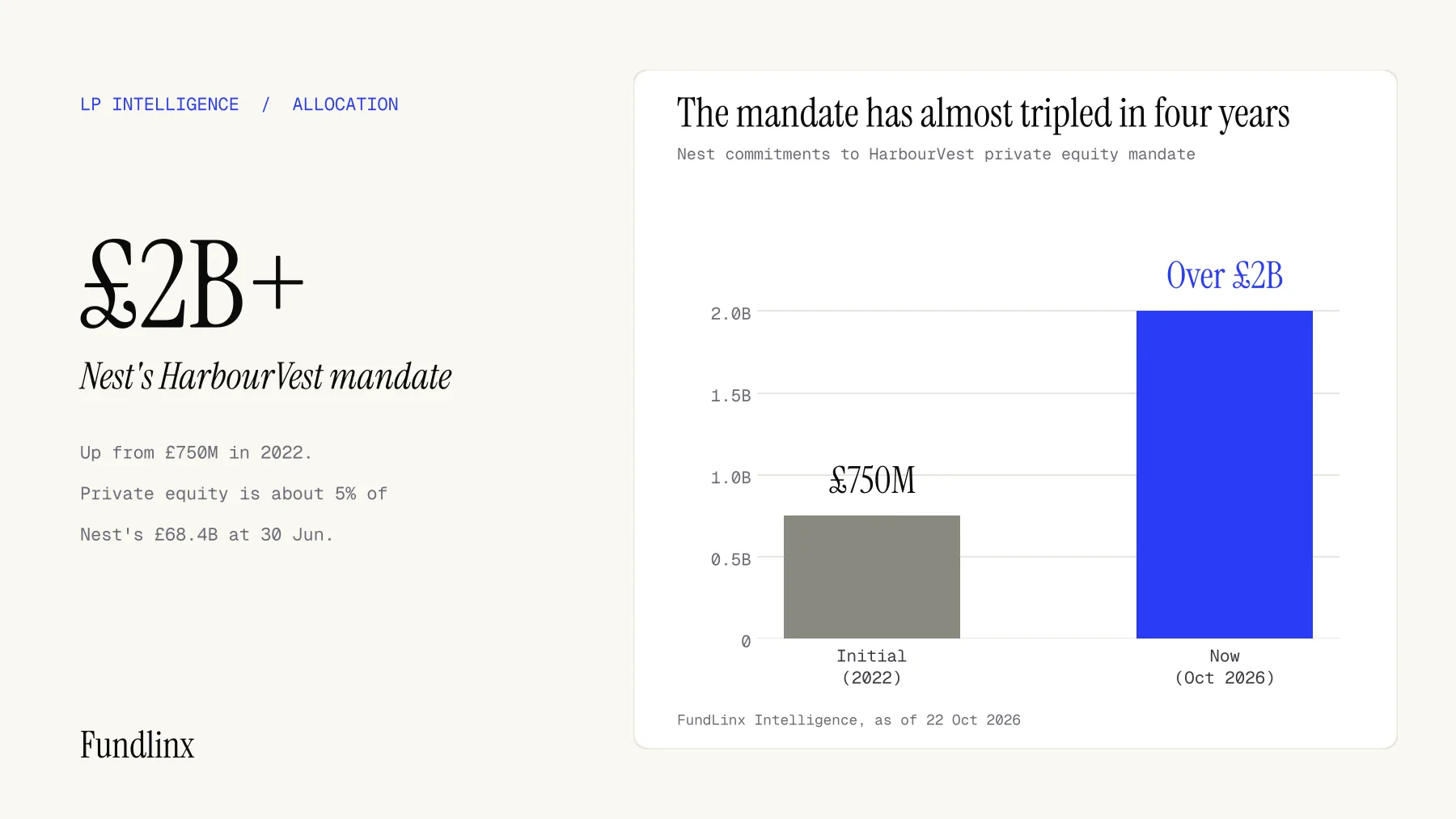
Nest, the UK workplace pension scheme with more than 14 million members, has passed £2 billion of commitments to its private equity mandate with HarbourVest, up from £750 million when the mandate began in 2022. The figures came out on 21 October. They show a defined contribution scheme growing a private markets programme through an outsourced co-investment mandate. Private equity is now about 5% of Nest's £68.4 billion of assets. Here is what we know, what we infer and what a GP can do with it.
What changed
The mandate has grown to more than £2 billion from an initial £750 million, so it has almost tripled in about four years. HarbourVest invests through co-investments, taking positions in individual companies alongside other private equity sponsors, across growth equity and buyout strategies and a range of sectors. The portfolio holds more than 60 private companies in 17 countries, including nine in the UK. Two of the UK holdings are named: the debt-markets data platform 9fin and the compliance services provider Citation. Elizabeth Fernando, chief investment officer of Nest Invest, said private equity is a key part of the scheme's private markets strategy. A HarbourVest managing director, Craig MacDonald, said the UK continues to stand out as an attractive market, which is why the manager invests in British businesses.
The numbers in context
At 30 June 2026 about 5% of Nest's £68.4 billion in assets under management was in private equity. Around 18% of Nest's private equity, or £566 million, was in UK private companies. On our arithmetic those two figures imply a total private equity book of roughly £3 billion, and a HarbourVest mandate of over £2 billion would then be about two thirds of it. That is an estimate, because the sources give the 18% share and the pound figure but not the total. The mandate multiple is simpler: £2 billion over £750 million is about 2.7 times, which fits the description of it having almost tripled.
The named LP
Nest is a UK defined contribution workplace scheme with more than 14 million members and £68.4 billion in assets. It uses outsourced mandates for parts of its portfolio. We covered an earlier example when Nest moved its £3.5 billion emerging markets book from passive to an active Wellington mandate. Both are mandates handed to an outside manager. The sources do not describe how Nest chooses managers, and we have not assumed anything beyond the public figures. For wider context on UK activity, see our note on the record UK venture fundraising quarter and on Greater Manchester's £30 million commitment to Newcore.
What a GP should do
This section is our advice, not guidance from Nest. First, work out whether your route to a scheme like Nest is direct or indirect. For the part of its private equity that runs through a co-investment mandate, the scheme buys exposure to your company or your sponsor-led deal through its manager, so the useful relationship may be with the sponsors and with HarbourVest-type intermediaries rather than with the pension scheme. Second, if you lead UK deals in growth equity or buyout, make it easy for a co-investor to underwrite you: a clear allocation process, a short company data pack, a plan for co-investor information rights and a point of contact. Third, avoid treating a milestone as a reason for a pitch. With private equity already at about 5% of assets, our reading is that further growth in the mandate may come mainly from the scheme's assets growing, although Nest has not said that. Fourth, do not assume a scheme with 14 million members wants complexity: reporting, fees and valuations will be read by people who answer to savers. A co-investment offer works best when it states fees, carry and timeline up front.
A checklist for a manager with UK exposure
Again this is our advice. Before you talk to any co-investor linked to a scheme of this kind, check four things. Can you explain in two sentences why your deal suits a minority investor? Do you have audited numbers that match the data pack? Can you share information on a timetable that fits a mandate manager's reporting cycle? And have you written down who decides on the allocation at your end, so a late question does not stall the process? A scheme whose private equity is delivered by a manager across more than 60 companies in 17 countries will see many such offers, and a clean, quick answer is a competitive advantage.
What to watch next
Watch for Nest's next report on its private markets holdings, and any further outsourced mandate announcements. See our view of LP allocation trends for the wider picture, and browse UK pension funds to place Nest among its peers. FundLinx members can see which pension funds are active in your strategy.
FundLinx Intelligence | FundLinx.ai
Playbooks, LP moves and compliance notes for emerging managers. Unsubscribe any time.