Nest Moves Its £3.5 Billion Emerging Markets Book From Passive to an Active Wellington Mandate
Nest will move £3.5 billion, about 5.2% of its £68 billion, from a passive emerging markets strategy of roughly 1,000 stocks to an active mandate holding 100 to 150.
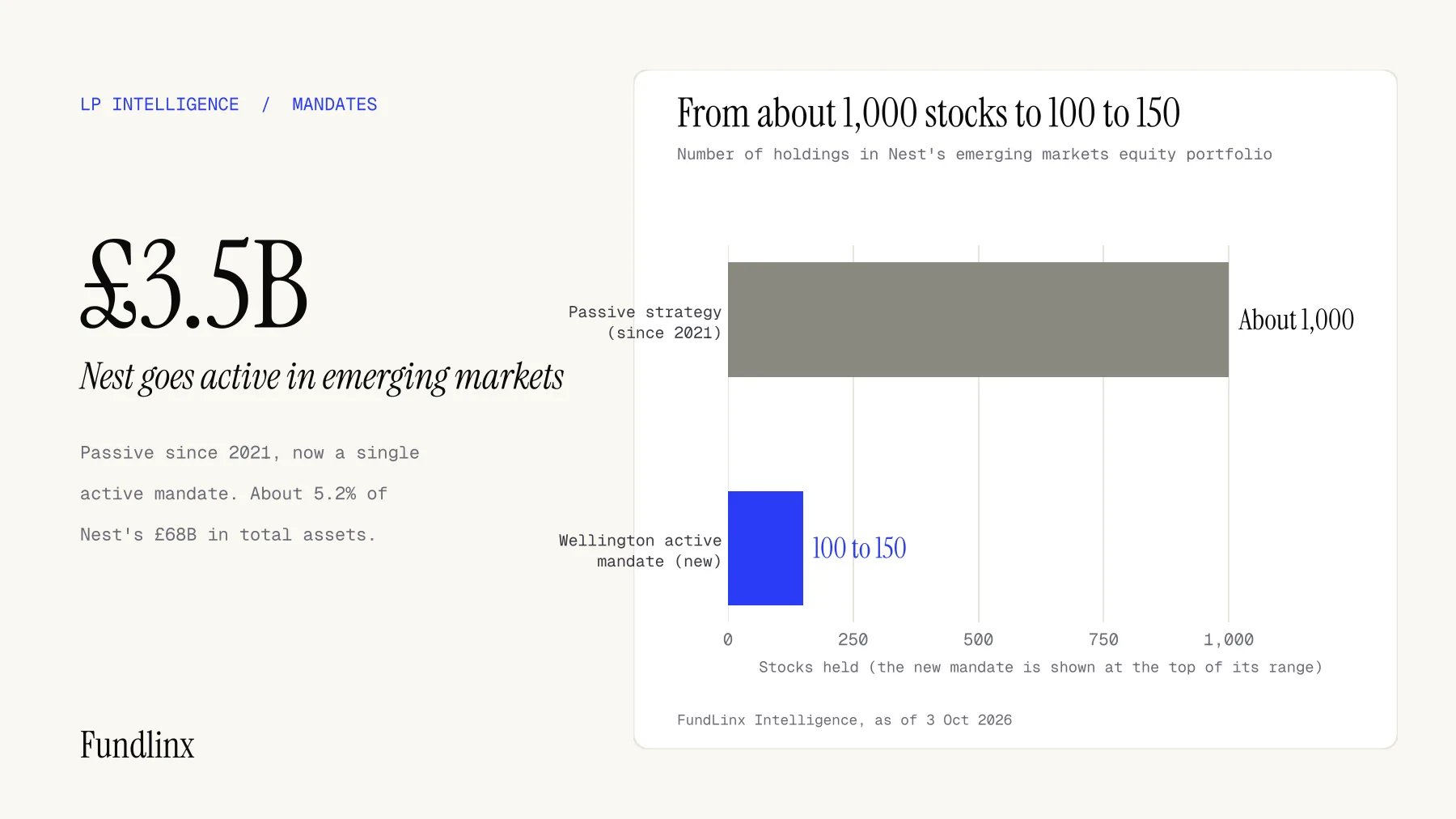
On 1 October 2026, Nest, the UK's National Employment Savings Trust, announced that it is moving £3.5 billion (about $4.6 billion) of emerging markets equities into an active mandate run by Wellington Management. The assets had been invested since 2021 in a passive, climate-aware index strategy that held more than 1,000 stocks. The new mandate is described as active, fundamental and discretionary, and it will hold between 100 and 150 companies, so the number of names falls by roughly 85% to 90%.
Who Nest is and how it invests
Nest is a defined contribution pension scheme set up to serve automatically enrolled workers in the UK. It has more than 14 million members and about £68 billion in assets, and it expects to reach roughly £100 billion by 2030. Rachel Farrell, Nest's director of public and private markets, leads the work, and Aisling Freiheit, Wellington's head of Europe, Middle East and Africa, spoke for the manager. Nest says more than 80% of its assets sit in segregated accounts, including this one, which makes its programme one of the most extensive of its kind in the UK defined contribution market.
The £3.5 billion equals about 5.2% of Nest's total assets, which is the size of its emerging markets equity allocation. The announcement describes a change in how that sleeve is managed, not a new allocation to emerging markets: Nest is changing who decides which companies to own.
What changes inside the portfolio
Nest wants the new strategy to add 100 basis points a year over the MSCI Emerging Markets index. Wellington manages about $1.3 trillion in total, including about $44 billion in emerging markets equities. The stated reason for the switch is engagement. Farrell said that a purely passive approach had not given Nest enough contact with the companies it owned, and that the team wanted a manager that places engagement at the centre of its process. Wellington will assess how company management approaches financially material sustainability issues and how it responds when investors raise concerns.
For a pension that holds thousands of positions through index funds, the shift to 100 to 150 holdings is a large change in concentration. Spreading the same assets across 100 to 150 names instead of more than 1,000 means each holding can be roughly seven to ten times larger on average, which helps explain why Nest is pairing the shift with a stewardship brief and not only a return target.
The numbers give a sense of what is at stake. If Wellington reaches the 100 basis point target, the extra return on £3.5 billion would be about £35 million a year, though that is a goal and not a guarantee, and it is measured against an index that the old strategy already tracked closely. Nest's growth from £68 billion to about £100 billion by 2030 would be an increase of roughly 47%, so the mandate sits inside a fund that is expected to grow substantially over the same period.
How this compares with other allocators this week
Emerging markets are drawing different answers from different pension funds. Los Angeles's city pension renewed a manager but cut its emerging market debt target to 3%. In contrast, a survey we covered found that 62% of Canadian institutions plan to add emerging markets, against 47% globally. Nest's move sits between those two poles: it is not announcing a bigger or smaller sleeve, but it is paying for active judgment where it previously bought the index. It is also a reminder that large UK schemes use scale to set up segregated mandates on their own terms.
What GPs should do now
For managers of listed emerging markets strategies, the lesson is that a concentrated, high-conviction portfolio and demonstrable engagement now clear a large UK scheme's bar, while a benchmark-hugging product does not. Lead with a record of company meetings that changed an outcome, and show how your analysts weight governance and sustainability findings in position sizes. Expect a segregated mandate request rather than a pooled fund subscription, and be ready to run to the client's own reporting needs.
For private markets managers, the relevant fact is who sits in the seat. Farrell's remit covers both public and private markets, so evidence of active stewardship that works in listed equities is likely to be read across to private managers. A credible approach names a specific strategy, shows how you engage with portfolio companies after investing, and takes a warm introduction through a shared investor or consultant rather than a cold email. Nest's growth to £100 billion by 2030 means its decision calendar is worth tracking even if it is not your target this quarter.
What to watch next
Watch for the start date of the Wellington mandate, whether Nest publishes engagement reporting for it, and whether the same logic is applied to other passive sleeves in its segregated programme. FundLinx members can see which pension funds are changing mandate structures this quarter.
FundLinx Intelligence | FundLinx.ai