Bowdoin's Endowment Returns 26% to a Record $3.6 Billion and Now Funds Half of a $250 Million Operating Budget
Bowdoin's endowment returned 26% in fiscal 2026 and reached a record $3.6 billion, well ahead of the 16.2% median. It now funds half of the college's budget, which shapes how GPs should approach it.
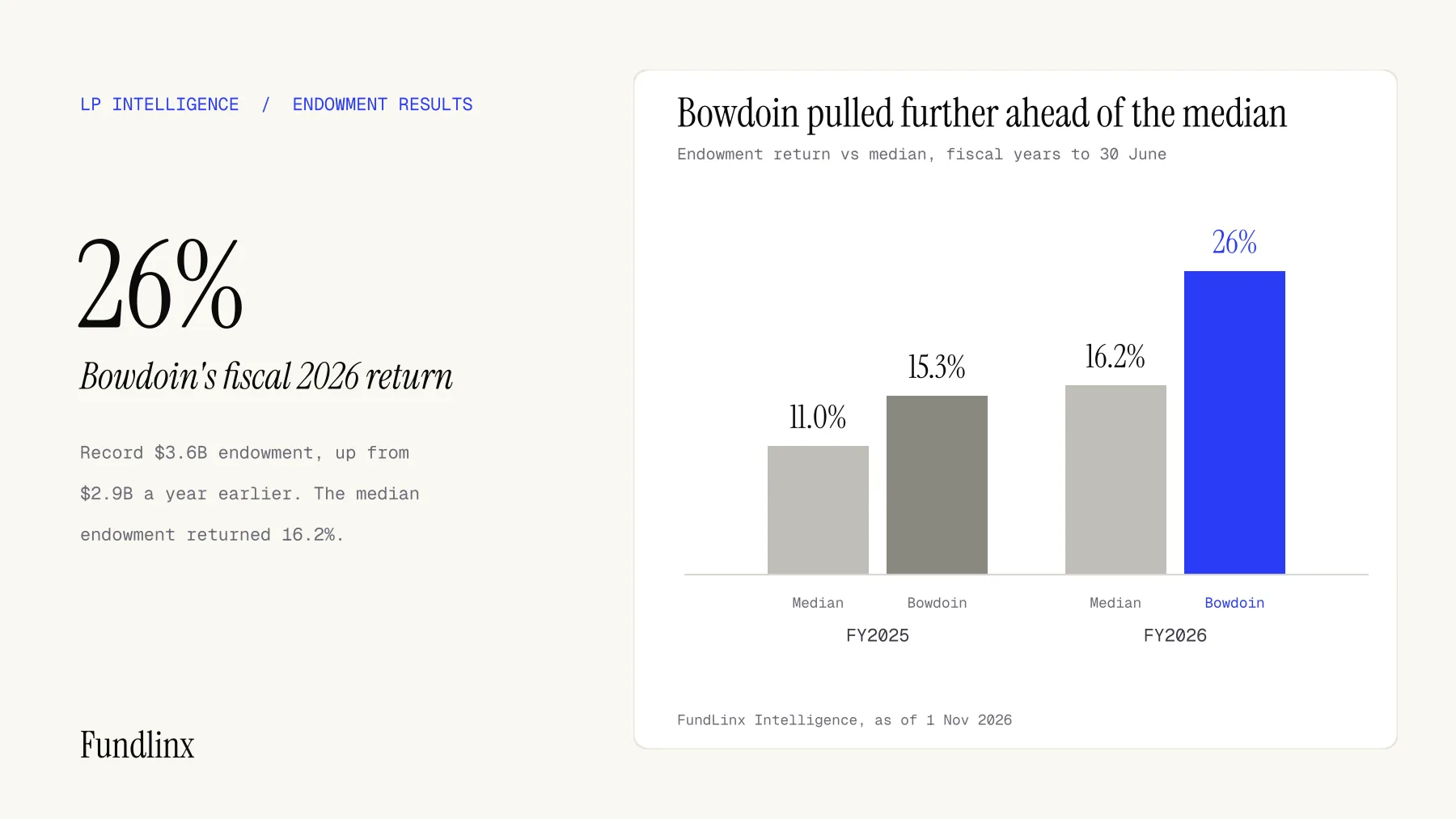
Bowdoin College announced on 23 October 2026 that its endowment returned 26% in the fiscal year that ended on 30 June 2026 and reached a record $3.6 billion. A year earlier it returned 15.3% and stood at $2.9 billion, so the pool is about $700 million larger after 12 months (our arithmetic on rounded figures). For a GP, the useful part is not the headline but how a small endowment that leans on its portfolio for half of its operating budget is likely to treat a year like this one.
What was announced
The College said its return beat the 16.2% median for college and university endowments in preliminary data from Cambridge Associates, and that its long-term results rank in the top 1% of the endowments that firm monitors. President Safa Zaki credited the investment team, led by Chief Investment Officer Boris Raykin, and the Investment Committee. Matthew Orlando, the senior vice president for finance and administration and treasurer, said the gain will help next year's budget but that its full effect will not be felt until fiscal 2029/30. The reason is the spending formula, which draws 5% a year from the endowment's average value over the previous 12 quarters, so a single strong year enters the budget gradually.
The numbers
Endowment distributions now supply half of this year's $250 million operating budget, which is about $125 million on our arithmetic, while net tuition and fees supply 38%. A year ago distributions supplied 51% of a $243 million budget, about $124 million, and tuition and fees supplied 37%. Ten years ago tuition and fees covered about half of the budget. Financial aid takes the largest share of endowment spending, about 46%, and endowment scholarship funds covered 80% of the aid budget in fiscal 2026. Orlando said the shift leaves the operating budget "much more sensitive to what happens in the financial markets", and the College has built larger reserves as a buffer.
Against prior periods, the margin over the median widened. Bowdoin beat the median by 9.8 points this year (26% against 16.2%) after beating it by 4.3 points a year ago (15.3% against 11%), and its own return rose 10.7 points year on year. Those are our calculations from rounded figures.
How it compares
Among the endowments we have covered for fiscal 2026, Bowdoin's 26% sits just below Yale's 26.3%, above Brown's 19.6% and Dartmouth's 17.5%, and above the 20.7% at Michigan that we cover today. Harvard's 27.1% and Stanford's merged pool at 31.7% were higher still. That is a comparison of the pieces we chose to cover, not a ranking of all endowments, and sizes differ widely: Bowdoin's $3.6 billion is a small fraction of Yale's $54.5 billion.
The named LP
Bowdoin's endowment is the investment pool of Bowdoin College, a US liberal arts college, and stood at $3.6 billion on 30 June 2026. Its LP profile sits among the endowments on FundLinx. In last year's results the College said the endowment comprised 1,944 individual funds, nearly half restricted for student financial aid, and that all assets are invested through carefully selected external managers across domestic and international equities, fixed income, private equity, venture capital, real estate and absolute return strategies. Raykin was named chief investment officer on 23 June 2026 after a nationwide search. He joined Bowdoin in 2021 as a director in its New York investment office, with expertise in marketable securities, and earlier led the public markets program at Willett Advisors, which invests on behalf of Bloomberg Philanthropies. The latest announcement does not give the asset mix, the pace of new commitments, a typical ticket or whether the endowment backs first-time funds, so we offer no Fund I or Fund II view and do not estimate those figures.
What a GP should do
This section is our advice, not guidance from Bowdoin. First, treat the announcement as context for a conversation, not a sign of open mandates, because it says nothing about new commitments. Second, lead with distributions. A budget that depends on the endowment for half of its funding, and a formula that averages 12 quarters, point to an investor that values steady and predictable cash over one spectacular year, so show realised distributions to paid-in capital alongside unrealised value. Third, expect the office to be in an early phase under a CIO whose own background is in public markets, and explain in plain terms how a private fund would sit alongside liquid holdings; that is our reading, not something Bowdoin has said. Fourth, size the ask honestly: at $3.6 billion, each 1% of the endowment is about $36 million, and the announcement gives no allocation, so state the minimum ticket you need. Fifth, look for a warm route through managers or advisers the College already uses, because it invests through external managers, and ask for an introduction before a cold note. Sixth, keep any note short: strategy, fund number, vintage and one line on why it fits.
What to watch next
If the pattern of the last three years holds, Bowdoin will report its next annual results in October 2027. Watch for how much of the fiscal 2026 gain reaches the budget as the 12-quarter average rolls forward, and for further endowment announcements from peers in the coming weeks. FundLinx members can see which institutions are allocating in your strategy.
FundLinx Intelligence | FundLinx.ai
Playbooks, LP moves and compliance notes for emerging managers. Unsubscribe any time.