Japan's GPIF Loses 1.65% in the July to September Quarter as Foreign Bonds Fall 6.52%, a Swing From an 8.20% Gain in the Prior Quarter
GPIF lost 5.25 trillion yen, or 1.65%, in the quarter to 30 September after gaining 8.20% in the one before. Foreign bonds fell 6.52% and alternatives are 1.72% of the fund.
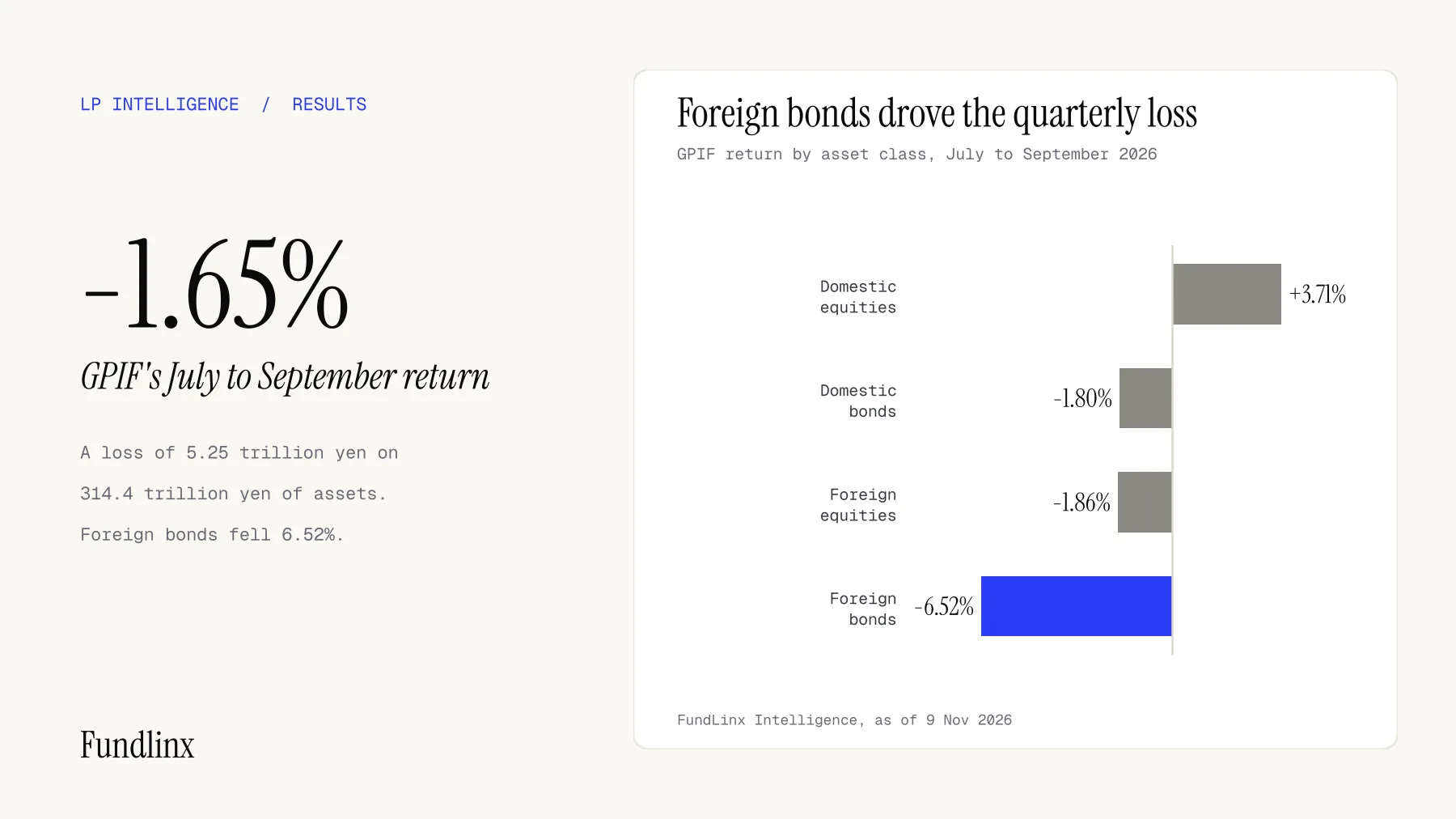
Japan's Government Pension Investment Fund, known as GPIF, reported on 6 November 2026 that it lost 5.25 trillion yen in the quarter from July to September, a return of negative 1.65%. Total assets ended September at about 314.4 trillion yen, down from about 317.8 trillion yen at the end of June. The result follows a strong April to June quarter, so the fund is still ahead for the half year. For fund managers who track the largest pools of public pension capital, the quarter is a useful reminder of how much a single asset class can move a result when a portfolio is split almost evenly between bonds and equities.
What GPIF reported
GPIF's loss for the quarter was 5,253.3 billion yen, a return of negative 1.65% that is not annualized. The previous quarter, April to June, was a gain of 24,089.5 billion yen, or 8.20%. Across the first half of the fiscal year, April to September, the fund is up 18,836.3 billion yen, or 6.42%. Assets under management at 30 September were 314,387.6 billion yen, compared with 317,759.6 billion yen at 30 June. The fund also said the share of its portfolio held in alternative assets was 1.72%, within a maximum of 5% of the total portfolio.
The numbers by asset class
Foreign bonds were the story. They returned negative 6.52% in the quarter, a loss of 5,230.1 billion yen. Domestic bonds returned negative 1.80%, a loss of 1,445.2 billion yen, and foreign equities returned negative 1.86%, a loss of 1,460.2 billion yen. Domestic equities were the one gain, up 3.71%, or 2,882.2 billion yen. Three of the four core asset classes lost money, which is 75% by count. The three losing classes together lost about 8,135.5 billion yen, our arithmetic from the disclosed figures, and the domestic equity gain offset part of it to leave the net loss of 5,253.3 billion yen. Foreign bonds alone account for about 99.6% of the net loss, again our arithmetic. We do not quote asset class weights here because the allocation table is easy to misread, and we would rather leave it out than risk mislabelling a percentage.
How it compares
The swing between quarters is the notable point: plus 8.20% followed by minus 1.65%. A half-year gain of 6.42% still sits comfortably above zero, so the fund is not in a drawdown for its fiscal year. Other large public funds have posted mixed third quarters too. We reported that Norway's wealth fund lost 0.5% in the third quarter as bonds fell 3.5%, and the common thread across both funds is that bond weakness, not equity weakness, drove the quarter. That matters for private markets because a fund that is hurt on the bond side tends to look at its growth and income balance across the whole portfolio.
The named LP
GPIF manages public pension reserves in Japan and is one of the largest pension funds in the world by assets. Its policy portfolio is spread across domestic bonds, foreign bonds, domestic equities and foreign equities, with alternative assets held inside those classes under a 5% ceiling. At 1.72%, alternatives are well below that ceiling, which leaves about 3.28 percentage points of headroom, our arithmetic from the two disclosed figures, and on a portfolio of about 314.4 trillion yen the current allocation is roughly 5.4 trillion yen. We reported earlier that GPIF's private markets chief of a decade, Yoshitaka Todoroki, joined StepStone as vice chairman for Japan, which is a reminder that the fund's private markets relationships are in transition. We have no verified figures for typical ticket size or for whether GPIF backs first-time managers, so we offer none.
What a GP should do
This section is our advice, not guidance from GPIF. First, do not treat a quarterly loss from bonds as a reason to expect GPIF to change its private markets pace, because the half-year result is still positive. Second, if you already have Japanese limited partners, send a short note that shows how your fund behaved in the same quarter, using your own net figures and the period named, so that the conversation is about portfolio construction and not just performance. Third, if you are building a Japan relationship from scratch, map the managers and consultants that GPIF's alternative assets program has worked with, because in our view introductions to a fund of this size are likelier to come through established intermediaries than through cold approaches. Fourth, make your reporting easy to translate: consistent quarterly figures, clear fee and expense disclosure and a named senior contact, since a limited partner with a large internal committee will read the same document several times.
What to watch next
Watch GPIF's next quarterly result, whether the alternatives share moves above 1.72%, and whether the foreign bond slide continues. Our own view is that a fund with a 5% ceiling and a 1.72% weight has more room to grow than to shrink. FundLinx members can see which sovereign and public pension funds are active in private markets.
FundLinx Intelligence | FundLinx.ai
Playbooks, LP moves and compliance notes for emerging managers. Unsubscribe any time.