NZ Super Fund Ends Its In-House Active New Zealand Equities Mandate, Keeps NZ$814 Million With Mint, and Hires a Portfolio Manager for Catastrophe Bonds and Spectrum Strategies
NZ Super Fund ended its in-house active NZ equities mandate, leaving NZ listed equities at about 4% of the fund, and hired an alternatives manager. An NZ$814 million external mandate stays.
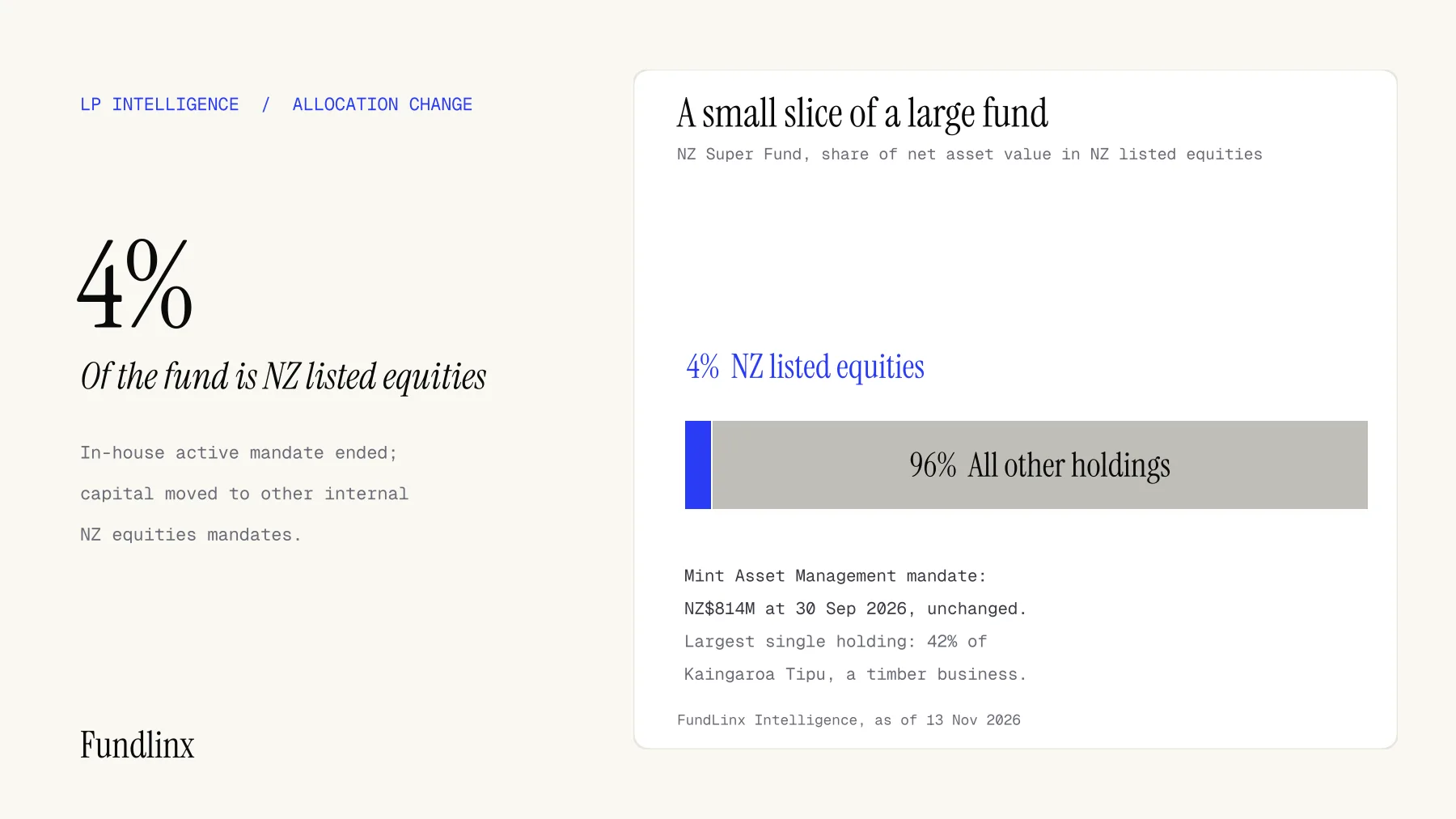
The NZ Super Fund has ended the internally managed fundamental active equities mandate it ran for New Zealand listed shares and moved that capital into its other internal New Zealand equities mandates. The Guardians of New Zealand Superannuation, which manages the fund, said on 12 November 2026 that the decision followed a detailed review earlier this year. Its external mandate with Mint Asset Management, valued at NZ$814 million at 30 September 2026, is unchanged, and New Zealand listed equities remain about 4% of the fund's net asset value.
What the Guardians announced
Members of the former active equities team will take up new roles elsewhere in the investment business unit. Engagement with the New Zealand companies the fund holds will now be led by Michael McNee, the newly appointed Head of Portfolio Completion, together with Anne-Maree O'Connor, Head of Sustainable Investment. The same update said the Guardians had appointed David Kandziora as Portfolio Manager, Alternative Investments, with a focus on catastrophe bonds, insurance-linked products and spectrum strategies. He has a 20-year career advising pension funds, iwi organisations, charitable foundations and wealthy individuals, and chairs CFA Society New Zealand.
The update also marked 20 years since the fund agreed, on 31 October 2006, to buy a minority interest in the Kaingaroa Forest estate. Today its 42% shareholding in Kaingaroa Tipu is its largest single investment. The Guardians said a commitment of that length to one investment does not fit the way much of the industry operates, which is a useful reminder of how this investor thinks about time.
The numbers, as a share of capital and of count
By capital, the Mint mandate is NZ$814 million. Against the NZ$94.4 billion the fund reported at 30 June it is roughly 0.9%, and if New Zealand listed equities are 4% of the fund, they are roughly NZ$3.8 billion, which would make Mint about a fifth of that. Both figures are our rough arithmetic, mixing a September mandate value with a June fund value, so use them as orders of magnitude only. By count, two active New Zealand equities mandates are named in the update: one ended and one continues. The update does not give the size of the terminated mandate.
How this compares with earlier moves
This is a change of method, not a retreat from a market. It sits alongside five senior appointments the Guardians announced between 1 July and 12 November: Anastasia Moskvina as Head of Data Analytics, Alex Bacchus as Head of Asset Allocation, Sam Brodie as Head of Strategic Tilting, Michael McNee as Head of Portfolio Completion and now Kandziora. We covered the fund's annual return of 14.17% and its cut to long-term return expectations. For a neighbouring comparison, see our piece on the Future Fund's one-year return and private equity share.
Who the limited partner is
The Guardians manage the fund for New Zealand's pension system and describe the fund as worth about NZ$95 billion in their September announcements. As a sovereign wealth fund, one of the sovereign wealth funds we track, it has a long horizon and a stated commitment to investing in New Zealand, and the update shows it working with other large institutional investors on assets it holds. It runs a joint venture with Copenhagen Infrastructure Partners, Taranaki Offshore Partnership, which welcomed the opening of New Zealand's first offshore renewable energy feasibility permit round. The update also reports on the Elevate Fund, whose backed companies grew aggregate revenue from NZ$125 million at first investment to NZ$561 million at 30 June 2026, about 4.5 times, across 3,797 full-time equivalent staff. Fifteen of those companies now generate more than NZ$10 million of annual revenue, 19 employ more than 50 people, and 56% of the roles are based in New Zealand. The manager of the Elevate Fund estimates that about NZ$271 million, or 69%, of the revenue of its 15 largest portfolio companies in the 2026 financial year came from exports. We have not verified typical commitment sizes to external managers or whether the fund backs first-time managers.
What a fund manager should do
This section is our advice, not guidance from the Guardians. The clearest signal is where the fund is adding people: alternatives, with a stated emphasis on catastrophe bonds, insurance-linked products and spectrum strategies. If you run reinsurance-linked, insurance-linked or other specialist strategies, a short note to the investment team that explains how your strategy fits an alternatives portfolio is reasonable. If you manage New Zealand-focused real assets, note the fund's pattern of holding assets with long horizons alongside local and institutional partners, as with co-investment structures, and be clear about the period for which you can hold capital. Do not read this update as a reason to approach it about listed New Zealand equities, where the in-house mandate has just ended.
What to watch next
Watch for the Guardians' next stakeholder update and for whether further alternatives hires follow Kandziora, since that would show how fast the team is being built. For another sovereign allocator in a very different stage, Canada's new fund has just named its first chief executive. FundLinx members can compare sovereign and pension allocators by strategy.
FundLinx Intelligence | FundLinx.ai
Playbooks, LP moves and compliance notes for emerging managers. Unsubscribe any time.