McKnight Foundation Names Priya Parrish Its First Chief Investment Officer From 30 November, Overseeing a $2.8 Billion Endowment With a $500 Million Climate Portfolio
McKnight created its first CIO seat and filled it with an impact investor who starts on 30 November. She will run a $2.8 billion endowment that is already more than half mission aligned.
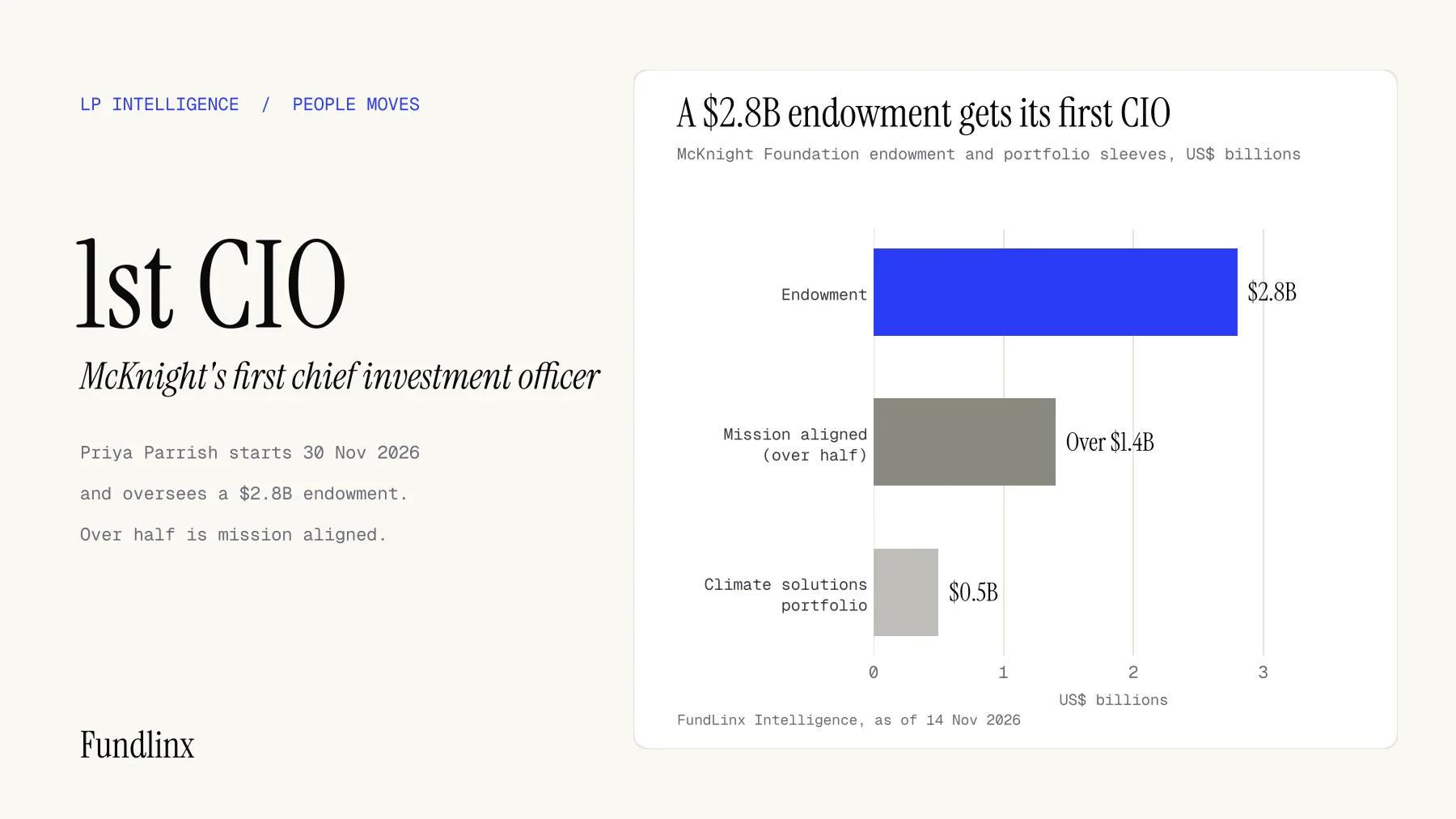
On 9 November 2026 the McKnight Foundation, a Minneapolis family foundation, announced that Priya Parrish will join as its first chief investment officer on 30 November. She will oversee the foundation's $2.8 billion endowment, lead its investment function, work with its investment committee and sit on the executive leadership team. Parrish comes from Impact Engine, where she is partner and chief investment officer. The foundation described the new seat as the next chapter in more than a decade of work to bring its investments closer to its mission, and she starts 16 days from today.
What McKnight announced
Until now McKnight ran its endowment without a CIO title. In April the foundation said Elizabeth McGeveran, its inaugural vice president of investments, would step down in June after more than 12 years, having built the in-house investment team. The new appointment creates a more senior role over the same portfolio. McKnight president Tonya Allen said Parrish brings the investment rigor, imagination and impact experience to build on more than a decade of progress. Karen Coleman, a board member who chairs the investment committee, said Parrish has the judgment and leadership to steward the endowment through both the challenges and opportunities ahead.
Parrish has more than two decades of institutional investing experience across traditional and impact strategies, public and private markets, and team leadership. At Impact Engine, an institutional venture capital and private equity investor, she leads a team deploying capital into private-market funds and co-investments across venture, growth and buyout strategies with an impact thesis. Earlier she was CIO of Schwartz Capital Group, where she built the investment office, and she held roles at Aurora Investment Management, Northern Trust Asset Management and KLD Research and Analytics. She also teaches an MBA course on impact investing at Chicago Booth, wrote The Little Book of Impact Investing in 2024, sits on the board of National Equity Fund and serves on the investment committees of Alta Futures, Blue Haven Initiative and the IDP Foundation.
The numbers behind the seat
McKnight launched its impact investing program in 2014 and says more than half of its endowment is now invested in ways that advance its goals while meeting its return targets. On the $2.8 billion endowment, that means more than $1.4 billion, which is our arithmetic. In 2021 it was the first of the nation's 50 largest private foundations to commit to net-zero greenhouse gas emissions across its portfolio, and it has built a $500 million climate solutions portfolio. That sleeve is about 18% of the endowment, again our arithmetic. The announcement does not give an allocation by asset class, a target for private markets or any change to strategy.
How this compares with other recent moves
Foundation investment leadership has been moving all autumn. We covered Mellon Foundation promoting its deputy to CIO and Cedars-Sinai hiring the Hilton Foundation's CIO. Both involved an existing leader. McKnight is different because the role itself is new, so there is no predecessor whose manager list a successor inherits and no CIO-level relationship to preserve.
Who the limited partner is
McKnight is a US foundation that pays out grants from an endowment of $2.8 billion. It has put climate and mission alignment at the center of its investing for years, and a CIO with an impact background suggests that theme continues. We have not verified its current manager roster, typical commitment sizes or whether it backs first-time funds, so treat any assumption on those points as unconfirmed.
What a fund manager should do
This section is our advice, not guidance from McKnight. Parrish does not start until 30 November, so there is nothing to pitch her yet. Use the next few weeks to prepare. If you already hold a commitment from McKnight, confirm who on the existing team is your day-to-day contact and ask how reporting will work during the transition. If you are a prospect, check whether you have a genuine overlap with her public affiliations, and follow a warm path to the right investment contact rather than writing cold. Impact-oriented strategies in venture, growth, buyout or climate solutions are the likeliest fit with her record, and your materials should show measurable outcomes next to returns. We set out how to map the connections in our warm paths guide to McKnight's new CIO.
What to watch next
Watch for McKnight's own announcements after 30 November, including any statement on how the investment function will be organised under a CIO, and for how the foundation describes its endowment in its next annual reporting. We would expect a first CIO to review the portfolio before changing it, so any shift in the manager roster is more likely to come in 2027 than in December, though that is our judgment, not something McKnight has said. FundLinx members can see which foundations are building out their investment teams.
FundLinx Intelligence | FundLinx.ai
Playbooks, LP moves and compliance notes for emerging managers. Unsubscribe any time.