Columbia's Endowment Returns 18.3% to Reach $17.9 Billion, Its Best Year Since 2021, but Still Trails the Ivy League Average of 22.1%
Columbia's endowment returned 18.3% in fiscal 2026 to reach $17.9 billion, led by hedge funds, yet five of eight Ivy schools did better. It says it is growing pickier on private deals.
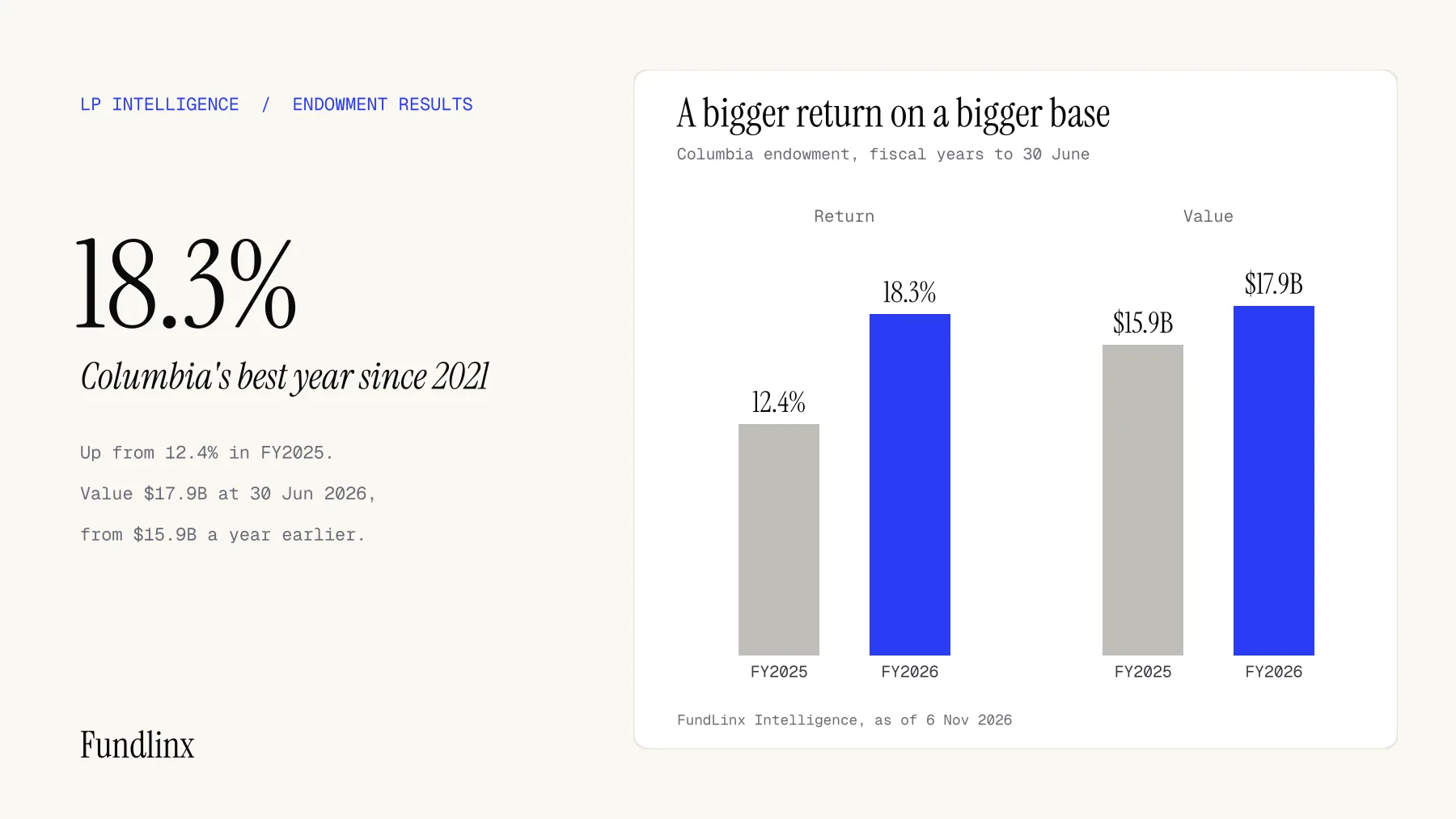
Columbia University's endowment returned 18.3% in the fiscal year to 30 June 2026 and was worth $17.9 billion at the year end, according to the statement from Columbia University Investment Management Company dated 3 November 2026. It is the last of the eight Ivy League schools to report. The result is a clear step up from the prior year, but it leaves Columbia in sixth place among its peers, and the commentary from its chief executive about private markets is as useful to a fund manager as the return itself.
What was reported
The investment company said the endowment's trailing five-year and ten-year returns are 7.5% and 9.9%. Kim Lew, its president and chief executive, said global equities performed in line with strong markets in fiscal 2026, which she described as the fourth straight year of double-digit equity returns. She named the hedge fund portfolio as a strong driver of performance, saying it substantially outperformed its benchmark, and attributed that to sector exposure, particularly AI-related, and to geographic exposure. The private portfolio, which she called a developing asset class for Columbia, also had a solid year, helped by growth in venture and offset in part by a shrinking natural resources portfolio. She added that Columbia remains enthusiastic about private investment but is increasingly selective because of record high valuations. The university said the endowment helped it provide financial aid to more than 50% of undergraduates.
The numbers
The endowment grew from $15.9 billion at 30 June 2025 to $17.9 billion, an increase of $2.0 billion, or about 12.6%. The return rose from 12.4% to 18.3%, a gain of 5.9 points, and the 18.3% is the largest since the 32.3% of fiscal 2021. The value rose by less than the return because the figure also reflects gifts, transfers and spending from the endowment. Over five years the return is 7.5% a year, below the ten-year 9.9%, so the latest year improves a medium-term record that has lagged the longer one. As a rough illustration of the gap to peers, matching the eight-school average would have meant a return 3.8 points higher, or roughly $0.6 billion more on the $15.9 billion starting base, before spending and flows.
How it compares
Across the eight Ivy League schools the returns were 27.4% at Penn, 27.1% at Harvard, 26.3% at Yale, 23.7% at Princeton, 19.6% at Brown, 18.3% at Columbia, 17.5% at Dartmouth and 16.9% at Cornell. The simple average of the eight is 22.1%, which puts Columbia 3.8 points below it. Five of eight schools, or 62.5% by count, returned more than Columbia, and two of eight, or 25%, returned less. We looked at the top end in our pieces on Yale's 26.3% return and its tax bill and Dartmouth's 17.5% return and weaker five-year figure, and we set the full spread out in our note on the Ivy League endowment gap.
The named LP
Columbia's endowment is run by Columbia University Investment Management Company under Lew, and sits with other US endowments on FundLinx and in the wider set of US LPs. The statement discloses no commitment sizes, no list of managers and no target weights, so we give no typical ticket and no view on whether it backs Fund I or Fund II managers. What it does disclose is useful: public equity and hedge funds drove the year, venture is growing inside a private book that Columbia still calls a developing asset class, and natural resources is shrinking.
What a GP should do
This section is our advice, not guidance from Columbia. First, do not pitch a general private equity story. Columbia has said it is increasingly selective because of record valuations, so lead with entry price discipline and what you did when prices were high. Second, if you run venture, you are in the part of the private book that is growing, so show realised outcomes rather than marks. Third, if you run natural resources, expect a harder conversation, because the statement describes that portfolio as shrinking. Fourth, hedge fund and liquid strategies are where Columbia saw outperformance, so a credit or event-driven manager that can show differentiated sector or geographic exposure has an angle. Fifth, remember the five-year figure of 7.5%: an endowment that is working to rebuild a medium-term record will ask how your fund behaves in a weaker year. Sixth, keep the first message short and specific to the sleeves Columbia named, since the statement gives you the language to use.
What to watch next
Watch the next statement from the investment company for changes in the private book and for whether the venture weighting keeps growing, and watch whether peers that returned more than 26% pull back from private markets as they rebalance. FundLinx members can see which endowments are allocating in your strategy. For the plain-English definition of the investors in these results, see our entry on the endowment.
FundLinx Intelligence | FundLinx.ai
Playbooks, LP moves and compliance notes for emerging managers. Unsubscribe any time.