Pennsylvania's PSERS Approves Up to $525 Million for Four Funds, Led by $200 Million for CD&R Fund XIII, as Its Fee Rate Falls to About 0.39%
Pennsylvania's PSERS approved up to $525 million for four funds on 22 October and says its fee rate has fallen to about 0.39% from 0.92% in 2017. What it means for a GP.
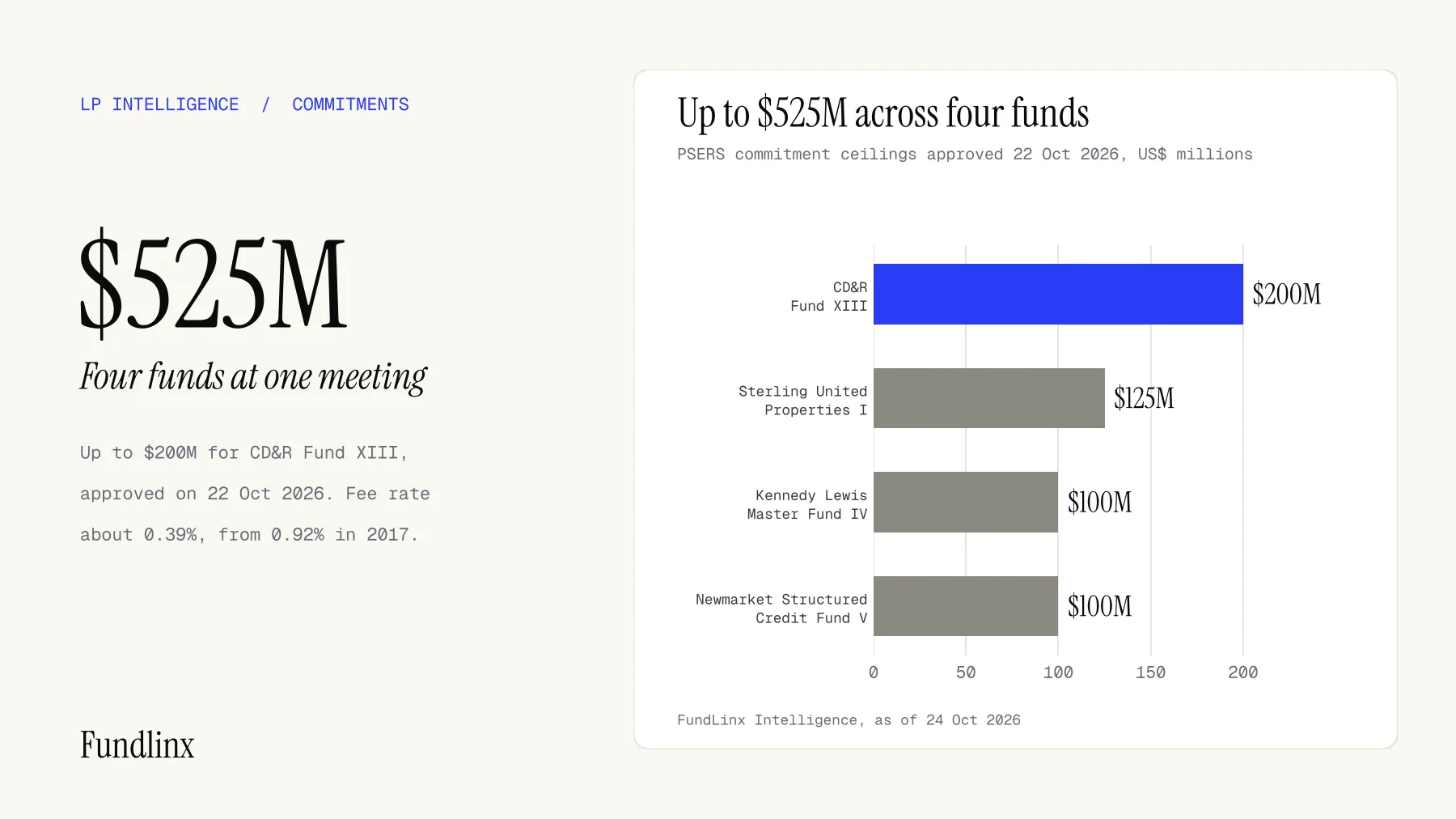
The Pennsylvania Public School Employees' Retirement System approved new commitments of up to $525 million to four funds at its trustee meeting on 22 October 2026, led by up to $200 million for CD&R Fund XIII. The same announcement reported investment fee savings of more than $197 million in the fiscal year to 30 June 2026 and a fee rate of about 0.39% of assets, down from about 0.92% in 2017. The system did not publish fund sizes, strategies or terms for the four commitments, so below we separate what it announced from what we infer.
What the board approved
Each approval is a ceiling, not a final amount: up to $200 million to CD&R Fund XIII, up to $100 million to Kennedy Lewis Capital Partners Master Fund IV, up to $100 million to Newmarket Structured Credit Solutions Fund V and up to $125 million to Sterling United Properties I. Reading the fund names and managers, one commitment is to a private equity fund, two are to credit funds and one is to a property fund. By capital that is about 38% private equity ($200 million), 38% credit ($200 million) and 24% property ($125 million) of the $525 million. By count it is 25%, 50% and 25% of four approvals. That split is our reading of the names, not a classification the system published.
The numbers in context
The size of this meeting stands out against the same meeting a year ago. On 23 October 2025 the board approved up to $100 million for Oak HC/FT Partners VI and up to $90 million for Graceada Partners Fund IV-QP, $190 million across two funds. This year's $525 million across four funds is about 2.8 times that figure. The broader numbers also moved. Net position rose to $90.9 billion from $83.7 billion a year earlier; the release describes the rise as about 10%, while our arithmetic on the two figures gives 8.6%, so they may use different bases. The fair value funded ratio rose to 73.60% from 68.04%, and the employer net pension liability fell to $32.6 billion from $38.3 billion in last year's announcement.
The fee story
The fee figures are the part a GP should read twice. PSERS says it saved more than $197 million in fees in fiscal 2026, which is 563% of the $35 million annual goal the board set in 2017. Over the same period its fee rate fell from about 0.92% of assets under management to about 0.39%. That is a fall of about 0.53 percentage points, or roughly 58% on our arithmetic. On the $90.9 billion net position, 0.39% is about $355 million a year, a rough figure because net position and the assets used for the fee rate may differ. The point is that a system that tracks and publishes its fee savings against a target will test every fund against that target.
The named LP
PSERS is a US state pension system for public school employees in Pennsylvania. The announcement names Richard Vague as chairman, Susan Lemmo as vice chair, Ben Cotton as chief investment officer and Uri Monson as executive director. Its tickets in this meeting ran from $100 million to $200 million, which is the only ticket-size evidence we can cite. We found no published position on first-time funds and have not assumed one. For comparable plans, see our list of US pension funds.
What a GP should do
This section is our advice, not guidance from PSERS. First, check whether your fund can absorb a ticket of that size. A $100 million ceiling is a large share of a fund under $1 billion, and a pension of this scale may prefer to hold a smaller percentage of any one fund, so be ready to explain how a large anchor would fit alongside your other investors. Second, put net returns and the full fee stack at the top of your materials. Show the management fee, how any fee offset works, and what happens to fees on co-investment. A system that has cut its fee rate by more than half will read these lines before it reads your track record. Third, pitch the sleeve, not just the fund. This meeting spanned private equity, credit and property, so a credit or real estate manager is competing for a share of a programme that is clearly active, not asking the system to start one.
A short checklist
Can you state your all-in fee in one sentence, net of offsets? Do you know which of the four managers above are also backed by your other LPs, which may give you a reference or an introduction? Have you compared your commitment pace with the system's recent activity, such as the Virginia Retirement System's $675 million of private equity and credit commitments or Kern County's $150 million across three strategies? Does your due diligence pack answer fee and reporting questions without a second email? Do not cite the system's fee savings back to it as a reason to invest.
What to watch next
Watch for the system's next trustee meeting, where further approvals could follow; we have not confirmed the date. Watch also for the final sizes of the four funds, which the system did not state, and for whether more of the budget goes to credit and property or to private equity. FundLinx members can see which pensions are active in your strategy.
FundLinx Intelligence | FundLinx.ai
Playbooks, LP moves and compliance notes for emerging managers. Unsubscribe any time.