Kern County's Pension Fund Commits $150 Million Across Quantitative Equity, Energy Credit and Real Estate Debt
KCERA split $150 million in September between a systematic equity mandate, an energy credit fund and a New York real estate loan. Two of the three built on managers it already backs.
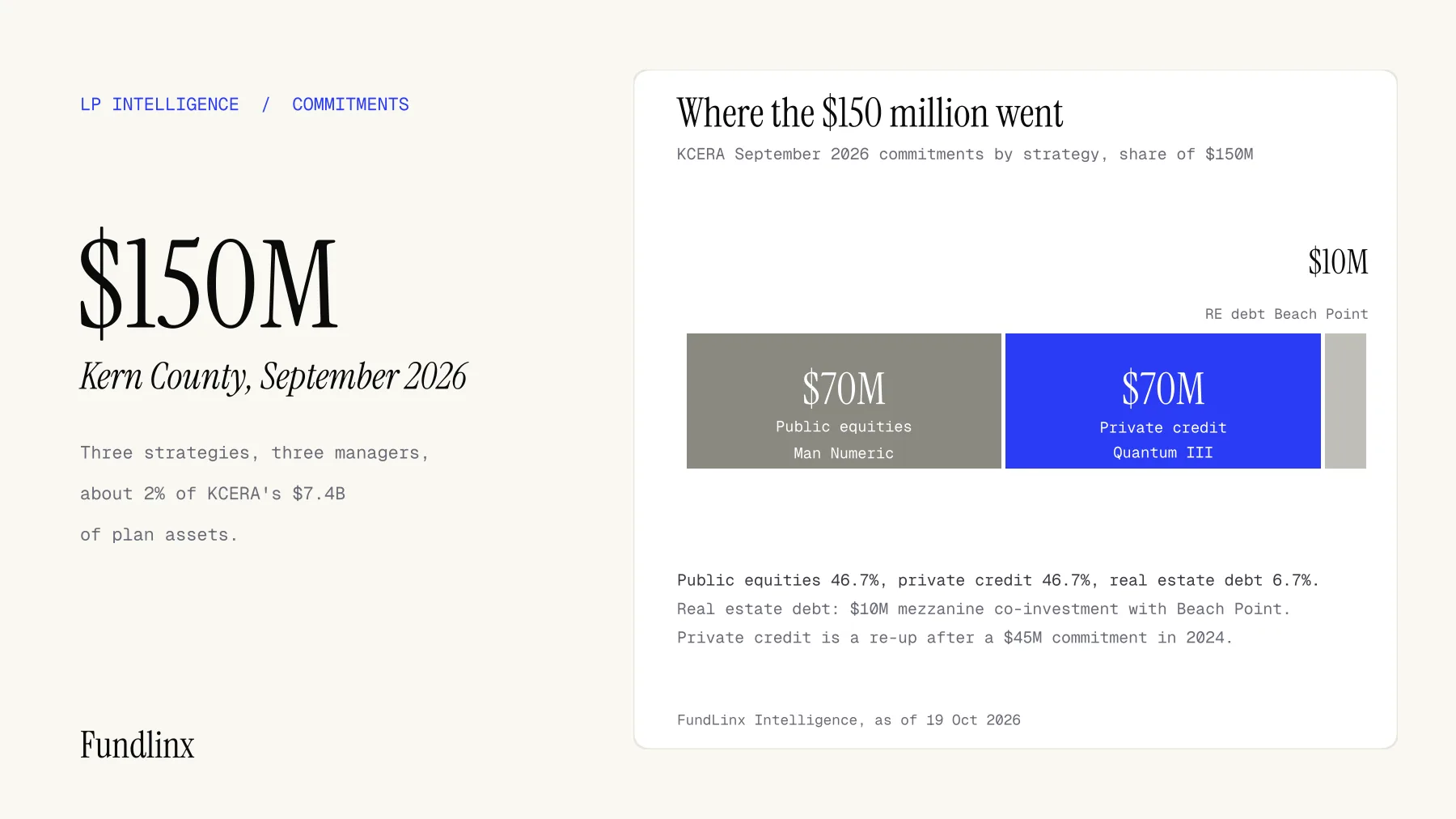
The Kern County Employees' Retirement Association (KCERA) committed $150 million across three strategies in September 2026, with the allocations becoming public in mid October. The three managers are Man Group's systematic equity arm, Quantum Capital Group and Beach Point Capital Management. The money is small against KCERA's plan assets of about $7.38 billion at 31 July 2026, roughly 2% of the total, which is our arithmetic. The mix is what makes it worth reading: a quantitative public equity mandate, an energy private credit fund and a real estate debt co-investment, all in one month.
What was committed
According to the reported breakdown, $70 million went to Man Numeric, an active systematic equity strategy that runs as a separately managed account with risk parameters set for KCERA. Another $70 million went to Quantum Capital Solutions III, a private credit fund from Houston-based Quantum that finances energy companies through asset-level financing, preferred equity and secured and unsecured debt. The remaining $10 million is a co-investment with Beach Point in a mezzanine loan refinancing a Class A mixed-use property in New York City. As shares of the $150 million, that is 46.7% to public equities, 46.7% to private credit and 6.7% to real estate debt. KCERA also committed $50 million in August to a Quantum energy fund, which would take the August and September total to $200 million, or about 2.7% of plan assets. The total and the three managers are widely reported, but the split between them has not been independently confirmed, so treat it as reported.
How it compares with earlier periods
Two of the three September commitments build on managers KCERA already uses. The private credit commitment is reported as a follow-on to a $45 million commitment to the predecessor fund, Quantum Capital Solutions II, in 2024, and KCERA's latest holdings report still lists that fund. The $10 million loan co-investment follows a $30 million commitment in 2025 to Beach Point's real estate debt fund. By count that is two of three commitments (67%) with an existing manager, and by capital $80 million of $150 million (53%). Quantum is the largest name in the pattern. Counting the August energy fund, Quantum-managed vehicles take $120 million of $200 million committed over two months (60%). The $10 million loan sits in KCERA's opportunistic real estate strategy, which is why a ticket that small can still carry weight: it extends a relationship that already exists. On this evidence KCERA is a pension that deepens relationships before it opens new ones, and a manager approaching it for the first time should plan for a longer runway than a manager it already holds.
The LP behind the commitments
KCERA is a California county pension, one of the many pension funds in the US that run mid-sized plans with a mix of public equities, credit, real estate and real assets. Its board approved changes to its investment policy statement on 12 August 2026 after a review of its capital efficiency programme, and staff have recommended keeping the long-term investment return assumption at 7.00% in the current experience study. A plan with a 7% target and a few billion dollars is a natural buyer of yield-oriented private credit. We do not have verified typical ticket sizes beyond the four amounts above, which range from $10 million to $70 million. For a nearby comparison, the LACERA consultant search shows how a larger California pension is reshaping its own process this month.
What GPs should do now
This is our advice, not a statement from KCERA. First, if you run energy, infrastructure or real estate credit, note that the $10 million Beach Point co-investment came after a fund commitment, so a co-investment sleeve is a realistic way to start a relationship at a modest size. Second, expect follow-on behaviour: the clearest path to a KCERA ticket is to be a manager it already holds, or to be introduced by one. Third, if your strategy is systematic or liquid, ask whether a separately managed account with KCERA-specific risk limits is the right structure, because that is how the quantitative mandate was set up. Fourth, prepare for a plan that is sizing commitments carefully against a 7% target, which means clear net yield, downside protection and reporting. Fifth, remember that September decisions surfaced in October, so the lag between a decision and public news is a few weeks, and your outreach should reference the strategy rather than the headline.
What to watch next
Watch KCERA's next board meetings for the decision on the 7.00% return assumption, for any further private credit or real asset commitments, and for whether Quantum's share of the book grows again. Our expectation, based on the four amounts above, is a run of $10 million to $70 million commitments rather than one large mandate, but that is a reading of the pattern, not a statement from KCERA. FundLinx members can see which pension funds are adding private credit this quarter, and our look at a UK pension's ring-fenced regional commitment shows another small-ticket route.
FundLinx Intelligence | FundLinx.ai
Playbooks, LP moves and compliance notes for emerging managers. Unsubscribe any time.