CPP Investments and OMERS Agree to Sell Their 63.9% of Associated British Ports to an IFM Fund, Ending Holds From 2006 and 2015
Two Canadian pension plans are selling their entire stakes in the UK's largest port operator to a fund managed by IFM Investors. Terms are undisclosed and closing is expected in 2027.
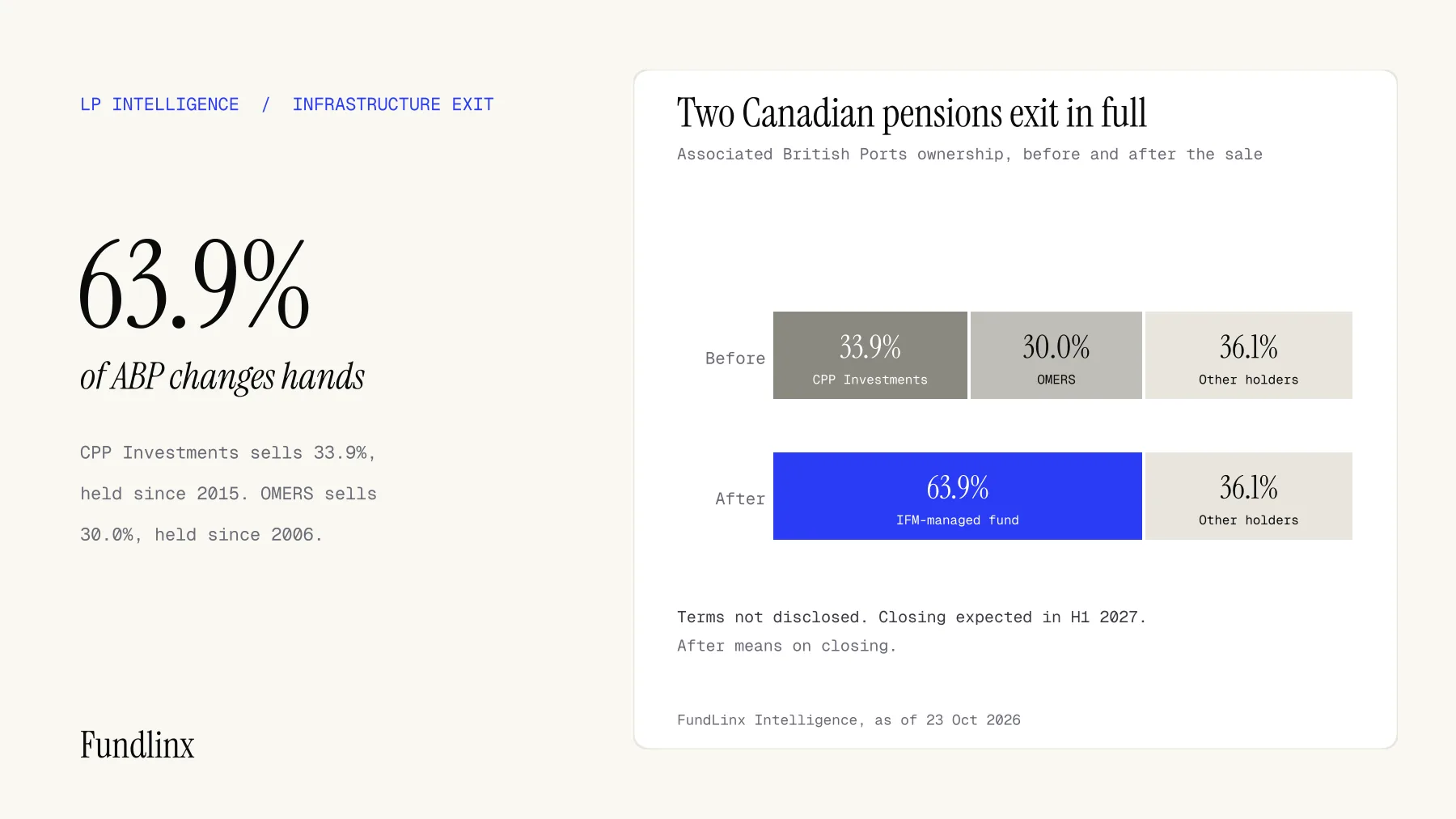
Two Canadian pension investors, CPP Investments and OMERS, have agreed to sell their entire stakes in Associated British Ports (ABP), the UK's largest port operator, to a fund managed by IFM Investors. The deal was announced on 21 October. CPP Investments is selling 33.9% and OMERS 30.0%, together 63.9%, which would give the IFM-managed fund a majority stake. Financial terms were not disclosed, completion is expected in the first half of 2027, and it needs shareholder and regulatory approvals. For LPs it marks the end of two long holds. For GPs it is a signal about where large pension capital may go next.
What changed
OMERS has held its stake since 2006 and CPP Investments since 2015, so the sellers are leaving after about 20 years and about 11 years. ABP operates 19 port facilities, including Southampton, Immingham and Hull, and handles about a quarter of UK seaborne trade. Its chief executive, Henrik L. Pedersen, called the deal an endorsement of the business and said ABP plans further growth alongside IFM and its remaining shareholders. Kyle Mangini, IFM's global head of infrastructure, said the investment would support the continued development of ABP's port infrastructure and operations. Both sellers said the sale lets them realise the value of long-term investments and redeploy capital.
The buyer is notable. IFM is owned by Australian pension funds and the UK's Nest, so one group of pension investors is buying from another through a manager that its own investors control.
The numbers in context
The two stakes add up to 63.9% of ABP, so 36.1% stays with other shareholders, a group the sources do not break down. The parties did not publish a price. Press reports put the valuation at about £10 billion, citing a person familiar with the matter. If that were the value of the whole company, a simple pro rata share of 63.9% would be about £6.4 billion, but the reports do not say whether £10 billion is equity value or enterprise value, so treat that as a rough guide and not a deal price.
Both sellers are Canadian pension plans and both are exiting in full, not trimming. That matters because a full exit frees all of the capital tied up in the asset, not part of it. CPP Investments has also been selling elsewhere in infrastructure: we covered its sale of two Sydney toll road stakes to Transurban, which makes this the second large infrastructure disposal from the same investor that we have reported since the start of October.
The named LPs
CPP Investments manages the investments of the Canada Pension Plan, and OMERS is the pension plan for Ontario municipal employees, which invests in infrastructure through its OMERS Infrastructure team. The ABP stake shows that both are willing to own large infrastructure assets directly and hold them for a long time. The sources we checked give no assets-under-management figures for either and say nothing about how either selects outside managers, so we have not assumed anything. OMERS has also been active in venture, and we covered Laura Lenz taking over as head of OMERS Ventures. For a plain definition of the type, see our glossary entry on a pension fund.
What a GP should do
This section is our advice, not guidance from either pension. First, treat the sale as a recycling signal and not as a retreat from infrastructure. The sellers said they intend to redeploy capital, but closing is not expected until the first half of 2027, so we would not expect proceeds to be available before then. That is our inference. Second, if you run an infrastructure strategy, use existing relationships to ask how the proceeds will be allocated and which sectors or regions the plans favour, because the announcement does not say. Third, be ready with a co-investment offer. An investor that has just owned a large direct asset for years will compare any fund pitch with the option of investing alongside a manager, so state your fees, carry and timeline on a co-investment sleeve up front. Fourth, study the buyer. IFM raises capital from pension funds and competes with GPs for assets, so check whether the pensions behind it are also on your target list and how your strategy differs by asset size, sector or geography.
A checklist for an infrastructure manager
This too is our advice. Can you describe your last exit and the IRR and multiple it delivered, net, in one paragraph? Do you know which of your LPs hold a direct asset in the same sector, and whether they would see you as a complement or a rival? Is your fund large enough to be a meaningful ticket for a pension that has just sold a stake worth several billion pounds on press estimates, or would a co-investment or separate account fit better? Have you mapped who covers infrastructure at each Canadian pension, and do you share a co-investor or adviser with them? A clear answer to each makes a first meeting more useful on both sides. For the wider fundraising backdrop, see our note on three mega funds that closed more than $42 billion of infrastructure capital in the third quarter.
What to watch next
Watch for the closing in the first half of 2027, for any confirmation of the price, for who holds the remaining 36.1%, and for any statement on how the proceeds are redeployed. FundLinx members can see which pension funds are active in infrastructure.
FundLinx Intelligence | FundLinx.ai
Playbooks, LP moves and compliance notes for emerging managers. Unsubscribe any time.