Wesleyan's Endowment Grows $231 Million to $1.87 Billion With Private Equity at 49.6% of Long-Term Investments, and the University Sold Fund Interests at 12.5% Below Net Asset Value After Year-End
Wesleyan's endowment rose about $231 million to $1.87 billion, with private equity at 49.6% of long-term investments. After year-end it sold fund interests for 87.5% of their stated value.
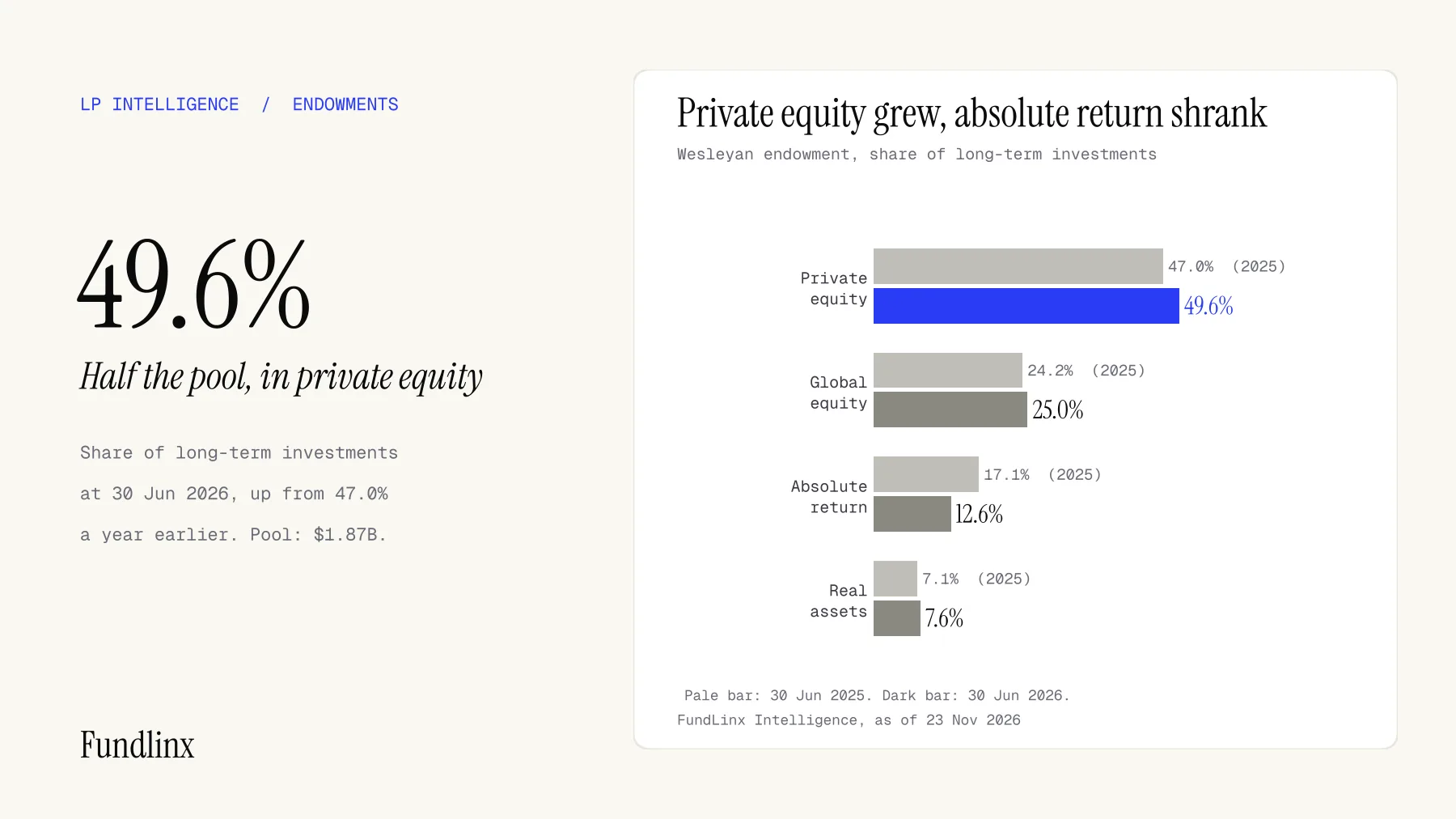
Wesleyan University's endowment grew by about $231 million to $1.87 billion in the fiscal year to 30 June 2026, and private equity now makes up 49.6% of its long-term investments, up from 47.0% a year earlier. The university also reported that on 30 September 2026 it sold private equity fund interests with a net asset value of $83.6 million for gross proceeds of $73.2 million, which is 87.5% of that value, or a 12.5% discount, on our arithmetic. These are the first results since Jonathan Farrar took over as chief investment officer on 1 July.
What the university reported
The endowment stood at about $1.64 billion on 30 June 2025 and at about $1.87 billion a year later, a rise of roughly 14.1%. The university reported an investment return of about $288 million for the year. Measured against the opening value, that is about 17.6% on a simple check of our own, while a 17.9% return has been reported separately. We cannot reconcile the gap of 0.3 points, so treat both as approximate. The endowment paid out $69.7 million to support operations, up from $66.7 million a year earlier, or about 4.6% more. That equals 22.3% of the university's $312.1 million of operating revenue. The board has approved $72.3 million for the current fiscal year.
Where the money sits
The long-term investment pool was about $1.91 billion at 30 June 2026, against $1.67 billion a year earlier. The pool is slightly larger than the endowment itself, so shares below are of long-term investments, by capital. The university does not give a count of funds, so we cannot give shares by count.
Private equity was $949.6 million, or 49.6%, up from $783.1 million, or 47.0%. That is $166.5 million more, a rise of about 21.3% in the dollar holding. Global equity was $478.1 million, or 25.0%, against 24.2%. Absolute return strategies fell to $242.1 million, or 12.6%, from $285.8 million, or 17.1%, a drop of $43.7 million, about 15.3%. Real assets were $146.0 million, or 7.6%, against 7.1%. Fixed income was 1.9% against 2.2%, and cash and equivalents were 1.7% against 0.9%. We do not know whether the shift out of absolute return reflects policy, redemptions or markets.
The sale after year-end
The most unusual line is the sale. On 30 September 2026 the university sold private equity fund interests with a net asset value of $83.6 million for $73.2 million. We have not seen the funds or the buyer named. A discount of that size on a secondary transaction is a single data point, not a policy statement, but it comes from an investor that is already about half in private equity, with a payout to fund every year.
How this compares with the prior year
In fiscal 2025 the pool returned 8.2%, against 10.0% for its composite benchmark, and the university said it trailed most benchmarks. Its ten-year return to June 2025 was 9.5%. The endowment grew about $58 million in fiscal 2025, so this year's rise of $231 million is roughly four times larger on our arithmetic. Across the wider market, we reported earlier this month that endowments gained a median 0.7% in the third quarter while corporate pensions lost 3.7%, which shows how far results for this LP type can vary by fiscal year.
Who the limited partner is
Wesleyan University is a private liberal arts university in Middletown, Connecticut, and one of the endowments in our coverage. Anne Martin retired as chief investment officer on 30 June after 16 years leading the office. Farrar, previously the deputy chief investment officer, took over the next day. An endowment of this size and mix is a meaningful private equity investor for its size. We have not verified ticket sizes, fund-level targets or whether it backs first-time funds. Leadership change at another asset owner was the subject of our piece on the McKnight Foundation naming its first chief investment officer.
What a fund manager should do
This section is our advice, not guidance from the university. First, treat the first year of a new chief investment officer as a window, and use the sequence in our guide to a warm path to LPs rather than a cold email. Second, if you run private equity, expect questions on distributions. An investor paying out about $70 million a year, and selling interests at a discount, will care about cash returned as well as the mark, so show your realised track record and the timing of distributions. Third, if you run an absolute return strategy, expect to defend your slot, because that sleeve shrank by about $44 million in the year, whatever the cause. Fourth, ask early about how the endowment sizes tickets, since a $1.87 billion pool backs smaller commitments than the largest pensions. Fifth, do not read a 12.5% discount on one sale as the price of your fund. It is one sale of unnamed interests.
What to watch next
Watch whether Farrar changes the private equity target in the coming months, whether the university sells more fund interests, and what the next annual update shows for the absolute return share. FundLinx members can see which endowments are active in private equity.
FundLinx Intelligence | FundLinx.ai
Playbooks, LP moves and compliance notes for emerging managers. Unsubscribe any time.