Connecticut's Pension Funds Raise Their Global Equity Target to 43% From 37% and Cut Absolute Return to 2% From 5%, as the Council Weighs About $1 Billion of Private Market Commitments
Connecticut moved 8 points of its long-term targets on 18 November, lifting global equity to 43% and cutting absolute return to 2%. Staff also put four private market commitments before the council.
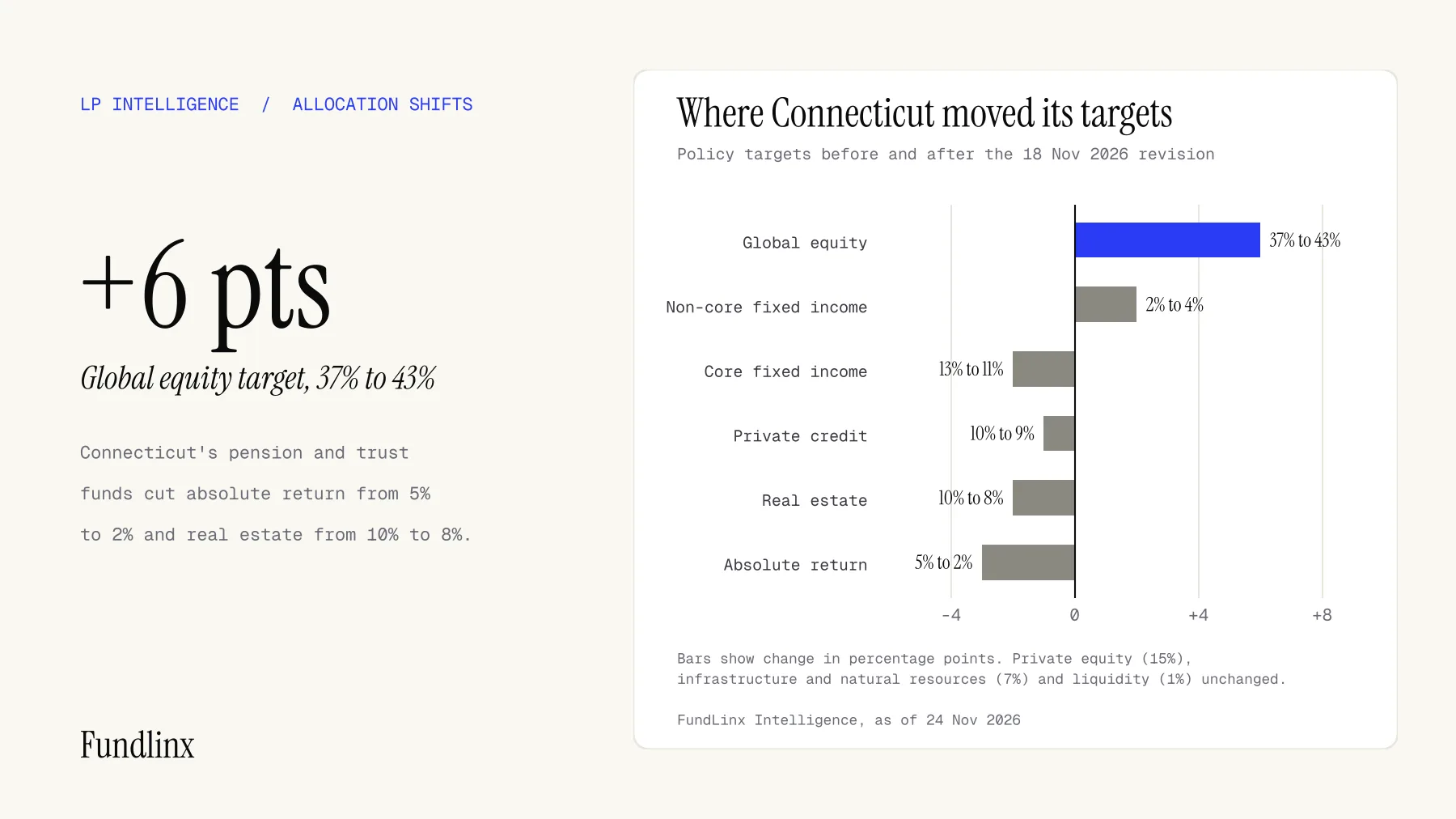
On 18 November 2026 the Connecticut Retirement Plans and Trust Funds, the pension and trust fund pool run by the State Treasurer, adopted a revised investment policy that lifts its long-term global equity target to 43% from 37% and cuts its absolute return target to 2% from 5%. The same council meeting heard staff recommendations for four private market commitments worth up to about $1.0 billion in total, on our arithmetic. Treasurer Erick Russell announced the changes and called asset allocation one of the most consequential decisions a fiduciary makes.
What changed in the targets
The policy statement was last revised in July 2025, when staff made 60 edits. This time staff proposed seven, of which three were substantive, and said the substantive ones came from the asset allocation committee. Global equity rises to 43% from 37%. Non-core fixed income doubles to 4% from 2%. Core fixed income falls to 11% from 13%, private credit to 9% from 10%, real estate to 8% from 10% and absolute return to 2% from 5%. Private equity stays at 15%, infrastructure and natural resources at 7% and liquidity at 1%. Both sets add to 100%. Eight points moved out of four sleeves and into two. Taken together, the private markets targets (private equity, private credit, real estate and infrastructure and natural resources) fall to 39% of the fund from 42%. The changes were presented by Deputy Chief Investment Officer Denise Stake, Principal Investment Counsel Karen Grenon and Deputy Director of Corporate Governance and Sustainable Investments Jessica Weaver.
Where the fund sits against those targets
At 30 September 2026 private equity was about 11.8% of the fund, with a market value of $8.8 billion and $7.8 billion of unfunded commitments. That is 3.2 points under the 15% target. Private credit was about 6.3%, or $4.7 billion, with $5.3 billion unfunded, against the new 9% target. Infrastructure and natural resources were 3.6% at 30 June against 7%, or 6.7% once unfunded and recommended commitments are counted. Those two market values imply a fund of roughly $75 billion, our own arithmetic. These are shares of capital. No manager counts were given, so we cannot give shares by count. Staff set 2026 pacing at $2.4 billion of new private equity commitments and $2.5 billion of private credit commitments.
The four commitments before the council
Staff recommended up to $525 million to Top Tier-CT Venture Partners II, a fund of one that succeeds an existing vehicle with the same venture manager. Venture is 6% of private equity exposure today, inside a long-term range of 5% to 10%. Staff also recommended $250 million to Anchorage Credit Opportunities X, a stressed and distressed credit fund targeting $1.75 billion with a $2.5 billion hard cap, plus $100 million to its co-investment vehicle. The fund terms shown include a 1.25% management fee on invested capital for commitments of $100 million or more, 20% carried interest and an 8% preferred return. Staff also recommended up to $150 million to Homestead Capital Credit I, a first-lien lending fund backed by US farmland that targets $350 million with a $500 million hard cap and a 9% to 13% net return. Its terms include a 1.5% fee, 15% carry and a 7% preferred return. The council heard presentations on all four, but we have not seen final commitments.
How this compares with prior periods
The fund returned 15.1% in fiscal 2026, after 10.14% in 2025, 11.5% in 2024 and 8.5% in 2023, and each year beat its 6.9% assumed return. The Treasurer said it outperformed nearly 80% of large US public plans in fiscal 2026. On the absolute return cut, staff showed a three-phase move from risk-mitigating strategies to liquid alternatives with a low beta to global equities, expected to finish by the end of 2027. Other asset owners are reworking the same sleeve. We covered how a Colorado pension is raising its diversifiers target and how CalPERS unveiled a diversifying multi-strategy initiative. The real estate cut also fits the wider pattern in our look at institutions holding real estate targets above where they sit.
Who the limited partner is
Connecticut Retirement Plans and Trust Funds is the investment pool for six state pension funds and thirteen trust funds, with the State Treasurer as principal fiduciary. Ted Wright is chief investment officer, and the Treasurer's office received an industry innovation award in the category for public defined benefit plans above $50 billion. It is one of the pension funds in our coverage. Staff said about 90% of 2026 private equity commitments went to existing managers, and that co-investments and other fee-advantaged vehicles make up about 25% of private equity exposure and about 21% of private credit exposure.
What a fund manager should do
This section is our advice, not guidance from the Treasurer. First, expect the door to be narrow for new private equity names: the one manager added in 2026 fits a stated aim of more mid-market European buyout exposure. Second, if you run credit, special situations was 16% of private credit exposure against a range of 0% to 40%, so there is room for a specialist with a loss record to show. Third, if you run liquid alternatives, the slot is now 2%, and staff described the target profile as a beta to global equities of 0.1 to 0.3, returns above cash plus 500 basis points and a Sharpe ratio above 1.5, so lead with correlation evidence. Fourth, offer fee-advantaged structures, since staff track them against a 15% to 30% range in private equity. Fifth, read our guide on LP allocation trends in 2026 before you build the pitch.
What to watch next
The 2026 infrastructure and natural resources pacing plan was set at the January 2026 council meeting, so the January 2027 meeting is the next place to look for 2027 pacing and any shift in how much goes to new managers. Funds that fit the new targets can see which LPs are rebalancing this quarter.
FundLinx Intelligence | FundLinx.ai
Playbooks, LP moves and compliance notes for emerging managers. Unsubscribe any time.