CalPERS Unveils a Diversifying Multi-Strategy Initiative to Reduce the Risk of Its Growth Assets, Built Around Risk Mitigation, Absolute Return and Dynamic Allocation
CalPERS is incubating a diversifying multi-strategy program with three strategies, and its latest figures show about $2.6 billion in the new book inside a $651.3 billion fund.
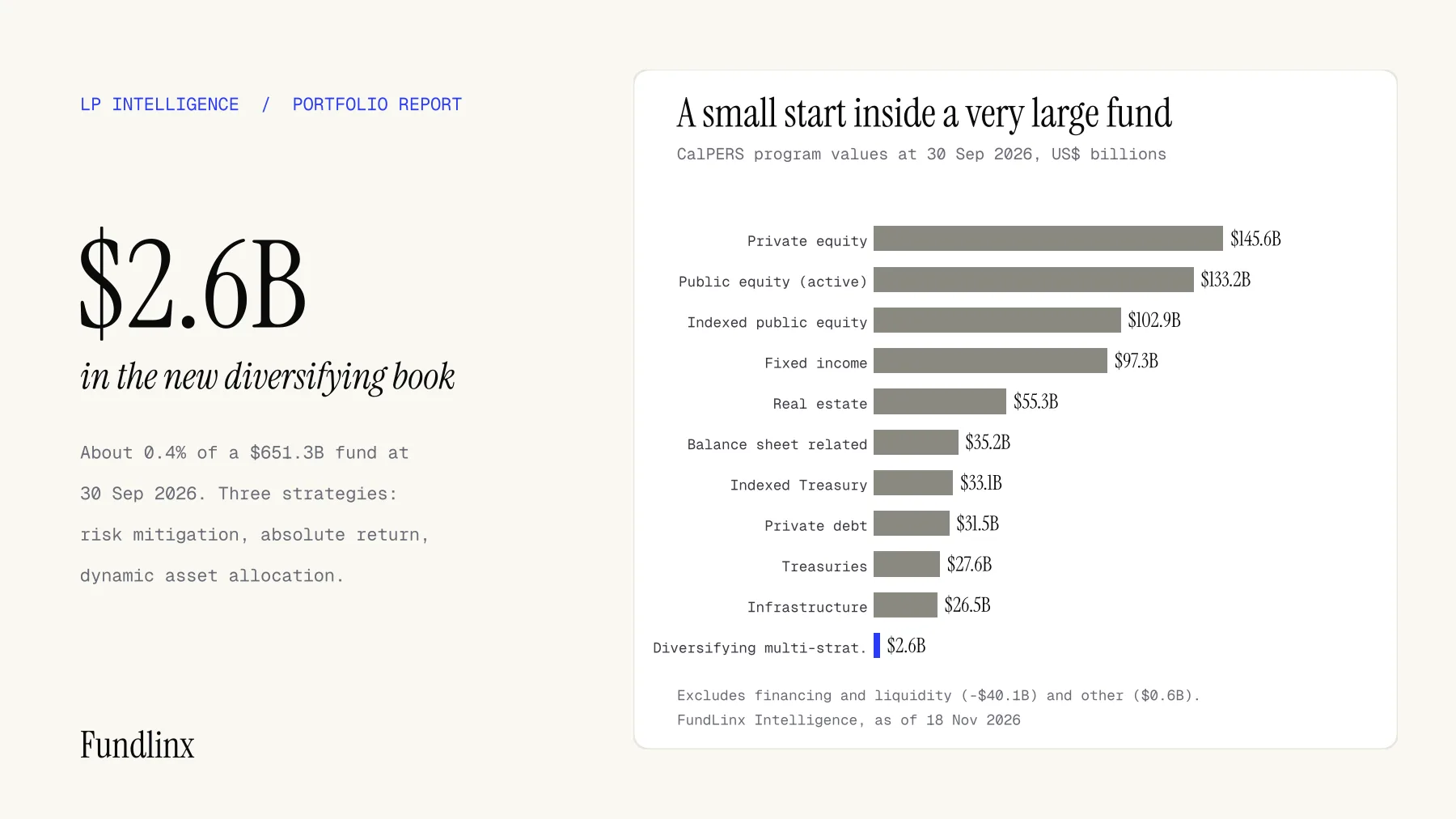
CalPERS introduced a "diversifying multi-strategy" initiative at its Investment Committee meeting on 16 November 2026, a new effort aimed at reducing the risk of the fund's growth assets. CalPERS described three strategies inside the program: risk mitigation, absolute return and dynamic asset allocation. The program is still being incubated. The fund's latest portfolio figures, at 30 September 2026, show about $2.6 billion in the new book, against a total fund of $651.3 billion.
What CalPERS said it is building
CalPERS told its committee that it had secured approval to incubate the program and had set up nine cross-functional workstreams. It said it had developed three distinct strategies, each designed to deliver unique benefits to the total fund, and that the overall aim is to improve the fund's risk-return profile and resilience through complementary diversifying strategies. The work builds on the fund's existing insurance-linked securities program. CalPERS also said it had designed a governance and operating model with objectives for the 2026-27 fiscal year, and that its team is working with the treasury function to assess the liquidity requirements of these strategies.
Equally important is what CalPERS did not say. As far as we can see, it has not published a target size or budget for the program, a return target, the number of managers it expects to use, how managers will be selected, or the date the incubation was approved. A $2.6 billion book is a starting point, not a mandate size, and nothing announced suggests a figure for where it should end up.
The scale, in context
At about $2.6 billion, the new book is roughly 0.4% of a $651.3 billion fund, which is our arithmetic. For comparison, the portfolio's largest program, private equity, stood at $145.6 billion at the same date, real estate at $55.3 billion, private debt at $31.5 billion and infrastructure at $26.5 billion. The new book is smaller than every other named program, and we read the $2.6 billion as the early stage of a build.
The wider fund numbers explain why diversification is on the agenda. CalPERS reported a one-year return of 11.3% to 30 September 2026 against 7.6% for its reference portfolio, and an equity-equivalent exposure of 75.2% against an operating range of 75% plus or minus 5 points. Active risk was 250 basis points, at the bottom of a 250 to 350 basis point range. These are the first quarterly figures since the total portfolio approach took effect for the main pension fund on 1 July 2026. CalPERS adopted that approach in November 2025.
How this compares with other recent moves
CalPERS is not the only pension building an uncorrelated book. We reported that the Fire and Police Pension Association of Colorado committed $240 million to Millennium and NovaCore while holding diversifiers at 11.1% against an 11% target, and that the State of Wisconsin Investment Board added $2.75 billion across hedge funds, private equity and real estate. The CalPERS program differs in that it is a named internal initiative with three defined strategies, not a set of individual manager commitments. Earlier we also showed that CalPERS earned 14.8% but only 6.83% a year over five years, a long-run figure close to its assumption. We read that as one reason a lower-risk return stream is attractive, though CalPERS has not said so.
Who the limited partner is
CalPERS is the largest US public pension fund and is based in California, with Stephen Gilmore as chief investment officer. The new program sits within its total fund portfolio management team, led by Derek Walker as managing investment director. We have not verified its ticket sizes for this program or whether it will use emerging managers. You can browse US pension funds in the FundLinx directory.
What a fund manager should do
This section is our advice, not guidance from CalPERS. First, do not assume a mandate is open. No manager selection process has been published, and the program is in incubation. Second, place your strategy in one of the three named buckets and say which: a strategy that protects in drawdowns fits risk mitigation, a return stream that does not depend on equity direction fits absolute return, and a strategy that shifts exposure across markets fits dynamic allocation. Third, expect liquidity to be a leading question, because CalPERS said it is assessing liquidity requirements with its treasury function, so set out redemption terms and how the strategy behaves under stress. Fourth, show your correlation to equities in down markets, because the fund frames its own exposure around equity-equivalent exposure and active risk. Fifth, build a verifiable track record in the bucket you choose. The relevant team may be in total fund portfolio management rather than an asset-class program, so confirm before approaching.
What to watch next
The next scheduled checkpoint is the Investment Committee meeting on 15 March 2027, though we have not seen whether the program will be on its agenda. Watch whether the $2.6 billion grows, whether any target or budget is disclosed, and whether CalPERS begins naming managers. FundLinx members can see which pensions are building diversifying strategies.
FundLinx Intelligence | FundLinx.ai
Playbooks, LP moves and compliance notes for emerging managers. Unsubscribe any time.