Oxford University Endowment Management Names Caroline Serdarevic Chief Executive as Sandra Robertson Retires
Oxford's endowment manager has hired the head of international and global sales at Millennium Advisors as CEO, starting 2 November 2026. The chief investment officer stays in place.
Oxford University Endowment Management, known as OUem, announced on 1 October 2026 that Caroline Serdarevic will become its chief executive officer. She joins on 2 November 2026, subject to approval from the UK Financial Conduct Authority, and replaces Sandra Robertson, who announced her retirement last December after two decades leading the firm and stands down on 29 January 2027. Neamul Mohsin remains chief investment officer, so the person who runs the portfolio does not change. The size of the Oxford Endowment Fund was not given in the announcement.
Who is arriving
Serdarevic joined Millennium Advisors in 2016 and most recently served as its Head of International, Global Head of Sales and a member of its Global Executive Committee. OUem's announcement adds that earlier in her career she worked at RBS, Morgan Stanley and Citi, where she managed relationships with UK institutional investors in credit markets. She holds a first-class law degree from Brasenose College, Oxford, is a CFA charterholder and has more than 20 years in financial markets. OUem's chair, Quintin Price, said the board ran a thorough search and that she brings a deep understanding of what institutional investors need.
Our reading of the hire is this. The new chief executive comes from the distribution side of asset management rather than from running a portfolio. That fits an organization whose main customers are its own charitable investors, and it leaves the investment seat with the person who already holds it.
The LP behind the hire
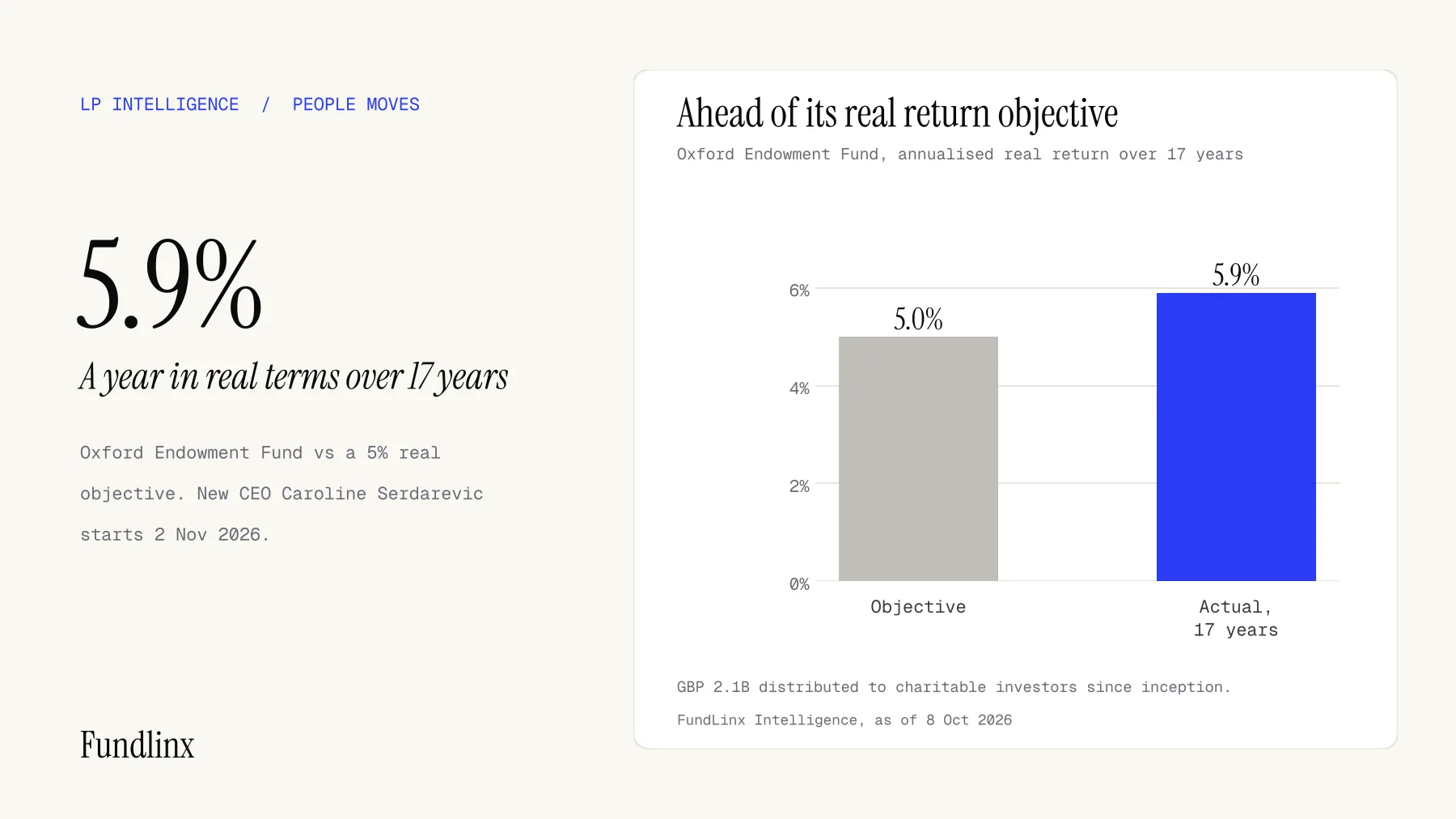
OUem manages the Oxford Endowment Fund for more than 45 charitable investors, including the University of Oxford and many of its colleges. The fund has distributed GBP 2.1 billion to them since inception, and over 17 years it has returned 5.9% a year in real terms against a real return objective of 5%. Those are the firm's own figures. By our arithmetic, 5.9% against 5.0% is 0.9 percentage points a year ahead of the objective, which compounds to roughly 16% more real purchasing power over 17 years than a steady 5% would have produced. The fund's aim is to protect the inflation-adjusted value of endowments while paying a steady annual distribution, which is a different brief from a US university endowment that reports one-year nominal returns. Results such as MIT's 10.3% for fiscal 2026 are not comparable with a 17-year real figure, and we do not compare them here. For the wider group, see the page on endowments and the UK investors tracked on FundLinx, and our definition of an endowment.
What stays the same, and how this compares with other LP moves
This is the third LP leadership change we have covered in four days. On 5 October we wrote about the Mellon Foundation promoting its deputy to chief investment officer, and on 6 October about the Colorado Health Foundation's hire of a managing director for private markets. Two of the three, or 67%, are investment seats and one, or 33%, is a chief executive. None of the three involved a disclosed amount of capital, so there is no capital percentage to compare. The point is that the Oxford move changes the investor-facing role while the investment role stays put, which is the reverse of the other two. In practice the fund's objective, its pooled structure and its investment leadership are all unchanged by the announcement, so a GP that was a credible fit last month is still a credible fit now.
What GPs should do now
This section is our advice and not something OUem said. First, keep your manager conversation with the investment team. The announcement says the chief investment officer continues, so work already under way with Mohsin's team has no stated reason to stop.
Second, expect the organization to be busy from 2 November to 29 January, when two chief executives overlap and then one leaves. Routine diligence will carry on, but a request that needs a change in how the firm works, such as a new reporting format or a new co-investment process, is better made after the handover than during it.
Third, shape your materials for a pooled fund that serves charities. The stated yardstick is real return against a 5% objective with a steady distribution, so show net returns in real terms, your distribution record and how liquid the commitment is. A pitch built around a high one-year gross number answers a question this investor is not asking.
Fourth, treat the new chief executive as a person to meet later, not first. Her background is in selling to institutions, and we expect her early meetings to be with OUem's own investors. Our recommendation is to ask for an introduction through the investment team once she has settled in, and to prepare a short note on how your fund fits the fund's real return objective. Our note on what to send a chief investment officer in endowment results season applies equally here.
What to watch next
Watch for the regulator's approval of the appointment before 2 November, for any statement from the incoming chief executive about priorities, for the handover on 29 January 2027, and for any disclosure of the fund's size. FundLinx members can see which endowments are adding to private markets.
FundLinx Intelligence | FundLinx.ai
Playbooks, LP moves and compliance notes for emerging managers. Unsubscribe any time.