CalPERS Looks to Add Energy-Transition Private Credit, Building on an $800 Million Goldman Sachs Fund
CalPERS wants more private credit aimed at the energy transition, and says it has seen near-equity returns for debt risk. Only $11 billion of $41.3 billion invested in the sector in H1 2026 was debt.
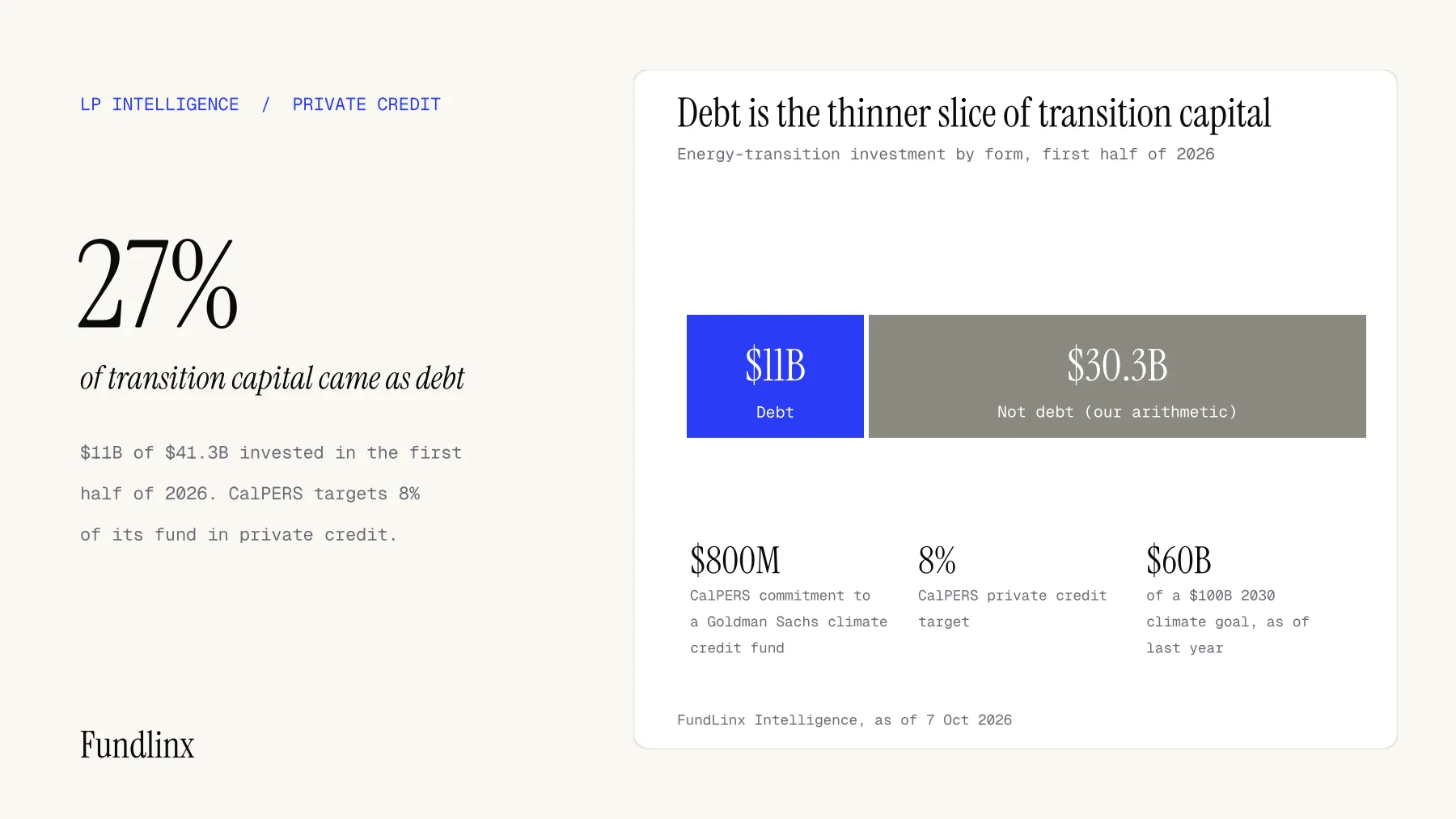
The California Public Employees' Retirement System, known as CalPERS, is looking to put more of its private credit programme into the energy transition, according to comments made public on 5 and 6 October 2026. It already has an $800 million commitment to a climate-focused private credit fund run by Goldman Sachs Asset Management, and it has an overall target of 8% of its portfolio in private credit. Peter Cashion, who oversees its sustainable investment programme, described specialised green energy lending as an underused corner of the market and said the fund has been able to earn returns more usually seen in equity while taking debt-level risk. How much new capital CalPERS would commit, to whom and by when were not disclosed.
What was said
CalPERS manages roughly $640 billion. It has a goal of investing $100 billion in climate solutions by 2030, and about $60 billion had been invested as of last year. Cashion's argument is that energy-transition companies have raised a great deal of equity but need leverage to reach profitability and scale, and that most private credit managers lend against conventional corporate cash flows rather than against greenfield and brownfield energy projects. That leaves, in his view, little specialist competition for the lender willing to underwrite them.
The market data support the gap he describes. Of $41.3 billion invested in energy-transition assets in the first half of 2026, only $11 billion came as debt. That is 27% of the capital, and by our arithmetic the other $30.3 billion, or 73%, was not debt. A count of deals was not provided, so the share by number of transactions is unknown. If debt were to make up a larger share of a sector this size, the lending opportunity would be considerably larger than the $11 billion that has been written this year.
The LP behind the programme
CalPERS is a US public pension fund based in California and one of the largest in the world. The $800 million is a committed capital figure, so we do not know how much has been drawn. We have not seen a stated ticket range for a new energy-transition credit manager, or any statement on whether it backs first-time credit managers.
How this compares with CalPERS' recent record
CalPERS is a frequent subject in our coverage. We covered how a 14.8% one-year return sat beside a five-year return of only 6.83%, barely above its 6.8% assumption, and how US public pensions committed $100.9 billion to private equity in 2025, with CalPERS taking the largest share. A fund whose five-year return sits close to its assumption has a reason to look for yield that does not rely on equity markets, and credit with equity-like returns is the kind of exposure that fits.
Other pensions are moving in the same direction. We covered how Oregon, over its private equity target and adding 7.5% in credit, is rebalancing toward credit. Two large US public plans pointing at credit in recent weeks is a pattern, though two is a small count and we would not call it a trend yet.
What GPs should do now
This section is our advice and not something CalPERS said. If you run a credit strategy that lends to energy-transition projects, whether renewable generation, storage, grid assets or transition infrastructure, this is a moment to reach the sustainable investment programme, not only the private credit team. The programme's stated view is that this debt is underused, so a pitch that shows where your loans sit against the equity in the same projects will land better than a generic credit pitch.
Show the numbers the argument turns on. CalPERS says it sees equity-like returns for debt-level risk, so a GP should be ready to show loss and recovery history, the position in the capital structure, how the coupon is set, and what happens in a downside case for a project that is delayed or over budget. A credit track record that cannot be broken down by project type will struggle against that framing.
Be ready for structure as well as a fund. The $800 million sits in one manager's fund, but a programme with a $100 billion goal may also use separate accounts or co-investment. If your strategy has capacity for either, say so in the first conversation. Our guide to how LPs allocate covers how to frame that.
Finally, remember the liquidity side of private credit. Evergreen credit vehicles have seen heavy redemption requests this quarter, which we cover in our playbook on liquidity terms. An institutional LP will notice if your terms depend on retail inflows staying steady.
What to watch next
Watch the agendas of CalPERS' investment committee for any staff proposal on a new energy-transition credit mandate, which would show a size and a timetable, and for any commitment news from the Goldman Sachs Asset Management fund it already backs. FundLinx members can see which pension funds are adding to private credit.
FundLinx Intelligence | FundLinx.ai
Playbooks, LP moves and compliance notes for emerging managers. Unsubscribe any time.