Ohio PERS Allocates $800 Million to Three Real Estate Debt Vehicles, Half of It to a First-Time Lodging Debt Account
Ohio PERS has allocated $800 million to three US real estate debt vehicles. Half goes to a separate account with Ohana, its first investment with that manager. The rest is split between two funds.
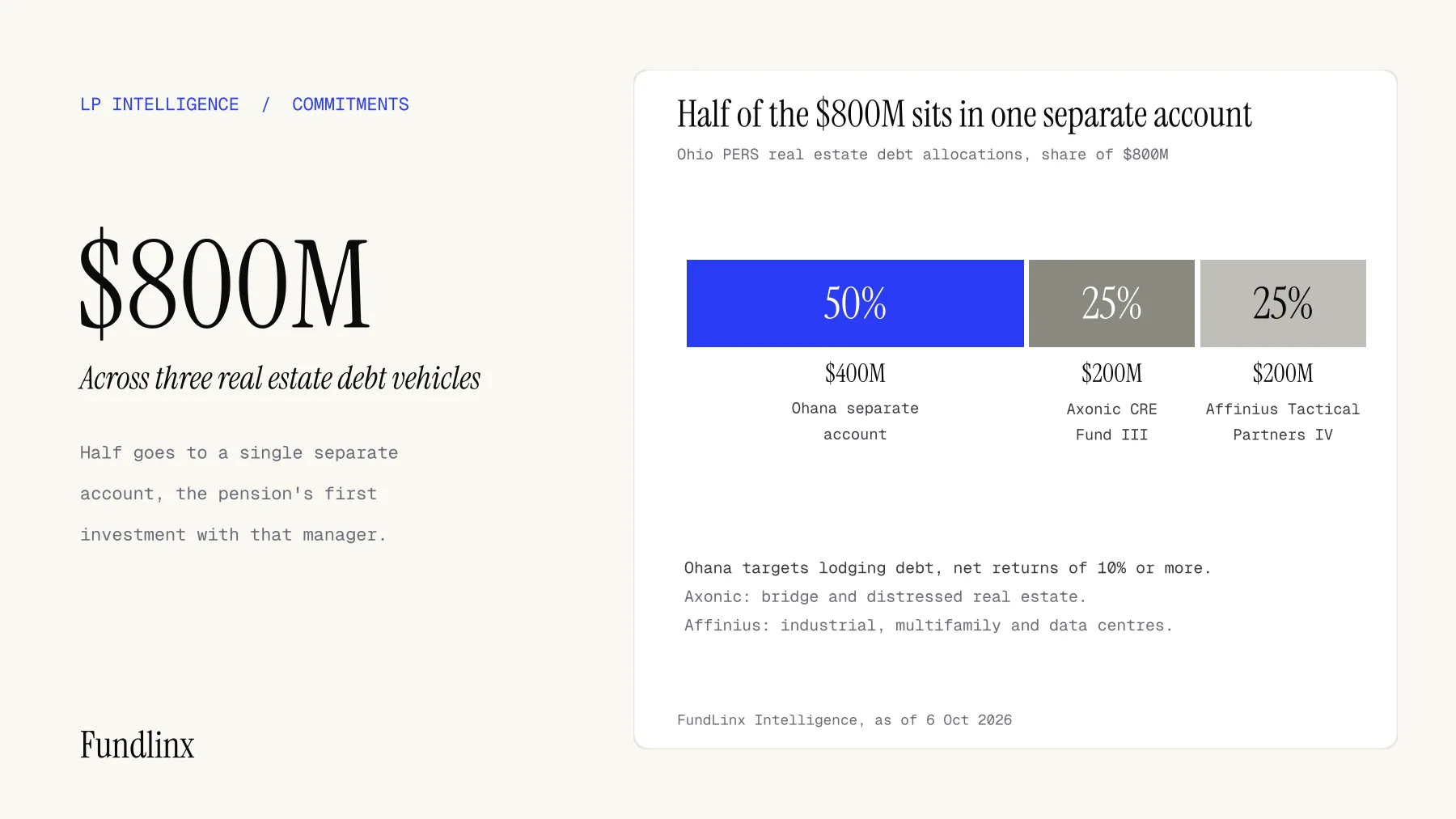
The Ohio Public Employees Retirement System has allocated $800 million across three US real estate debt vehicles, with the aim of enhancing portfolio yield and stabilising net asset value. The allocations were reported on 29 September 2026. Half, or $400 million, goes to a separate account with Ohana Real Estate Investors, the pension's first investment with that manager. The other $400 million is split evenly between Axonic Commercial Real Estate Fund III and Affinius Tactical Partners IV. By capital that is 50% to one separate account and 25% to each of two funds; by count, one of three vehicles is a separate account and two are commingled funds.
What each vehicle does
Ohana will hold full investment discretion over its $400 million account and will target debt opportunities in lodging assets. The expected net return is at least 10%, which gives other managers a reference point for what this LP is underwriting to in hospitality credit.
Axonic Commercial Real Estate Fund III targets US bridge financing, rescue capital and distressed real estate, which puts it at the opportunistic end of real estate debt. Affinius Tactical Partners IV is a debt vehicle focused on industrial, multifamily and data centre properties, which is a more conventional set of collateral types. Each commits $200 million. The pension has not stated a target return for either fund in what we have seen. An allocation is not a drawdown: the capital is committed now and called over time as the managers find loans, so the money will not reach borrowers all at once. For the mechanics, see our glossary entries on committed capital and the capital call.
How this compares with other credit commitments we have covered
Ohio PERS's move fits a pattern of public and insurance investors building private credit and real asset debt sleeves with a mix of structures. This week we covered Liberty Mutual's ceiling of up to $750 million with Orion Infrastructure Capital, another case of an LP using a managed account in credit instead of a blind-pool fund. We also reported that Oaktree's Asset-Backed Finance fund closed at $2 billion with US public pensions among its investors. Ohio PERS's $800 million is slightly above Liberty Mutual's $750 million ceiling and well under half of the Oaktree fund, by our arithmetic about 40%, though the three are different kinds of commitment. The common thread is a preference for yield and control of pacing, and a willingness to use both formats at once.
The LP behind the allocation
Ohio PERS is a large Ohio public pension, one of the US pension funds that GPs track for real estate and credit commitments. We have not quoted its assets or its real estate target, because the figures reported publicly differ by date and by measure, and we would rather leave them out than give a number we cannot tie to one date. What the allocation does tell us is the plan's approach: it gave the largest share to a manager that is new to it, in a niche with a stated return hurdle, and split the rest between two funds with different risk profiles. We do not know whether it had worked with Axonic or Affinius before, and GPs should not assume it had.
What GPs should do now
First, if you run real estate debt, decide which format you are offering and be ready to offer both. This LP used a discretionary separate account for half of the money and commingled funds for the rest. A manager that can only sell a fund will miss the first kind of mandate, and one that can only run accounts will miss the second.
Second, lead with a niche and a number. The account that received the largest share has a defined asset type, lodging, and a net return target of at least 10%. A pitch that names the collateral you lend against, the net return you underwrite to, and the loss history on similar loans is easier for a consultant to compare than a general real estate credit story.
Third, treat being a new manager as workable. Ohana's account is the pension's first investment with it, so incumbency was not a requirement. That is encouraging for newer managers, though it does not mean the process was easy, and we cannot tell how long the diligence took.
Fourth, plan for pacing. Because the allocation is not yet called, a manager that wins a mandate like this should expect deployment over time and should prepare reporting that shows the pace of draws, the pipeline and the yield on deployed capital to the plan's staff.
What to watch next
Watch for the first drawdowns on the three vehicles and for whether the pension adds to other credit strategies at its next board meeting. FundLinx members can see which pensions are allocating to real estate debt.
FundLinx Intelligence | FundLinx.ai