Liberty Mutual Can Deploy Up to $750 Million With OIC in Infrastructure Credit, $240 Million Already Committed
Liberty Mutual Investments has set aside up to $750 million for a new infrastructure debt strategy with Orion Infrastructure Capital. About 32% is committed already. What credit managers should note.
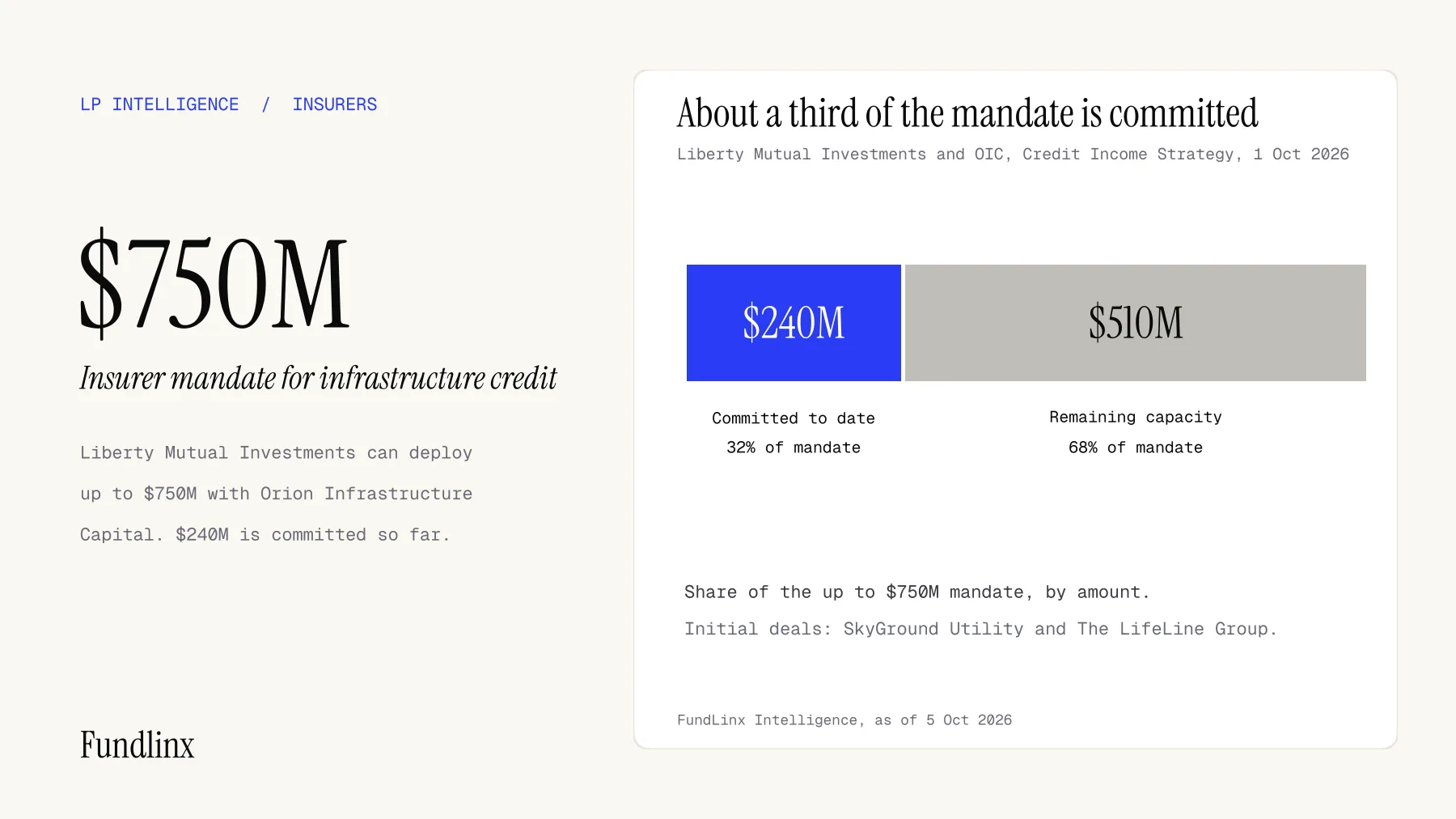
On 1 October 2026, Liberty Mutual Investments and Orion Infrastructure Capital (OIC) announced a Credit Income Strategy that focuses on middle market infrastructure debt. Under a long-term investment management agreement, Liberty Mutual Investments can deploy up to $750 million through the strategy, and $240 million has been committed to date. That means 32% of the ceiling is spoken for and $510 million, or 68%, is still available. The first two investments are SkyGround Utility, an electrical distribution and transmission business, and The LifeLine Group, which makes corn-based food ingredients and renewable fuel.
What the strategy targets
The mandate is aimed at businesses with resilient cash flows across five areas: energy infrastructure, transportation and logistics, power infrastructure, digital infrastructure, and waste and recycling. Ethan Shoemaker, OIC's Investment Partner and Head of Infrastructure Credit, said the commitment lets OIC "expand the range of capital solutions we can provide." John Kim, Liberty Mutual Investments' Head of Alternative Credit, said the firms were pleased to deepen a long-standing relationship. OIC manages about $6.6 billion and was founded in 2015, with about 50 professionals across New York, Houston and London.
The structure matters as much as the headline number. This is not a commitment to a blind-pool fund that closes on a single date. It is a long-term agreement under which the insurer's capital is drawn as deals are found, which is why the announcement gives a ceiling and an amount committed so far rather than a final size.
How this compares with earlier insurer and credit moves
This is not the only insurer move into credit that we have covered recently. Last week we looked at how Suva plans its first CLO purchases, a Swiss insurer taking a measured first step into a new credit niche. Liberty Mutual Investments is taking a similar approach: a defined ceiling, a manager it already knows, and a first tranche rather than the full amount at once. Compared with Suva's planned allocation of 2% of its portfolio, Liberty Mutual's up to $750 million is small against the more than $130 billion it invests globally, at roughly 0.6% if fully drawn. That calculation is our own, not a figure the firms published.
The LP behind the mandate
Liberty Mutual Investments invests more than $130 billion across public and private markets on behalf of Liberty Mutual Group. It is a corporate insurer investor, so its priorities differ from a pension fund's: steady income, credit quality, and assets that match long-dated liabilities usually matter more than headline return. The firm has not disclosed a standard ticket size for fund commitments, and the OIC arrangement is the only piece of that structure we can size. GPs should treat anything beyond it as unconfirmed.
What GPs should do now
The clearest lesson is about relationships. Liberty Mutual's team called its tie to OIC long-standing, which suggests the mandate grew out of earlier work rather than a cold search. A credit manager hoping to land a similar arrangement should start by listing the insurers it already touches through co-lenders, sponsors and borrowers, then ask which of those relationships could be formalised. Our look at how warm introductions help GPs close LPs sets out how to build that map.
Second, think about what a separate mandate offers an insurer that a commingled fund does not: control over pacing, sector limits and the speed of deployment. A manager that can offer a defined sleeve, with reporting that matches an insurer's investment committee calendar, is closer to what this announcement describes. For managers that are not yet at that scale, the co-investment route can be the first step. A deal-by-deal relationship builds the track record that a later mandate conversation will draw on. Infrastructure managers raising capital this year should also read how Contra Costa plans about $90 million a year for middle market infrastructure, since the same debt-versus-equity question runs through both stories.
Third, think about pacing. If the remaining $510 million were drawn in tranches like the $240 million committed so far, that would be a little over two more tranches of that size, by our rough arithmetic. That gives OIC a long runway, and it means the insurer will be looking at deals for some time. The two first investments, an electrical distribution business and a food ingredients and renewable fuel producer, also show how wide "infrastructure" can be in a mandate like this, so GPs should not assume the label means only the classic assets.
Fourth, be specific about sectors. The five areas named here are a ready-made checklist. A GP whose deals sit in power, digital infrastructure or logistics can point to the overlap in a single line, while a generalist pitch asks the insurer to do the matching itself.
What to watch next
Watch for the next deals under the strategy, since each new investment shows how quickly the $510 million of remaining capacity is used. A fast pace would be a sign that insurers are comfortable with this kind of structure. FundLinx members can see which insurers are active in your strategy.
FundLinx Intelligence | FundLinx.ai