Arizona's PSPRS Is 2.9 Points Under Its Private Equity Target and 2.1 Under Private Credit, and Says It Is Funding Both Incrementally
rizona's $28.1 billion public safety pension holds 23.1% in private equity against a 26% target and 17.9% in private credit against 20%, and says it is funding both gradually. What it means for a GP.
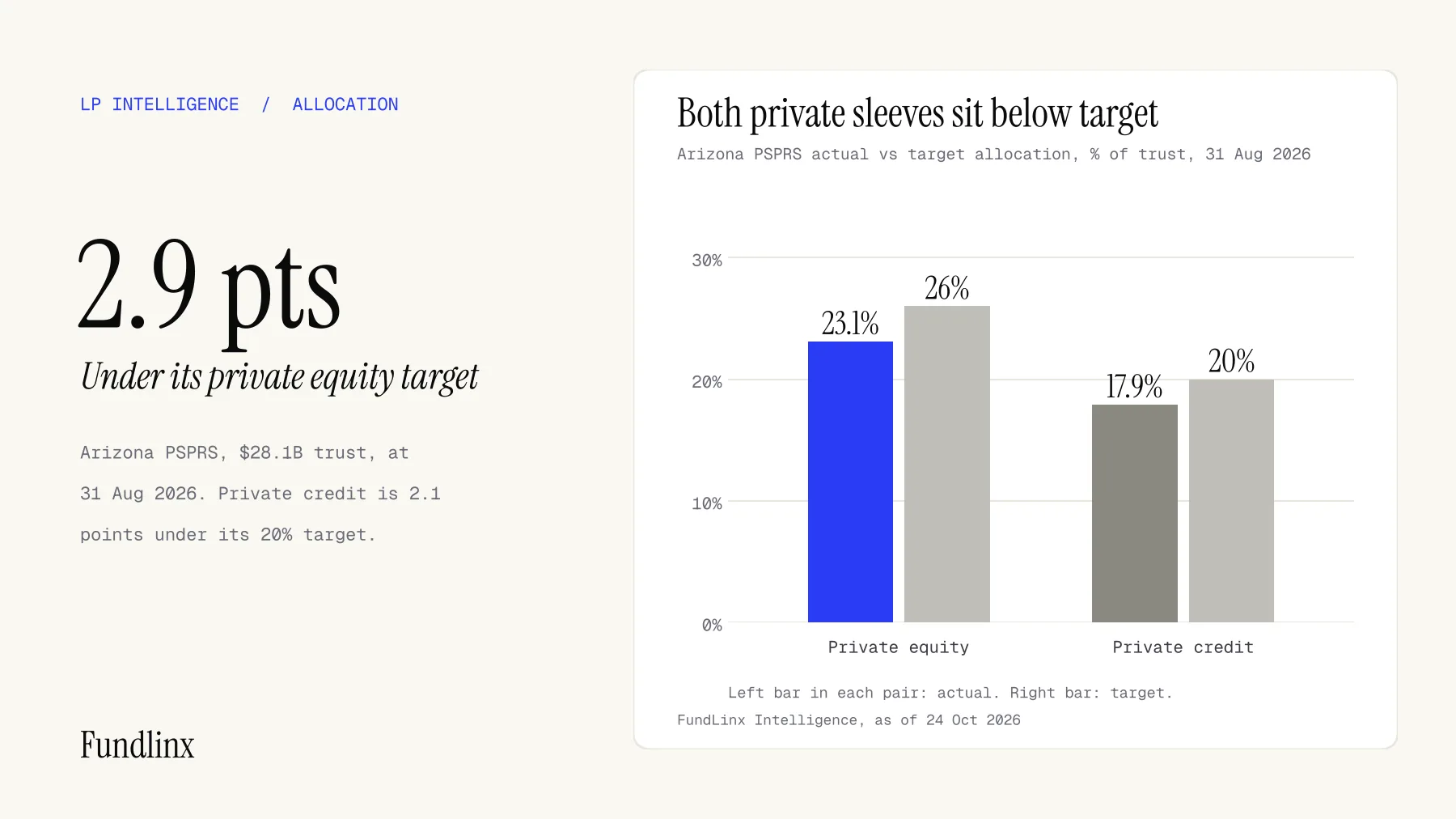
The Arizona Public Safety Personnel Retirement System was below its target for both private equity and private credit at 31 August 2026, according to the investment report prepared for its 21 October trustee meeting. Global private equity was 23.1% of the $28.1 billion trust against a 26% target, and private credit was 17.9% against 20%. Staff say both are being funded incrementally to manage cash drag and vintage year diversification. The gap is a pacing decision, not a signal that the system wants to be underweight, and that is useful to know before you approach it.
What the report shows
At 31 August the trust held $28.1 billion. Private equity at 23.1% sat 2.9 percentage points under its 26% target, inside its 21% to 31% range. Private credit at 17.9% sat 2.1 points under its 20% target, inside a 13% to 23% range. The system's cash was 4.1% against a 2% target, fixed income was 7.0% against 5% and diversifying strategies were 5.9% against 5%. On our arithmetic the 5.0 points of shortfall in private equity and credit are close to the 5.0 points by which cash, fixed income and diversifying strategies exceed target, which on our reading means the money has not left the trust and is waiting to be committed.
The same meeting agenda listed a preliminary presentation and discussion on asset allocation for the trust, led by chief investment officer Mark Steed. It states no changes or amounts, so we do not read it as a target move.
The numbers in context
On a $28.1 billion trust, 2.9 points is about $815 million and 2.1 points is about $590 million, roughly $1.4 billion in total. Those are our estimates, which ignore market movement and the range around each target. By capital the shortfall is split about 58% private equity and 42% private credit. Both of the two private sleeves with a stated target in the report are below it. The system's private credit sleeve is the closer to its target in relative terms, at 89.5% of target against 88.8% for private equity, on our arithmetic.
Performance may explain some of the caution, though the report does not say so. Net of fees the total trust returned 13.9% over one year and 8.9% over ten, against policy benchmark returns of 20.8% and 10.2%, and against the system's 7.2% assumed rate of return. Private credit has beaten its benchmark over five, seven and ten years, for example 8.4% against 5.5% over ten. Global private equity trails its benchmark in every period shown, including 7.6% against 14.6% over ten years. The report itself cautions that private assets can take about three months after quarter-end to value, so short comparisons can mislead, and it records a change to the policy benchmark from 1 July 2026, which may affect comparisons across periods.
The named LP
The Arizona Public Safety Personnel Retirement System is a US state pension plan for public safety employees. Its report names Mark Steed as chief investment officer and Alex Dorf as deputy CIO. At the September investment committee meeting its trustees reviewed the global private equity portfolio. We found no published ticket size or position on first-time funds in the materials and have not assumed either; the report excludes details of co-investment and continuation vehicle transactions. For similar plans, see our list of US pension funds.
What a GP should do
This section is our advice, not guidance from the system. First, treat the gap as appetite with a pace. Staff describe incremental funding as a deliberate choice to spread commitments across vintage years, so a manager that offers a smaller first ticket with room to grow fits the stated approach better than one that asks for a large cheque. Second, expect scrutiny of private equity returns. Private equity trails its benchmark over every period in the report, so a GP should show net returns against a public-market comparison that the investment office will recognise and explain the time lag in valuations. Third, private credit is the sleeve with the better record, which suggests the credit conversation may be easier than the buyout one. Fourth, mind the calendar: the system is discussing asset allocation now, so materials that arrive while that work is live may be read against it.
How this compares
Other pensions with room to fill have drawn similar attention. We looked at the same pattern when Ohio Police and Fire was 3.35 points under its real estate target and when the Virginia Retirement System committed $675 million to private equity and credit in four weeks. In each case the shortfall to target told us how much room an LP had, not when it would move.
What to watch next
Watch for the investment report that follows the next committee meeting, which will show whether private equity and credit moved toward target as commitments fund. Watch also for any update to the asset allocation that came out of the October discussion. Our view of LP allocation trends tracks how others are pacing. FundLinx members can see which pensions are below target in your strategy.
FundLinx Intelligence | FundLinx.ai
Playbooks, LP moves and compliance notes for emerging managers. Unsubscribe any time.