Norway's Wealth Fund Commits EUR 1.2 Billion to CIP's CI VI, 33% More Than It Put Into CI V
Norway's wealth fund is committing EUR 1.2 billion to Copenhagen Infrastructure Partners' sixth flagship fund, up from EUR 900 million in 2024. Unlisted renewables are just 0.4% of its holdings.
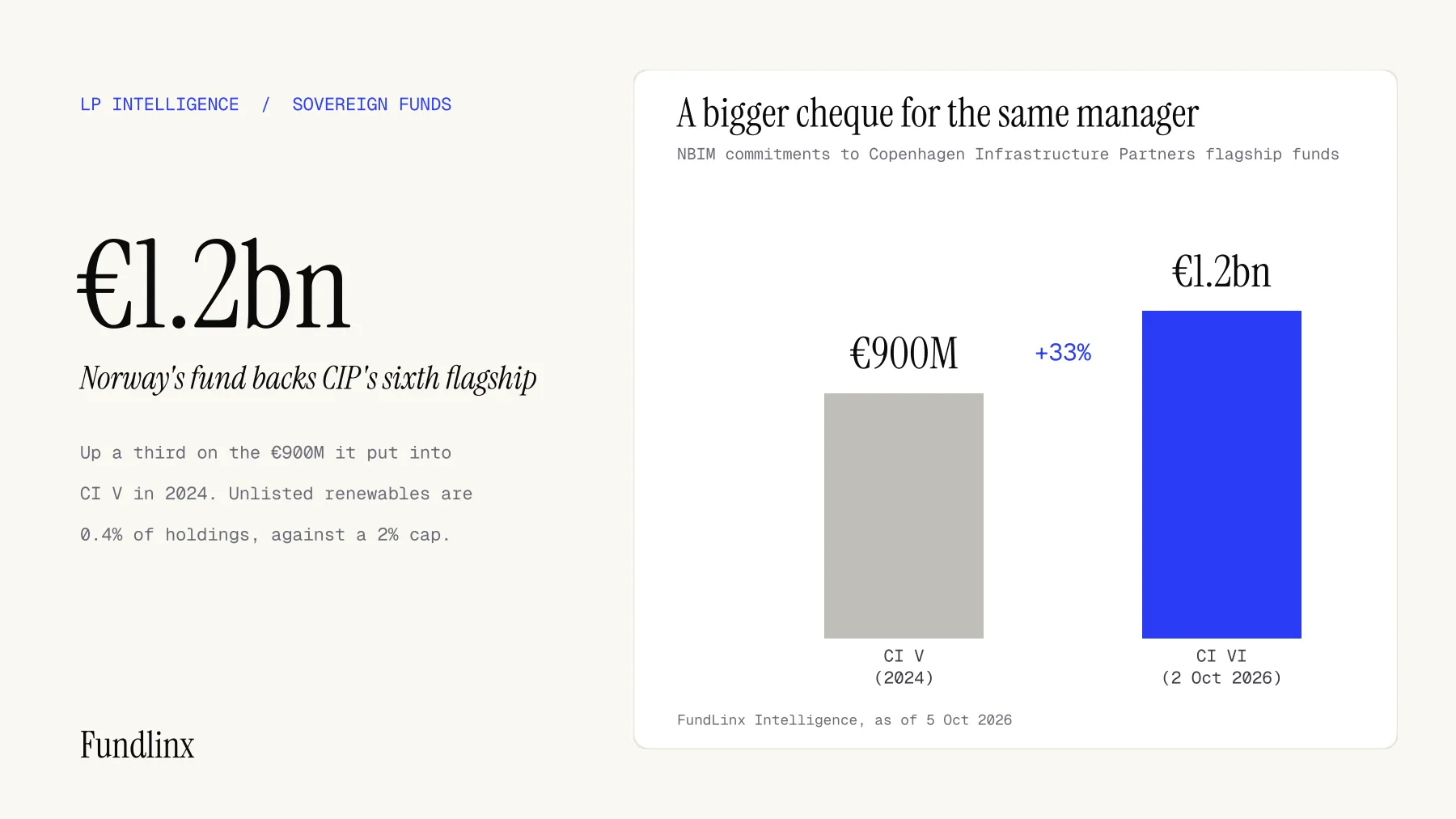
On 2 October 2026, Norges Bank Investment Management (NBIM), which manages Norway's Government Pension Fund Global, said it will commit EUR 1.2 billion to Copenhagen Infrastructure Partners' sixth flagship fund, CI VI. The fund targets development-stage renewable energy projects, covering generation and storage, across OECD economies in North America, Western Europe and Asia Pacific. The cheque is 33% larger than the EUR 900 million NBIM put into the predecessor, CI V, in 2024. A repeat commitment that grows by a third is one of the clearest signals an LP can send about a manager.
What NBIM said and why it matters
Harald von Heyden, NBIM's global head of energy and infrastructure, said CI VI "allows us to keep investing in renewable energy projects at the development stage and builds on a partnership that has worked well for the fund since 2024." CI V closed at EUR 12 billion and held 50 infrastructure projects at launch, so NBIM's EUR 900 million was about 7.5% of that fund by our calculation. The size of the CI VI final close was not part of the announcement, so we cannot yet say what share EUR 1.2 billion represents.
The commitment also follows a change in NBIM's own plans. In December 2025, NBIM set out a three-year plan to widen its renewable energy exposure, both across technologies and through indirect structures such as funds. Unlisted renewables are now 0.4% of NBIM's holdings, well below the 2% its mandate allows, across eight wind assets, five solar assets, three fund allocations and one grid investment. Put another way, NBIM is using about a fifth of the room it has, which leaves a lot of space to fill: if it reached the ceiling, unlisted renewables would be five times their current share.
How this compares with other sovereign investors
Sovereign funds have been taking positions in infrastructure and credit in several parts of the world. We covered how Temasek plans its first Middle East offices, a story about a state investor placing people closer to deals. We also covered how GIC bought 16 Marriott-run hotels in Japan, a direct purchase. NBIM's move is the opposite style: a large cheque to an outside manager it already knows. For GPs, that is the more useful pattern, because it shows where a sovereign allocator is willing to hand capital to a third party instead of building a team to do the work in house.
The LP behind the commitment
NBIM is one of the largest sovereign wealth funds in the world and manages the Government Pension Fund Global on behalf of Norway. It runs listed and unlisted portfolios, and its unlisted renewables work has so far combined direct assets with fund commitments. Reported conversions of the CI VI cheque into dollars vary between sources, from about $880 million to about $1.35 billion, so we use the euro figure that NBIM's announcement gave. NBIM does not publish a standard ticket range for fund commitments, but this pair of cheques, EUR 900 million and EUR 1.2 billion, shows the order of magnitude when a relationship is established.
What GPs should do now
For infrastructure and energy transition managers, the lesson is that sovereign money tends to follow a chain: an initial commitment, then a larger one if the first fund delivers. A manager with a first or second fund should therefore think about how to become the first link in that chain. That starts with giving a sovereign investor a reason to commit a small amount early, and then reporting well enough that the second cheque is easy to justify. Our look at why co-investors are the warmest route to fund LPs covers how co-investment can create that first link.
Development-stage projects are earlier in their life than operating assets, so a manager pitching this kind of strategy should be ready to explain how it handles construction, permitting and offtake risk in plain terms, since an LP that has now committed to the strategy twice will compare any new manager with the one it knows. NBIM's wording about a partnership that has worked well is, in effect, the standard a newcomer has to meet.
Be realistic about scale. NBIM wrote a EUR 900 million cheque to a EUR 12 billion fund. Smaller managers will not be a fit for a ticket that size, but they can still read the announcement for what it tells them about timing and focus: development-stage renewables across the OECD, a push to use funds as well as direct assets, and a stated gap between actual and permitted exposure. A manager whose strategy sits in that gap should say so in plain terms. Those raising a first close should also note that sovereign investors tend to want proof of a manager's discipline before the cheque grows.
What to watch next
Watch for the final size of CI VI, for any further renewables fund commitments from NBIM as it works through its three-year plan, and for whether its unlisted renewables share moves from 0.4% toward the 2% ceiling. Each is a clue to how quickly it will look for more managers. FundLinx members can see which sovereign investors are active in your strategy.
FundLinx Intelligence | FundLinx.ai