New Jersey's Pension Fund Returns 14.82% for the Year to 30 June 2026, 7.82 Points Above Its Assumed Rate, With Real Assets Beating Their Benchmark by 10.43 Points
New Jersey's pension fund returned 14.82% in the year to 30 June 2026, its third straight double-digit year, and real assets returned 23.76% against a 13.33% benchmark.
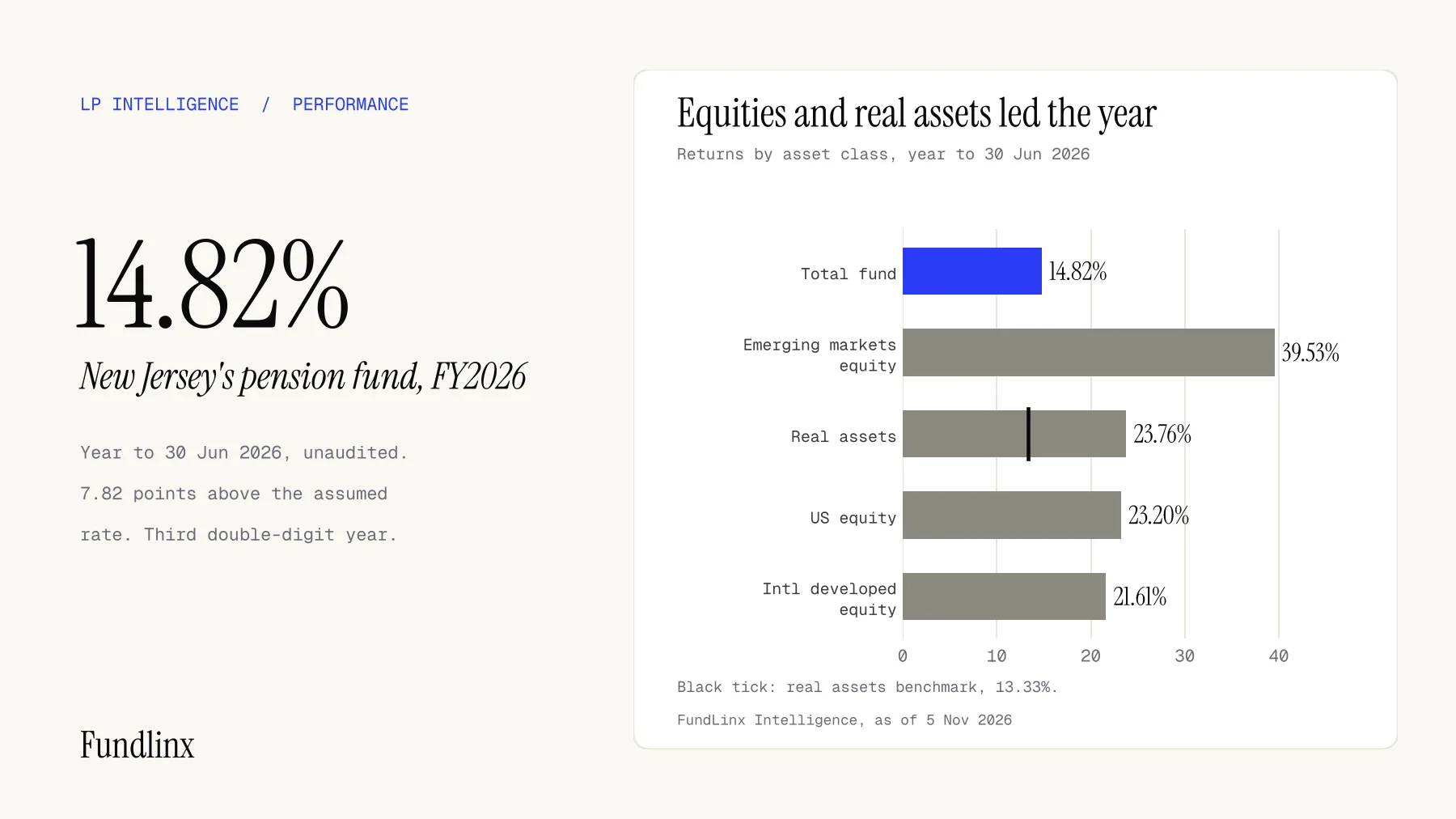
The New Jersey Division of Investment reported on 4 November 2026 that the state's pension fund earned a final, unaudited return of 14.82% for the 12 months ended 30 June 2026. That is 7.82 percentage points above the fund's long-term assumed rate of return, which implies an assumption of 7.00%. The Division told the State Investment Council that the result was the third consecutive year of double-digit returns, and that every asset class in the portfolio finished the year positive. For a GP raising from US public plans, the useful detail is where the return came from, and what the announcement leaves out.
What was reported
According to the announcement, public equities delivered the largest positive impact. Within public equities, emerging markets returned 39.53%, US equity 23.20% and international developed market equity 21.61%. Real assets returned 23.76% against a benchmark of 13.33%, an outperformance of 10.43 points. The three-year annualised return is 12.16%. The state also made a record pension payment of $7.3 billion for fiscal 2027, the sixth full payment in a row and the first under Governor Mikie Sherrill. State Treasurer Aaron Binder and Shoaib Khan, the Division's chief investment officer and director, both welcomed the result. The announcement adds that the state's full pension payment was cited by Kroll Bond Rating Agency as one reason for its recent credit rating upgrade of the State, and Binder described the three-year run as a huge step in returning the pension fund to solid ground. The Division said performance figures remain unaudited pending completion of the fiscal 2026 audit.
The numbers
The comparison with the prior year is sharp. For the year to 30 June 2025 the fund returned 10.96%, 3.96 points above its assumed rate, so the margin above the assumption roughly doubled, from 3.96 to 7.82 points. Real assets returned 11.1% a year earlier and 23.76% this year, a gain of about 12.7 points. Emerging markets equity rose from 16.3% to 39.53%, US equity from 15.2% to 23.20% and international developed equity from 18.9% to 21.61%. The three-year annualised figure of 12.16% is consistent with returns of 10.74%, 10.96% and 14.82% over the last three fiscal years. The pension payment rose from $7.2 billion for fiscal 2026 to $7.3 billion for fiscal 2027, an increase of about 1.4%. The announcement gives no total fund size, no private equity return and no private credit return, so we do not estimate them.
How it compares
Our note on the funded ratio of US public pensions shows that plans were still carrying deficits in September, and our coverage of Pennsylvania's PSERS approvals shows how another large state plan is deploying capital into private funds. New Jersey differs in the mix of what drove the year: public equity and real assets did the work in the figures given, and the announcement is silent on private equity and credit.
The named LP
The Division of Investment manages New Jersey's state pension investments and reports to the State Investment Council, which sets asset allocation and investment policy. It sits among pension funds on FundLinx and with other US LPs. The announcement gives no typical ticket size and says nothing about whether the Division backs first-time funds, so we offer no Fund I or Fund II view. It does show that the Division has a real assets programme that is outperforming its benchmark, which is a useful fact for managers in that area. On the same day the Treasury announced two new asset class heads at the Division, for private equity and real estate, who joined on 2 November, which we cover in our piece on mapping warm paths into New Jersey's new asset class heads.
What a GP should do
This section is our advice, not guidance from the Division. First, ask for the figure the announcement omits: if you are a private equity or private credit manager, find out how those books performed against their benchmarks before you write, since the headline result was led by public equity and real assets. Second, if you invest in real assets, lead with the benchmark gap. A 10.43 point outperformance is a number the Division's own team will recognise, and your strategy should be framed against it. Third, expect a plan that has just had a strong year to focus on pacing and rebalancing rather than on new managers; strong equity returns can push private markets below target as a share of the fund, though the announcement does not say whether that has happened. Fourth, remember the asset class heads are new, so first meetings may be exploratory. Fifth, speak in net terms and show how your fund behaves if equities fall.
What to watch next
Watch for the completed fiscal 2026 audit, which could move the figures, for the Division's next commitments under its new private equity and real estate heads, and for the State Investment Council's next meeting. FundLinx members can see which institutions are allocating in your strategy. For the term behind the investors this plan backs through funds, see our entry on limited partners.
FundLinx Intelligence | FundLinx.ai
Playbooks, LP moves and compliance notes for emerging managers. Unsubscribe any time.