Bouwinvest and Tishman Speyer Launch a US Office Account With the Chrysler Building Lease as Its First Investment, in a $235 Million Deal Led by PSP
Bouwinvest and Tishman Speyer launched a US office account on 23 October. Its first investment is the Chrysler Building lease, a $235 million equity deal. Account size is undisclosed.
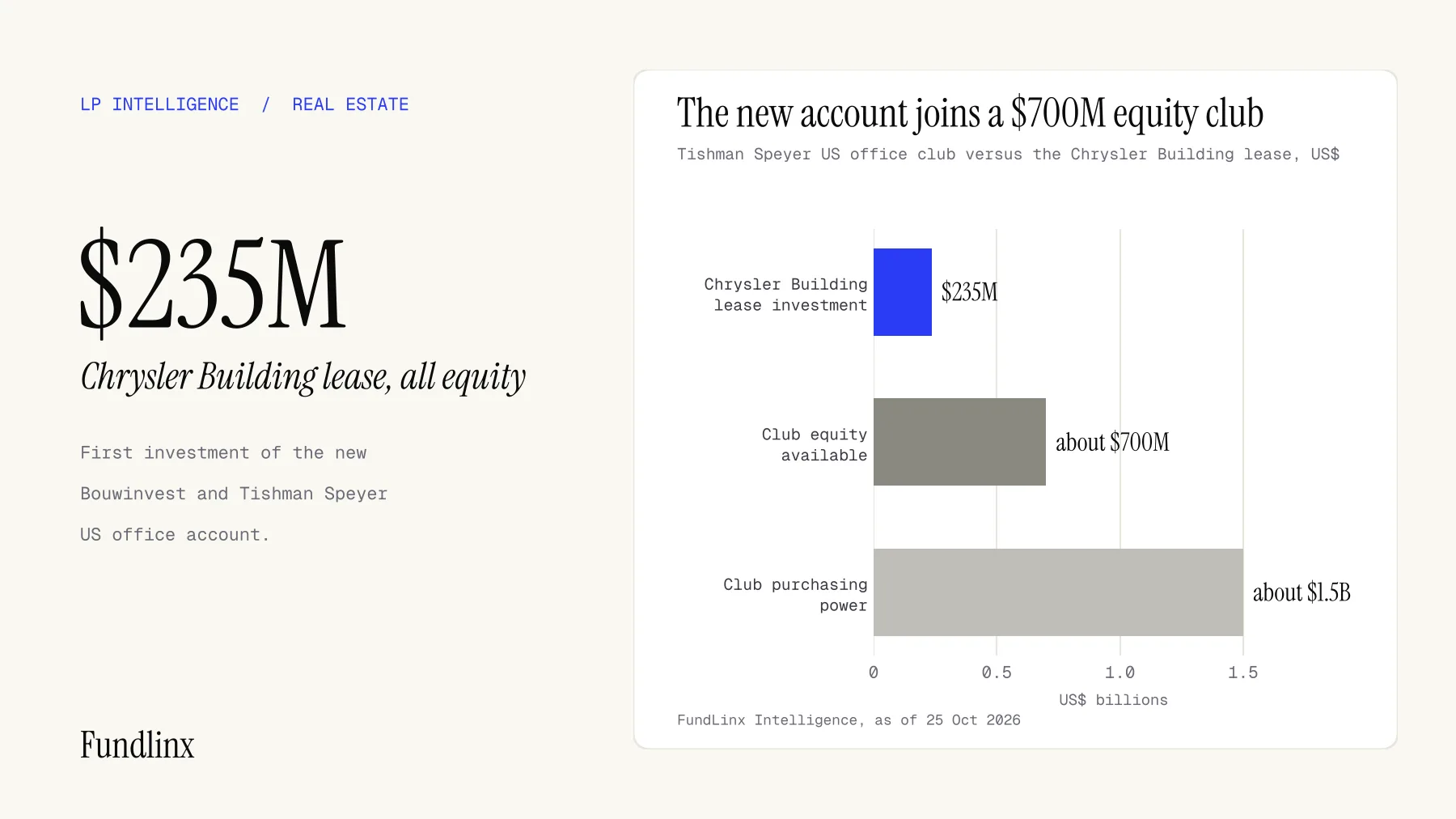
Bouwinvest Real Estate Investors and Tishman Speyer launched a separately managed account on 23 October 2026 to buy top-tier US office buildings, and its first investment is the 150-year ground lease on New York's Chrysler Building. Neither partner disclosed the size of the account or how much each is committing, so we cannot size it. What can be sized is the first deal: an investment of $235 million, plus ground lease payments to the landowner, funded entirely with equity, with PSP Investments named as lead investor when the lease was announced on 7 October.
What was announced
The account targets core-plus and value-add office assets in gateway cities including New York, Boston, Chicago and San Francisco, plus established growth markets. It can co-invest alongside other Tishman Speyer-managed office vehicles and with like-minded institutional investors, and it joins a Tishman Speyer US office club that has about $700 million of available equity, or roughly $1.5 billion of purchasing power. The gap between those two figures is about $800 million, which is presumably debt or other capital; that is our reading, not something the partners said. Robert Wagenaar, Bouwinvest's director of North American investments, described a tactical opportunity in US office and said Bouwinvest invests selectively, early in the cycle, and through specialist partners. Nate Shanok, a senior managing director at Tishman Speyer, said the aim is well-located buildings with durable demand and limited new supply.
The first deal in numbers
The lease runs 150 years from The Cooper Union, which has owned the land since 1902. The tower has 77 stories and about 1.3 million square feet. The announcement said Tishman Speyer's investment is $235 million plus ground lease payments, with no debt, and that the plan is to reposition the building as a boutique office tower with a hospitality programme, an amenity floor on the 61st floor and prebuilt suites for 75% of current and upcoming vacancy. Coverage describes the $235 million in different ways, some as the lease payment and some as covering building improvements, so treat it as the deal's headline investment, not as the account's share, which is undisclosed. Simon Marc, PSP's senior vice president and global head of private equity and real estate investments, said PSP is proud to be part of the building's transformation. The other institutional investors in the deal were not named.
How it compares
Tishman Speyer first bought into the building in 1997 for $220 million, and the tower changed hands in 2019 for about $150 million. The 2026 figure of $235 million sits between the two, but the instruments differ, so it is not a like-for-like price comparison. A more useful comparison is PSP's own activity. As we reported, PSP and Nuveen Real Estate launched a $790 million US shopping center venture earlier this week, so this is the second US real estate headline linked to PSP in under three weeks. It suggests large North American and European institutions are choosing to build US property exposure through a small number of operating partners, rather than through broad fund programmes.
The named LPs
Bouwinvest Real Estate Investors is a Dutch real estate investment manager. Coverage of the launch says it serves more than 35 institutional clients, and that bpfBOUW is its largest client and a shareholder. That makes it a manager that invests on behalf of institutions rather than a single balance sheet, which matters for how you approach it, as we set out in our outreach piece on writing to an LP that invests through a manager. PSP Investments is a Canadian pension investor, and Marc's title above is the only senior name the announcement gave on its side. For comparable institutions, browse our list of European institutional investors.
What a GP should do
This section is our advice, not guidance from either firm. First, be ready to describe a one-investor account before you are asked. Bouwinvest chose a single partner, a single asset class and a defined market list, so a GP in real estate or a neighbouring strategy should be able to say which assets, in which markets, with what governance and what reporting, an account with you would hold. Second, lead with timing and specialisation. The language reported from the launch was selective, early in the cycle and through specialist partners, so show where you have a repeatable sourcing edge and what you would not buy. Third, treat co-investment as a second door. Because the account can invest alongside other vehicles, a deal-by-deal option next to your fund gives an institution a way to say yes without a full fund commitment. Fourth, map the route in. Capital in deals like this often sits behind a manager, so work out who covers your strategy at the manager and who at the end investor is consulted; our guide to warm paths sets out how. Do not assume a ticket size: none was disclosed.
What to watch next
Watch for the size of the account, for further acquisitions announced under it, and for whether the Chrysler redevelopment brings in the other institutional investors who were involved but not named. If the account adds a second asset, it will show whether this is a one-building mandate or a programme. FundLinx members can see which institutions are active in your strategy.
FundLinx Intelligence | FundLinx.ai
Playbooks, LP moves and compliance notes for emerging managers. Unsubscribe any time.