London Pensions Fund Authority Returns 4.2% Against a 7.0% Objective but Stays 120% Funded and Averages 7.7% a Year Over Ten Years
A London local government pension fund earned 4.2% against a 7.0% target for the year, yet reports 7.7% a year over ten years and a 120% funding level. What it means for GPs.
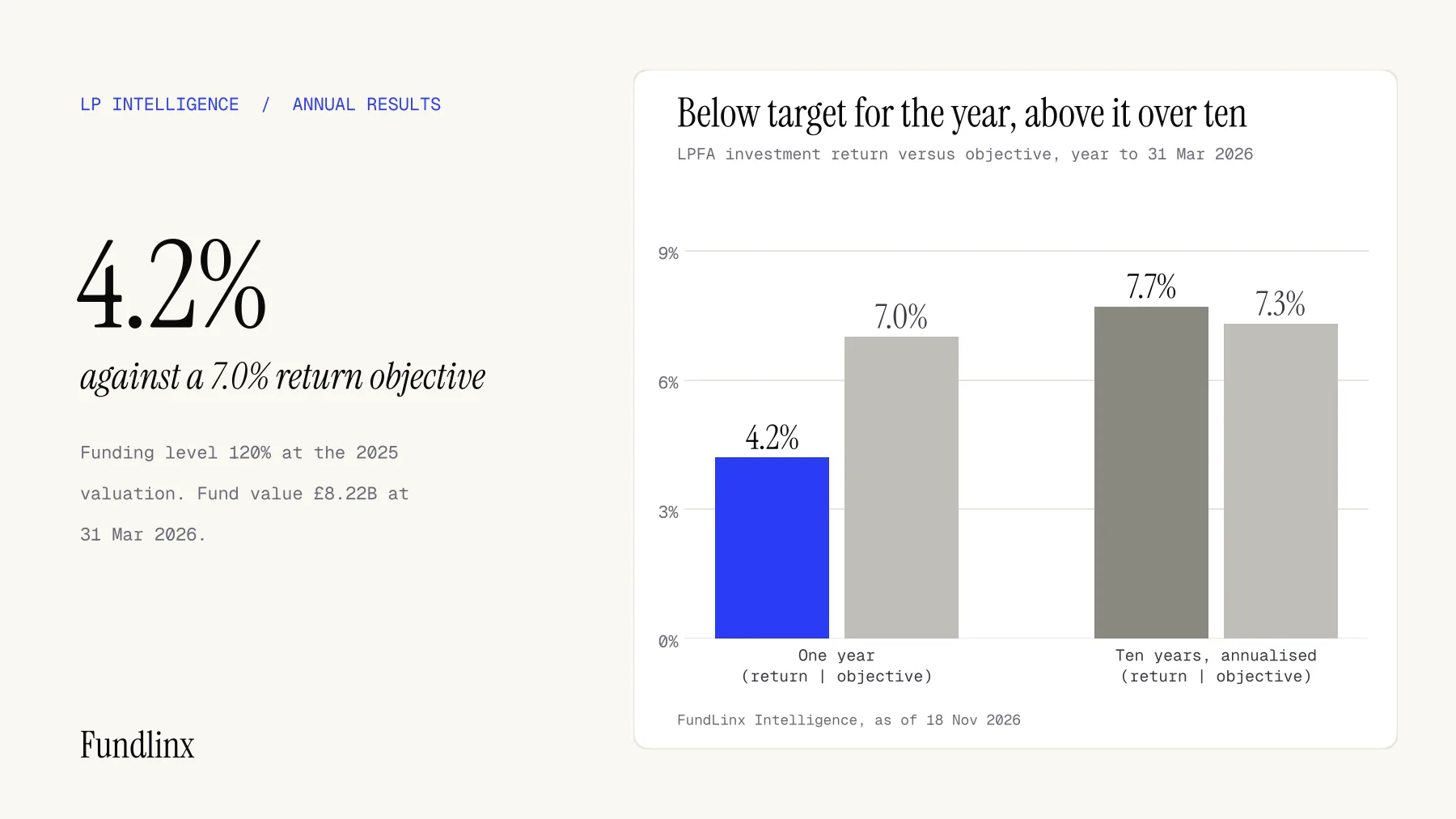
The London Pensions Fund Authority (LPFA) announced on 17 November 2026 that its investments returned 4.2% in the year to 31 March 2026, against a return objective of 7.0%. The year fell short of target, but the fund said it earned 7.7% a year over ten years against an annualised objective of 7.3%, and it reported a funding level of 120% from its 2025 triennial valuation, so it remains in surplus. The LPFA is a Local Government Pension Scheme fund and was valued at £8.22 billion at 31 March 2026.
What the numbers show
The one-year result was 2.8 percentage points below objective, which is our arithmetic from the two published figures. The ten-year result was 0.4 percentage points above its objective on the same basis. One weak year therefore sits inside a decade that beat its target, and that is the framing the fund itself chose to lead with. We have not seen a breakdown of the 4.2% by asset class, and the LPFA has not said which holdings held the year back, so any explanation of the miss would be a guess.
The fund's size and membership give the figures some scale. At 31 March 2026 it had 101,305 members and 117 participating employers. A fund with that many employers has a long list of parties relying on a stable contribution rate, which is why the funding level matters as much as the return. At 120% funded, the fund holds more than it needs against its liabilities on the valuation basis used, so a below-target year does not by itself change its position.
How this compares with other recent results
A short-term miss next to a long-term beat is not unusual among the pensions we cover, though the opposite pattern also appears. We reported that CalPERS earned 14.8% but only 6.83% a year over five years, a strong single year sitting on top of a long-run figure close to its assumption. The LPFA shows the mirror image: a weak year, a ten-year record above objective. Taken together, they are a reminder that one-year numbers say little about how an LP will judge a manager over a full cycle.
The result also lands in a busy period for UK pensions and private markets. We covered how UK pension providers hold £22.1 billion in private markets under the Mansion House Accord and how two UK workplace pensions have now opened venture programs through managers. The LPFA sits in a different part of the UK system, the local government schemes, but the direction of travel on private markets is part of the same conversation.
Who the limited partner is
The LPFA is a UK pension fund in the local government scheme, with John Preston as chair and Jo Donnelly as chief executive. The announcement points to pooling savings of £21 million in 2025-26 and cumulative net savings of more than £141 million since pooling began, and to the expansion of its pool, LPPI, and the onboarding of six additional partner funds. We have not verified how its private markets decisions are divided between the LPFA and the pool, nor its typical ticket size, its named managers or whether it backs emerging managers, so treat any assumption on those points as unconfirmed. You can browse UK pension funds in the FundLinx directory.
Climate detail worth a manager's attention
The most concrete investment detail in the announcement is on responsible investment. The LPFA said more than 80% of its assets are subject to Paris alignment-related requirements, that it has committed around £40 million through a new Environmental Opportunities allocation, and that it targets investing 5% of the fund in climate solutions. Five percent of £8.22 billion is about £411 million, and £40 million is about 0.5% of the fund. Both are our arithmetic, and the LPFA has not said how much of the target it expects to place through external managers or through its pool.
What a fund manager should do
This section is our advice, not guidance from the LPFA. If your strategy invests in climate solutions, the 5% target and the new Environmental Opportunities allocation are the clearest hooks, so say which part of the fund's climate agenda your strategy serves and how you measure it. If your strategy is not climate-related, use the 7.0% return objective as the bar: show your expected net return against that number and explain how the strategy behaves in a year when a fund of this kind misses target. Because the fund highlights pooling savings, expect fee scrutiny and be ready with a full cost breakdown. Finally, confirm before approaching who makes the decision for your asset class, since the LPFA and its pool may split that responsibility. For scale, each 1% of the fund is about £82 million, again our arithmetic.
What to watch next
Watch whether the LPFA reports further commitments under its Environmental Opportunities allocation, whether the six additional partner funds change how its pool selects managers, and how the fund describes this year's return when it next updates its committee. A second below-target year would put more attention on the ten-year figure that currently protects the narrative. FundLinx members can see which UK pensions are building climate and private markets programs.
FundLinx Intelligence | FundLinx.ai
Playbooks, LP moves and compliance notes for emerging managers. Unsubscribe any time.